
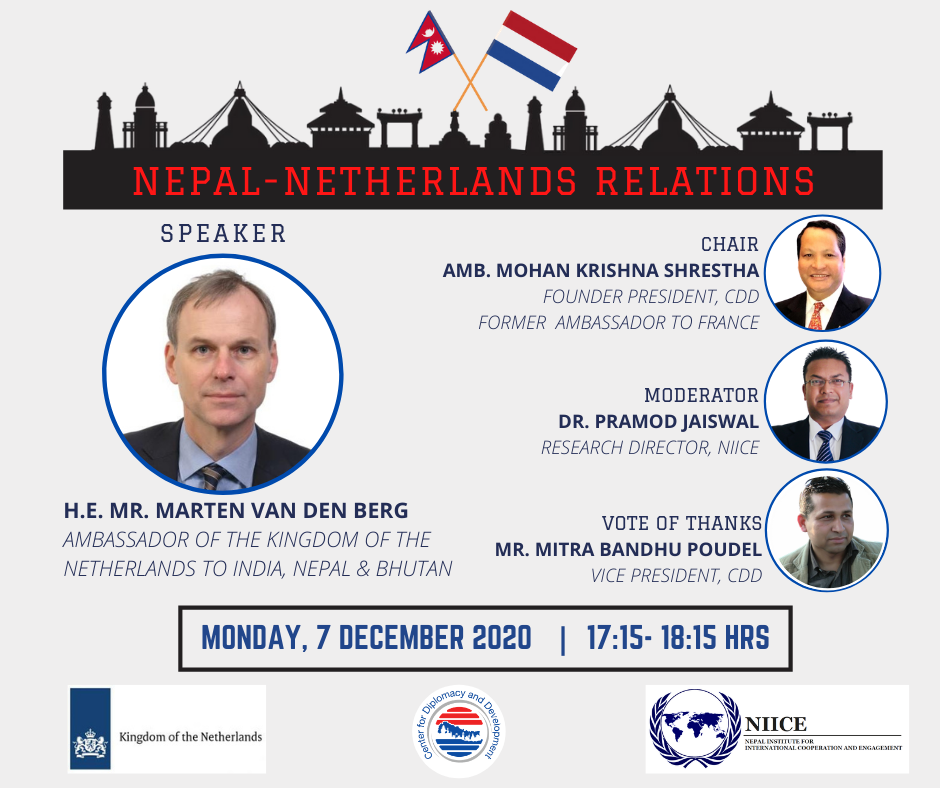
Nepal-Netherlands Relations
Watch it on NIICE Nepal Youtube Channel
Event Report
The webinar was a joint effort by the Centre for Diplomacy and Development, the Embassy of the Kingdom of the Netherlands, and NIICE on Nepal-Netherlands relations. The talk is about relations between Nepal and the Netherlands in diverse sectors like trade, tourism, foreign direct investment, etc. The webinar also highlights the areas of improvement in bilateral ties between Nepal and the Netherlands, its future prospects, and suggestions for Nepal to improve in various sectors.
Nepal and the Netherlands share a very strong and intense history and have a close relationship between them. Relations between Nepal and the Netherlands were established in 1960, and economic relations began in 1976. Nepal is a very well-known country in the Netherlands, and every year, Dutch tourists visit Nepal for hiking and to witness the scenic beauty of the country. Nepal and the Netherlands have cooperation in areas like agriculture, forest products, energy, water, sanitation and hygiene, food security, etc.
Dutch Assistance to Nepal
The Netherlands has programmes supporting international relationships, some of which did market studies in Nepal looking for market opportunities for companies in agricultural production and export, enabling and increasing the infrastructure to export goods from Nepal to the European Union. Another program on the development of agriculture infrastructure focuses on cold storage chains, quality for food production, food transport, and storehouse facilities for the export sector. The Dutch can be very helpful to the Nepalese in the logistics sector. There is a Dutch good growth fund supporting companies to invest abroad. In Nepal, such companies can focus on clothing production and coffee imports.
Bilateral cooperation in the hydropower sector: more than 20% of the Netherlands is below sea level, and 40–50% of its GDP is earned there, making the Dutch water management system excellent, as it is exported all over the world. One is Royal Haskoning, which is looking for opportunities in Nepal. There are further opportunities and possibilities in the hydrogen sector related to water management systems to share expertise and work closely together.
Improving tourism in Nepal: Nepal welcomed 15,000 tourists from the Netherlands this year. Nepal can use publicity to make opportunities in Nepal transparent in European countries, create sustainable tourist infrastructure, by showing tourists that they can visit Nepal in a sustainable way.
Enhancing bilateral ties between Nepal and the Netherlands: Areas of mutual importance like agriculture, water, food processing, textiles, and logistics infrastructure provide a scope for enhancement of bilateral ties between Nepal and the Netherlands. The Netherlands is strong in the dairy sector, the agricultural sector, horticulture, and flowers. Both countries can share knowledge on food production, high-quality seeds, and fertilizers to boost productivity and sustainability. Sustainability is very important for the Netherlands. The focus should not only be on production but also on logistics, transportation, and transparency in safety standards.
High level visits: high-level bilateral visits are important for countries to have healthy bilateral relations. Both Nepal and the Netherlands have an open and friendly atmosphere, and both countries have strong ties through communication. According to the speaker, the present structure in place is perfectly capable of facilitating intensive and good relations.
Governance mechanism: the Netherlands and Nepal have had a long history of development collaboration between companies and institutions and have realized great opportunities to benefit from each other through trade. Increased Dutch investment will help strengthen bilateral ties between the two countries.
SNV: a Netherlands development organization is an important organization which has a great presence in Nepal and has been active in relations between Nepal and the Netherlands. The SNV is partially funded by the Dutch government, the European Union, and other sources of funding and is working with many companies in the country in the agricultural sector and on water-related projects.
Areas where the Netherlands can work jointly with Nepal, Bhutan, and India: According to the speaker, it is not easy to work on a joint project as there are a lot of challenges in collaboration. India, Nepal, Bhutan, and the Netherlands overlap in areas of knowledge, expertise. It is complicated to set up a project which involves all three because it questions the efficiency of the project. So, he emphasized that bilateral relationships are better for projects.
The Netherlands' recommendations for south-eastern countries to boost productivity: higher productivity can be achieved using commercial farming by using high quality seeds, water use, creating value added on the land, different production techniques, new fertilizers, and tracking produce with new apps on phones by satellite, which are productive and cost-efficient. Cold storage chains, logistics, and transportation are important to prevent any kind of food loss.
Education is not very expensive in the Netherlands and the Dutch government offers many scholarships for students and some scholarships for Nepalese students studying in the Netherlands. There are many undergraduate and master’s programmes in the Netherlands in English, which facilitates the language barrier between international students.
Nepal has a trade deficit with the Netherlands. Increasing tourism can help monetise agricultural products and clothing to improve the trade deficit between the two countries.
Conclusion: Important takeaways from the session are to focus on productivity and sustainability to improve businesses in Nepal. The innovations in terms of seeds or high-quality products and new technology in the form of digitization helps increase productivity. The Netherlands has affirmed its commitment to establishing strong relations with Nepal in the times to follow.
Prepared by Khyati Anand, Intern at NIICE
Recent Comments