11 May 2026, NIICE Commentary 12488
Arman Sidhu
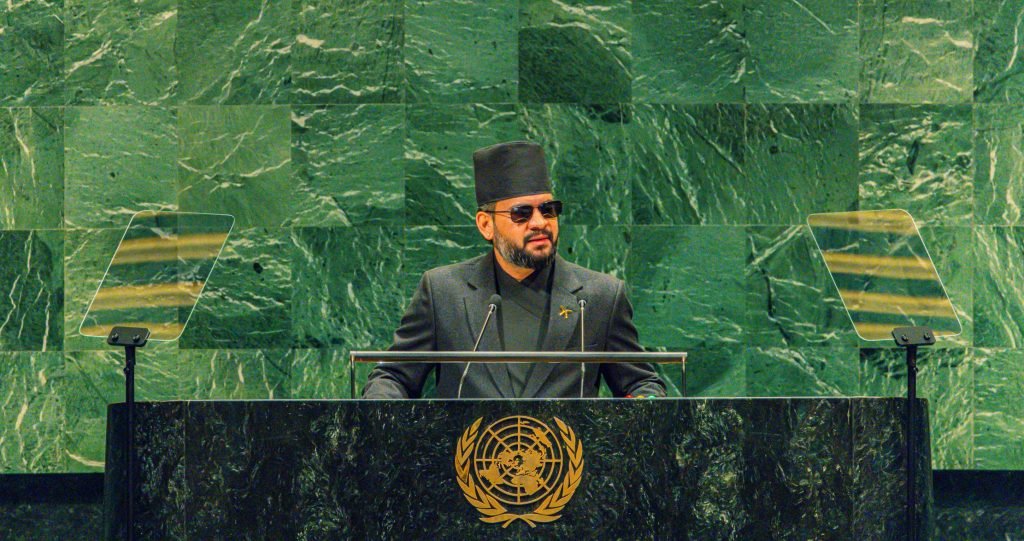
The Rastriya Swatantra Party’s 182-seat majority in Nepal’s House of Representatives gives Prime Minister Balen Shah something no Nepali leader has held since 1999: the unilateral legislative capacity to pass sweeping structural reform. The question is whether this government will direct that capacity toward one of the country’s most neglected governance deficits. Nepal’s mining sector operates under the Mines and Minerals Act of 2042 BS (1985), a 41-year-old law that predates Nepal’s federal constitution, modern environmental standards, indigenous rights frameworks, and the global critical minerals era. As a result, the law is structurally irrelevant to the conditions it is supposed to govern.
What the 1985 Act Cannot Do?
Nepal’s 2015 constitution established a federal system with three tiers of government, each claiming jurisdiction over natural resources. The 1985 Act contains no provisions for allocating mineral rights, licensing authority, or revenue distribution across federal, provincial, and local governments. The result is jurisdictional confusion that deters investment and enables administrative rent-seeking at every level. The Department of Mines and Geology (DMG) has issued extraction permits for 16 mineral categories as of March 2026, yet mining contributes just 0.51 percent of GDP. Nepal imports over $1 billion in iron and steel annually, its second-largest import category after petroleum, despite identified iron deposits exceeding 200 million metric tonnes at the Jhumlabang site alone, with additional reserves at Dhaubadi and other Lesser Himalayan locations.
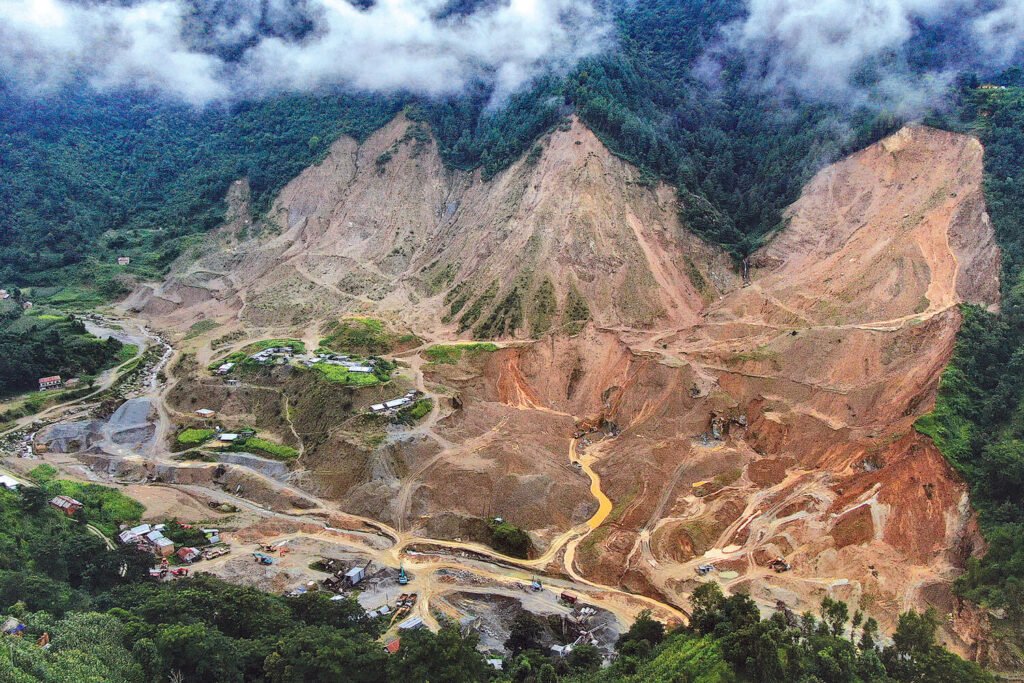
The 1985 Act also contains no provisions for free, prior, and informed consent (FPIC) of indigenous communities affected by mining operations. Nepal ratified ILO Convention 169 and endorsed UNDRIP, both of which require meaningful consultation before resource extraction proceeds on indigenous lands. The Jhumlabang iron deposit in Rukum East, where the DMG granted a mining concession to Elevate Minerals Pvt. Ltd., a sister company of Ramesh Steels, covering 750 hectares without obtaining free, prior, and informed consent from affected communities, illustrates the governance vacuum that the current law creates. Magar community members and Indigenous rights advocates reached a consensus in July 2025 to halt the project. The DMG instructed the local municipality to facilitate mining regardless.
The Draft That Never Passed
A draft Mines and Minerals Act 2025 circulated before parliament’s dissolution in September 2025. It proposed a Mineral Development Bank, updated licensing procedures, and environmental provisions. The bill lapsed when the Gen Z-led anti-corruption protests brought down the Oli government. A companion Construction Materials Bill, which would have regulated the sand and gravel sector (estimated at Rs 40 trillion in untapped stone quarry resources), also expired. Nepal’s mining governance reform has been deferred for a generation. The legislative architecture from 1985 remains the sole governing framework for a sector the RSP manifesto identifies as a priority employment driver.
What a Modern Framework Requires?
Bhutan’s experience offers a directly relevant model. Bhutan’s 2017 Mineral Development Policy, supported by the World Bank’s Extractives Global Programmatic Support, established clear licensing tiers, environmental rehabilitation requirements, revenue-sharing formulas between central and local governments, and a State Mining Corporation to manage strategic assets.
The Bhutanese mining sector accounts for roughly 2.71 percent of GDP (2021 figures) and 73.6 percent of total goods exports by value (2019 figures, per USGS), figures that dwarf Nepal’s 0.51 percent mining GDP share despite the two countries sharing comparable Himalayan geology. After the State Mining Corporation assumed operation of formerly private dolomite mines in 2020, export prices more than doubled from Nu 520 per metric tonne to Nu 1,150 per metric tonne, demonstrating the revenue capture gains available under consolidated state stewardship.
The same trajectory is visible in Bhutan’s broader development strategy, which will be informative for the statecraft of similar countries. Nepal shares Bhutan’s Himalayan geography, hydropower surplus, and small-state governance challenges. A replacement Mines and Minerals Act for Nepal would need to address five structural gaps. The first is the federal-provincial-local jurisdictional allocation of mineral rights and licensing authority.
The second is a meaningful consultation process for indigenous communities before mining begins on their ancestral lands. International standards Nepal has already signed onto, including ILO Convention 169 and the UN Declaration on the Rights of Indigenous Peoples, require that affected communities be informed of planned extraction, given complete project details in advance, and granted the ability to withhold consent. The 1985 Act provides for none of this, which is how cases like Jhumlabang reach the stage of community-led shutdowns rather than being resolved at the licensing stage.
Third is environmental assessment sequencing that precedes rather than follows license issuance. The fourth is transparent revenue collection and distribution, given that Nepal’s cement industry alone generates an estimated annual turnover of Rs 150 billion against minimal government revenue capture. Finally, a geological survey mandate should be imposed, given that Nepal’s last systematic mineral exploration programme ended in the mid-1980s.
Nepal’s hydropower position adds a dimension absent from most resource-rich developing economies. The country became a net electricity exporter in FY 2023/24 and earned Rs 17.46 billion from electricity sales to India and Bangladesh in FY 2024/25, with theoretical capacity estimated at 83,000 MW and roughly 42,000 MW considered economically feasible. Mineral processing for ferroalloys, cement clinker, and refined iron remains among the most energy-intensive industrial activities globally. A replacement framework that conditions mining licenses on domestic value addition, paired with industrial tariff pricing for hydropower offtake, would allow Nepal to capture downstream margins rather than exporting raw ore at extraction-stage prices.
Outlook
Nepal is scheduled to graduate from Least Developed Country status on 24 November 2026. The International Trade Centre projects annual export losses of $59 million from the transition, equivalent to 4.3 percent of total exports, with garments, textiles, and carpets absorbing the heaviest tariff increases under the EU’s Generalised Scheme of Preferences once the Everything But Arms transition period expires in 2029. Nepal will also lose access to the Least Developed Countries Fund and a range of concessional climate financing instruments tied to LDC eligibility.
A modern mining framework offers one of the few domestically controlled levers for offsetting these revenue losses. Even a conservative ad valorem royalty regime applied to construction aggregates, cement inputs, and identified iron deposits could capture revenue streams that currently bypass the treasury entirely, replacing aid dependency with extractive sector receipts under Nepali sovereign control.
Mining is the sector with the widest gap between resource endowment and economic contribution. The RSP’s 182-seat majority eliminates the coalition arithmetic that has stalled reform legislation in every prior parliament. The political conditions for passing a modern mining governance framework exist for the first time in Nepal’s federal history. Whether the Shah government treats mining law reform as a legislative priority or allows it to remain a deferred aspiration will shape the country’s resource development trajectory for the next generation.
Arman Sidhu is an American geopolitical analyst and writer.