20 May 2026, NIICE Commentary 12500
Dr Chander Shekhar
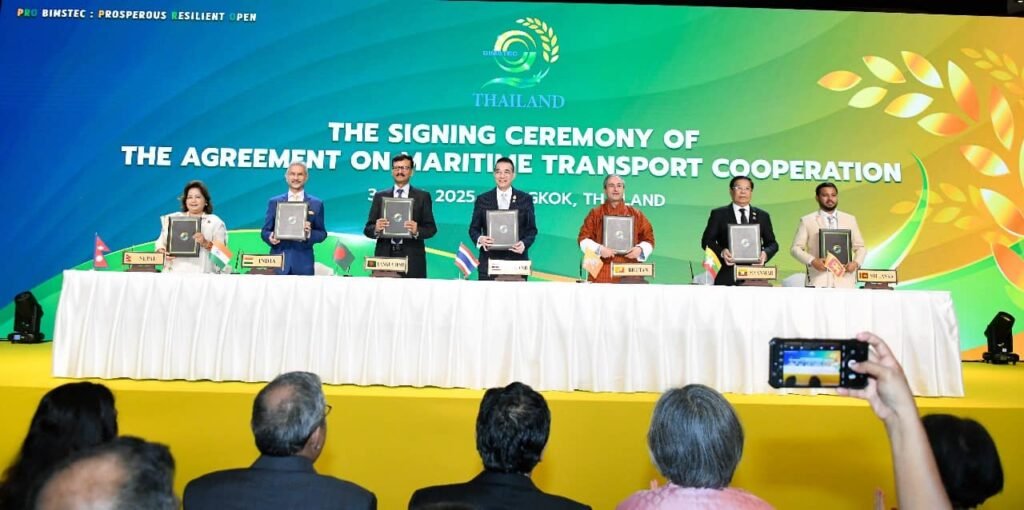
Maritime connectivity plays a critical role in the growth and development of countries. The sea-based transport connectivity has a role in shaping regional development and prosperity. Countries, especially in the Global South, have undermined the importance of regional connectivity at the onset. China after its Opening Economy policy has built up a long and strategic chain of transport of shipments, such as goods, services, etc. The Strait of Hormuz has also shown the vulnerability of maritime connectivity if not utilized for the global good in the international community’s interests, and weaponizing waterways has evolved into a weakness of the global economy. Amidst these global challenges, the Bay of Bengal Initiative for Multi-Sectoral Technical and Economic Cooperation (BIMSTEC) has entered its long-delayed Agreement on Maritime Transport Cooperation (AMTC) into force on 16 May 2026. This is an important milestone in the integration of regional economies to advance maritime cooperation and connectivity in the region. The growth in port led development cautiousness and fostering inter-regional connectivity in the BIMSTEC countries have set a new tone of their developmental journey for regional prosperity and rejuvenating Indic belt.
BIMSTEC: Connectivity and Prosperity
Regional organizations have emerged as a critical avenue for cooperation in different domains, as the world is facing the decline of international institutions due to the great power rivalries between countries. Among others, the Bay of Bengal Initiative for Multi-Sectoral Technical and Economic Cooperation (BIMSTEC) has grown into an important regional gathering of seven states coming from Southeast and South Asian countries. This initiative is believed to be the fastest-growing region in the world as the member states have witnessed a steady growth in spite of challenges. Its member countries are Bangladesh, Bhutan, India, Nepal, Sri Lanka, Myanmar, and Thailand, these states historically share a common civilizational connection and culture. The organization collectively holds over USD 5.2 trillion GDP and home to 1.73 billion people, and the aim of AMTC is “to reduce logistical bottlenecks and deepen economic integration, Minister of Foreign Affairs, Thailand, says. Also, the organization has prioritized sectors, such as AMTC and countries have come together to shape regional development through port.
After coming into effect, experts believe that the BIMSTEC is needed “to enhance regional maritime connectivity and contribute to increased intra-BIMSTEC trade, travel and tourism”. Given the challenges unfolding in different multidomain fronts, it’s imperative to strengthen this organization in areas, especially maritime cooperation and connectivity, enhancing intra-regional trade and regionalization of supply chains in the region.
Reduction of Logistical Bottlenecks and Port Management
Logistical bottlenecks have been a troubled spot in the free movement of commerce. There are several reasons to delay the flow of goods, such as communication, a lack of shipment data, etc. To deal with these, there is a need for digitalization of port management to prepare for any unprecedented events influenced by intra and external factors in the Bay region. The growing significance of port management lies in the fast movement of ships, and the growing geopolitical tension poses potential risks and challenges to the port-led development vision and management.
The BIMSTEC’s AMTC is a ground-breaking attempt to deal with such issues and strengthen cooperation in multidomain operations as far as maritime connectivity is concerned. To strengthen maritime connectivity and cooperation, India, as a member country of the BIMSTEC, has undertaken several attempts, such as organizing port conclaves to bring member states on a platform for common security issues. The first port conclave was organized on 7-8 November 2019 in the Indian city of Vishakhapatnam, aimed to provide a platform for member states “to strengthen maritime connection, port-led connectivity initiatives and share best practices” for the common future. The second BIMSTEC Ports Conclave was held on 14 July 2025 to boost connectivity and sustainable development in the Bay of Bengal region. The Union Minister of Ports stated that, “the conclave stands as a springboard to unlock the immense potential of blue economy from the bay and to enhance collaborations for strengthening port-led industrialization, digital integration and skill development.” The sessions of Conclave stressed on to focus on the operational aspect of the Maritime Transport Agreement, ‘harmonizing customs and logistics’ to boost intra-regional trade by adopting a joint approach. Member states deliberated on various issues during the conclave, the major focus was stressed on BIMSTEC port collaboration, enhancing intra-regional trade through creating a harmonizing customs and logistics for efficiency, etc. After integrating all major ports in the BIMSTEC, the challenge lies with its management part. The port management needs to be equipped with all necessary capacities, including data and upgraded technologies based on AI. The organization needs to focus on automation in the port. China and other countries are actively working on it, among them, Tuas Port in Singapore working since 2022, has changed the trajectory of port management with efficiency.
Conclusion
The Bay of Bengal is a maritime zone and strategic space. Countries around it are paramount to integrate and expand the trade ties. Port-led connectivity and maritime cooperation are a watershed moment for the BOB region. The BIMSTEC’s long-pending AMTC cooperative regime is in effect now. This would boost maritime connectivity and regional trade by enhancing maritime connectivity between the South and Southeast Asian regions. The challenges after transport connectivity came into force are there, the port managements need to be reinforced, upgraded, and upskilled with the use of AI and Automation to smoothly manage the maritime traffic and potential security situations.
Dr Chander Shekhar is a Researcher at the Center for International Politics, Organizations and Disarmament, Jawaharlal Nehru University, New Delhi, India.