12 November 2026, NIICE Commentary 12888
Nasrin Ahmed
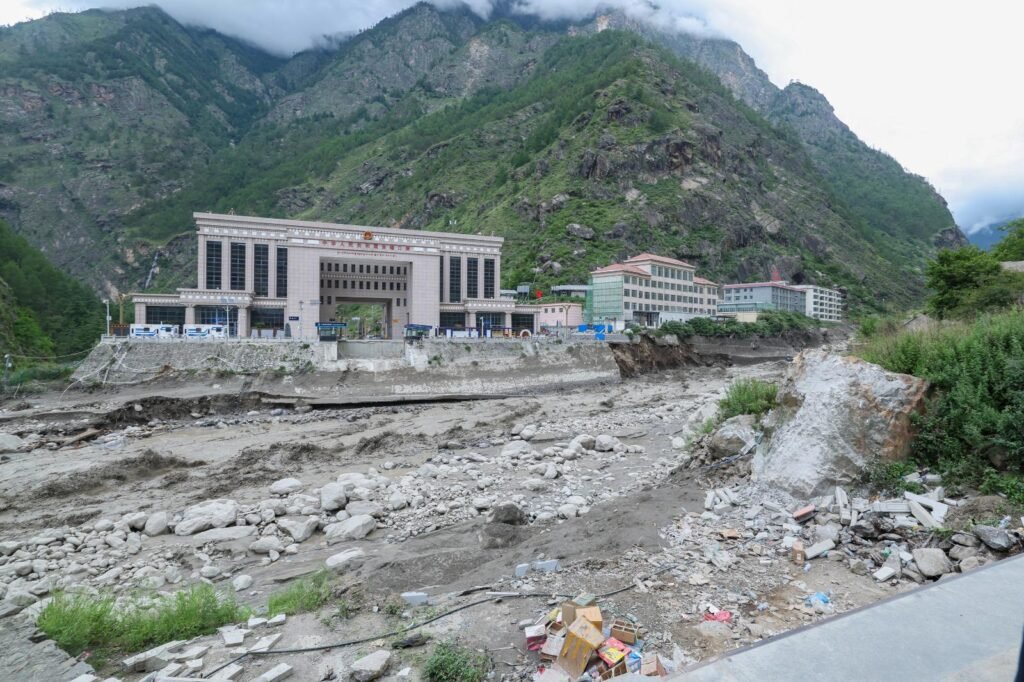
A river does not stop at a frontier, and neither do its consequences. On 26 August 2026, a flash flood along the Bhote Koshi in Nepal’s Rasuwa region tore through settlements and roads on a corridor used by traders, workers and pilgrims. Nepal’s Ministry of Foreign Affairs described extensive rescue work and listed Nepali and foreign nationals among the missing (Ministry of Foreign Affairs, Nepal, 2026a), while Reuters recorded families anxiously seeking news of Indian pilgrims bound for Mount Kailash (Reuters, 2026). This commentary treats the episode less as an isolated misfortune than as a stress test of how well two close neighbours protect people who move between them.
Grief and the Discipline of Verified Facts
Condolences are owed to Nepali families who lost relatives, to those still waiting for news, and to Indian families whose members were travelling in the area. Reporting clearly establishes the presence of foreign travellers and pilgrim groups; it does not show how many Indians were there for medical treatment, and commentary should not guess at victims’ purposes. Early casualty figures must likewise be treated as provisional: the ministry’s own briefing of 29 August, which reported 626 bodies recovered and about 2,400 people still unaccounted for, warned that these numbers could change as verification continued (Ministry of Foreign Affairs, Nepal, 2026a). For a family awaiting news, uncertainty is a distinct kind of suffering, worsened when roads and mobile networks fail and relatives must chase tour operators, police, hospitals and embassies at once.
India’s Response in Context
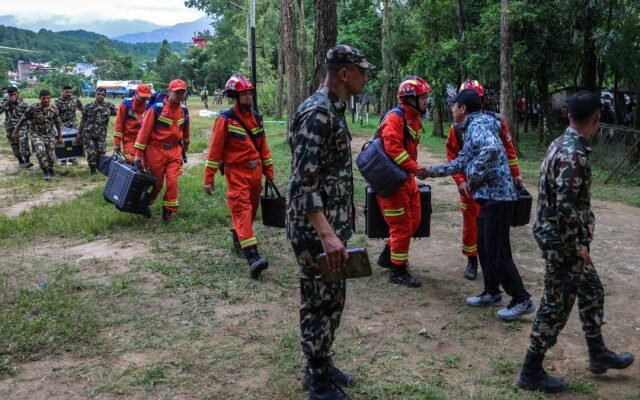
India’s Prime Minister spoke with his Nepali counterpart, Balendra Shah, conveyed condolences and said India stood ready to provide all possible humanitarian assistance (Prime Minister’s Office, 2026). Nepal’s briefings, for their part, noted that tunnel-rescue experts from India, China and the Republic of Korea were mobilised to work with the Nepali Army (Ministry of Foreign Affairs, Nepal, 2026b), and that Kathmandu had requested international support only for specific needs, expecting larger help later for reconstruction. This is a sound template: Nepal directs its own emergency, and partners contribute particular skills under that direction.
There is precedent. After the floods and landslides of September 2024, the Indian Embassy reported relief consignments of 4.2 and 21.5 tonnes in October (Embassy of India, Kathmandu, 2024a, 2024b), and within days handed over the first components for ten prefabricated steel bridges to restore road links (Embassy of India, Kathmandu, 2024c). Operation Maitri after the 2015 earthquake is another reference point. Yet a record of generosity is not proof of readiness. Recurring floods raise harder questions about warnings, route safety and the flow of information.
Shared Rivers, Shared Risk
The Kosi, Gandak and Bagmati rise in Nepal and run into India, so upstream conditions shape downstream safety. Mechanisms already exist, notably a Joint Team on Flood Forecasting (Ministry of Jal Shakti, 2022) and a Joint Committee on Inundation and Flood Management, whose 14th meeting in March 2022 included visits to border sites proposed for emergency works (Embassy of India, Kathmandu, 2022). Their worth, however, depends on timely data, technical compatibility and public confidence. Researchers add that water cooperation between the two countries is complicated by contested readings of international water law (Vasani, 2023) and by differing perceptions of risk and benefit (Rai, Sharma & Wolf, 2019). Technology cannot settle what are partly political disagreements; transparency and fair treatment of affected communities must accompany it.
Protecting People on the Move
The open border lets people cross freely for work, family visits, worship and treatment. That same openness means emergencies quickly involve foreigners who may not know local languages, hazards or warning systems. Pilgrimage routes are especially exposed, with long distances, hired vehicles, organised groups and weather that can turn within hours. Three gaps stand out: operators who lack dependable passenger lists, no agreed channel for sharing verified information on the missing, rescued and deceased, and uneven access to consular and medical help.
Recommendations
First, India and Nepal should document and rehearse a bilateral emergency protocol that names focal agencies, sets out how assistance is requested and how specialist teams are deployed, and is tested through joint exercises rather than improvised in a crisis. Nepal’s practice of asking for help only where it is needed should be written into that protocol. Regional partnerships point the same way: Japan’s 2026 package for Bangladesh includes grant funding for a Coast Guard vessel intended partly for responding to natural disasters (Akon, 2026).
Second, the two countries should exchange rainfall, river-level and landslide data in near real time, building on the existing flood-forecasting and inundation bodies. Warnings need to reach local administrations, transport and tourism operators in languages they understand, and public dashboards should separate confirmed from preliminary information.
Third, a single coordination channel should handle missing-person and consular cases: registering reports, verifying information, giving families designated contacts, supporting identification and repatriation, and protecting personal data from misuse. Nepal has already opened an Emergency Control Room for foreign nationals reported missing (Ministry of Foreign Affairs, Nepal, 2026a), which is a natural anchor for such a channel.
Fourth, pilgrimage and tour operators on hazardous routes should be required to keep manifests, emergency contacts and route plans, and to halt journeys when warnings are issued.
Fifth, drills, shelters and first-aid training should be funded with local groups, and relief should be linked to reconstruction guided by Nepal’s own priorities, so that support does not fade once attention moves on.
Sixth, after major disasters, and with Nepal’s consent, the two governments should conduct a joint review that yields a time-bound action plan before the next monsoon.
Conclusion
None of these steps can abolish Himalayan hazards, but they can reduce avoidable confusion and loss. Respect for Nepal’s sovereignty must stay central: India’s role is most constructive when it complements Nepali institutions and answers needs Nepal identifies, rather than treating each disaster as an opportunity for diplomatic visibility. India’s recent diplomacy offers a caution here. Mishra notes that the leaders’ September 2026 meeting in New Delhi produced more hotlines and more talks rather than a settlement (Mishra, 2026); process, however welcome, is not the same as outcome, and the same is true of preparedness. The real measure of neighbourly friendship is not the solidarity voiced after a catastrophe but the preparation done beforehand to keep ordinary people alive.
Nasrin Ahmed has completed her Master’s in Political Science from the University of Science and Technology Meghalaya, India.