04 November 2026, NIICE Commentary 12856
Md. Saifullah Akon
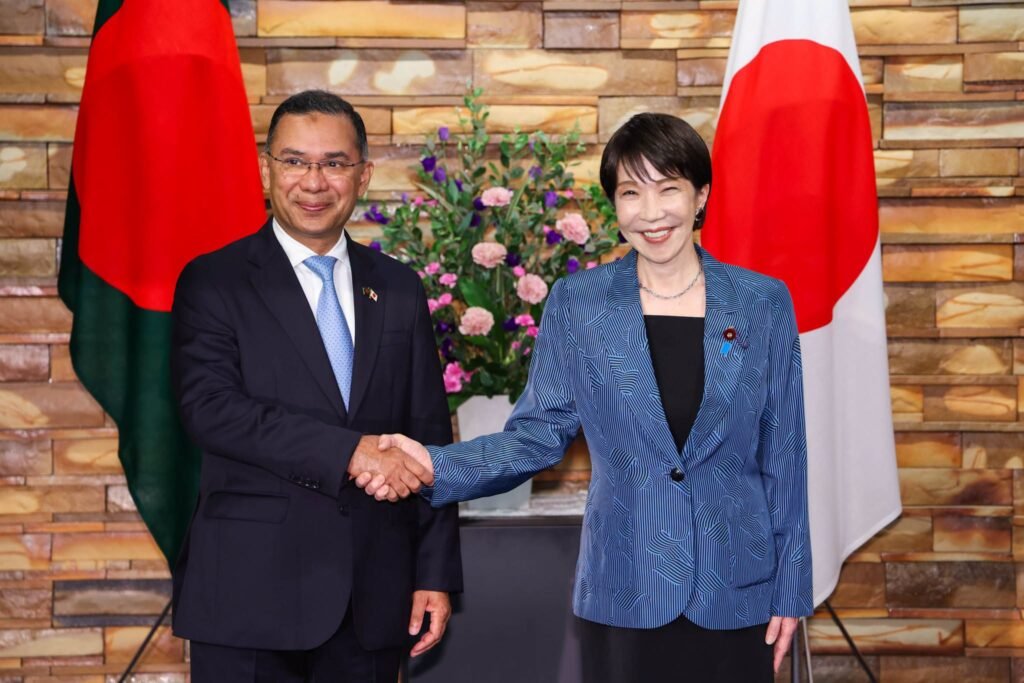
Tarique Rahman, in his capacity as Prime Minister, made his first official visit to Japan from 26 to 29 October 2026. On 27 October, he met Japanese Prime Minister Sanae Takaichi in Tokyo. Through this visit, Bangladesh sought to expand export opportunities in the Japanese market, attract private investment, and advance ongoing infrastructure projects. Japan, for its part, expressed interest in deepening cooperation with Bangladesh in trade, regional connectivity, and maritime security. These discussions rest on a long-standing foundation of bilateral development cooperation.
Bangladesh-Japan Relations
Established in 1972, the formal foundation of Japan-Bangladesh diplomatic relations was initially cemented under the donor-recipient framework. Japan’s early engagement focused on post‑war reconstruction and humanitarian assistance, reflecting its traditional aid diplomacy. As part of its development cooperation, Japan has financed major infrastructure projects in Bangladesh. These include Dhaka’s Metro Rail, the Jamuna Railway Bridge, Matarbari Deep Sea Port, and the third terminal at Hazrat Shahjalal International Airport. However, this relationship gradually evolved in response to Bangladesh’s growing geo-economic and geo-strategic significance in South Asia as well as in the broader Indo-Pacific. As cooperation expanded beyond development assistance, the two countries sought to give their wider relationship a formal structure.
Consequently, in 2014, the bilateral relationship was elevated to a comprehensive partnership, aimed at enhancing collaboration in politics, development, energy, trade, investment, and people-to-people interactions. Later, in 2023, it was further upgraded to a strategic partnership immediately following Japan’s announcement of a new FOIP plan. This progression underscores Bangladesh’s increasing relevance to Japan’s Indo‑Pacific vision.
Agreements and Commitments
A principal item on the agenda in Tokyo was the Japan–Bangladesh Economic Partnership Agreement (EPA). The agreement was signed in Tokyo on 6 February 2026, during Bangladesh’s interim government. At the October meeting, the two prime ministers reaffirmed their commitment to bringing it into force promptly. Once in effect, tariffs on a range of qualifying goods will be reduced or eliminated. The agreement also contains provisions on trade in services, investment, and the rules of origin and customs procedures. During their discussion of maritime security, the two leaders also welcomed a separate agreement on the transfer of defence equipment and technology, which was signed in Dhaka on 3 February and entered into force the same day.
The new instruments signed during the visit included memoranda of cooperation on improving the business environment, on agriculture, and on fisheries and livestock. The two sides signed a letter of intent on climate change cooperation. Japan agreed to provide up to 2.12 billion yen in grant funding for a Bangladesh Coast Guard patrol vessel. The vessel is intended to help the Coast Guard tackle maritime crime and respond to accidents at sea and natural disasters. The two countries also agreed to advance preparations for opening the third terminal at Dhaka’s Hazrat Shahjalal International Airport and to discuss future cooperation on the operation and management of Matarbari Deep Sea Port. The leaders also discussed energy security and supply chain resilience. In their discussion on Myanmar, Japan expressed support for continued humanitarian assistance to the Rohingya. Japan also pledged two loans totalling 46.56 billion yen, or approximately US$295.5 million. One pledge, worth about US$100.8 million, is intended to improve the investment climate. The other, worth about US$194.7 million, would support the second phase of the Upazila Governance and Development Project.
On private investment, Takaichi stated that Japanese corporate investment in Bangladesh could reach up to 1 trillion yen over the next five years, and that this could generate roughly 200,000 jobs. Both figures are projections. Takaichi also indicated her intention to send a business delegation to Bangladesh. According to the Japan External Trade Organization (JETRO), seven memoranda of understanding and ten investment or cooperation projects were announced at an economic forum in Tokyo on 28 October. In their joint statement, the two leaders also resolved to expand the scope of the Bay of Bengal Industrial Growth Belt (BIG-B) initiative, which is built around ports, industrial zones, and investment.
BIG-B and Matarbari
BIG-B stands for the Bay of Bengal Industrial Growth Belt. The initiative emerged in May 2014 at a meeting in Tokyo between then Prime Minister Sheikh Hasina and Japanese Prime Minister Shinzo Abe. It initially emphasized industrial, infrastructure, and connectivity development centered on Dhaka, Chattogram, and Cox’s Bazar. During the 2026 visit, the two countries broadened its scope and renamed it “BIG-B for Shared Prosperity.” In addition to connectivity, the new framework incorporates responses to disaster and geopolitical risks, joint public–private undertakings, and cooperation on peace and security.
The plan envisages linking the port with roads, railways, waterways, and industrial zones in order to develop a hub for industry, energy, and freight transport in the Matarbari–Moheshkhali area. The project also has a regional dimension. In 2023, Japan proposed linking the Bay of Bengal with India’s northeast to expand industrial and commercial connectivity. Bangladeshi ports could offer producers in that region an additional route for exporting goods, while Bangladeshi firms might gain access to the Indian market. Japanese companies, too, could find expanded avenues for sourcing raw materials, manufacturing, and selling products in the region.
Challenges Ahead
Although the large investment figure attracted attention, the joint statement did not publish a detailed breakdown of how much investment or how many jobs are expected for each project. At the Tokyo business forum, Rahman acknowledged Japanese firms’ concerns about reliable energy supplies, efficient infrastructure and predictable tax rules. Whether the projected investment materializes will depend in part on how Bangladesh addresses those concerns and simplifies customs clearance and licensing.
The ability to lower transport costs in Matarbari will largely depend on cargo volumes and its connections to inland. As large vessels need enough cargo, any delays could erode any savings at sea. On the other hand, to connect northeast India, both Dhaka and New Delhi must maintain friendly economic and diplomatic relationships. At the same time, both countries need to agree on rules for border inspections, freight transport, and port access. It is also necessary to calculate how much of the port’s cost can be met from its revenue if cargo volumes fall short of expectations. The environmental impact of construction and compensation for those affected by land acquisition should form part of this assessment.
How Bangladesh Could Benefit
The first opportunity lies in the Japanese market. Once the EPA takes effect, Bangladesh will need to look for export opportunities beyond ready-made garments. Helping small exporters test their products, obtain certificates of origin, and find buyers in Japan would allow more firms to use the tariff preferences. Bangladeshi exporters could meet Japanese importers and access demand for products such as jute goods, leather products, and processed foods, including halal food for Muslim consumers.
A second opportunity lies in Matarbari. If large vessels can get access to the port directly, exporters could save both time and money. Besides, handling cargo from neighboring countries could also generate revenue and also create jobs in this sector. Bangladeshi firms could earn income by providing storage, trucking and cargo-handling services.
However, the October visit opened the way for Bangladesh and Japan to build on decades of development cooperation by expanding trade and industrial ties. Bangladesh’s government should now publish who will carry out each commitment, how much funding has been secured, and when each project is expected to finish. Reporting these details would make it easier to distinguish signed agreements and loan pledges from projects already under way. Over time, the impact of Tarique Rahman’s visit can be assessed by how many Bangladeshi firms start selling in Japan, how many local businesses take part in new investment projects, and whether shipping through Matarbari reduces transport times and costs.
Md. Saifullah Akon is a Doctoral Student at the Osaka School of International Public Policy (OSIPP), The University of Osaka, Japan.