
17 September 2026, NIICE Commentary 12741
Vanshika Mishra
India and China are, by most public signals, on better terms today than at any point since the Galwan clash of 2020. Border talks have resumed, trade curbs have eased, and New Delhi is preparing to host its biggest diplomatic moment of the year this September. The temptation, understandably, is to call this a thaw. Whether it actually deserves that word, or whether what is unfolding is something more calculated and far more reversible, is a question worth asking properly before the applause gets too loud.
This can be traced back to Oct 21, 2024, when Indian Foreign Secretary Vikram Misri announced a patrolling arrangement between India and China in the Depsang and Demchok sectors of eastern Ladakh. The border tension in these areas remains unresolved. The following day, Modi and Xi met for the first time in 5 years at the BRICS summit in Kazan. By the end of the month, there were announcements about disengagement in the border areas and renewal of trade flows between the two countries. While this appeared to be a reset between two geopolitical rivals, the uncomfortable truth was not this apparent. The said arrangement was never put out as a treaty. It was just a ‘patrolling arrangement’ and was kept to a limited number of officials. This ambiguity was not to be overlooked, as it defines the actual normalcy between New Delhi and Beijing.
To analyse the reset, we first need to answer the question: why did India agree to this after more than four years of holding its ground in the standoff? The answer is India’s outstanding stakes in the economic, technological, and military spheres. India’s trade deficit with China was capped at about $100 billion in 2024-25 and reportedly surpassed that mark again by early 2026. Delhi still relies on Beijing for more than 75 per cent of the lithium-ion batteries, rare-earth magnets, and antibiotics needed for its EV and defence sectors. Furthermore, the military strain borne by India in facing both China and Pakistan at once demonstrates the vulnerabilities New Delhi faces in a closed-border scenario.
In our analysis of the reset, we aim to determine whether it was a strategic thaw or a strategic hedge. So first lets define these terms. A strategic thaw is a genuine, structural improvement between two countries, in which the core disputes are resolved or set aside for good, so that cooperation can outlast political leaders. On the other hand, a strategic hedge is a more calculated attempt, a kind of insurance policy, to manage risk under uncertainty by running contradictory policies at once. These are done quietly, undeclared, so a state never has to fully commit to one side or the other. The term was first introduced in 2008 by a Malaysian academic, Cheng-Chwee Kuik, to describe how smaller states deal with a rising power by quietly pursuing conflicting policies simultaneously, rather than choosing between resistance and accommodation. In IR, hedging can be placed between two extremes: one is balancing, where a state openly builds strength or alliances against the threat, and Bandwagoning, where it simply joins the stronger power and accepts a subordinate role. Hedging is what a state does when it wants neither.
On the surface, the recent development thus appears to be a real thaw. Special Representatives resumed border talks in December 2024 after a five-year stalemate. Direct flights were restarted in January 2025. Tourist visas were reopened. Furthermore, in August 2025, after Jaishankar raised the issue with Wang Yi, China lifted export restrictions on rare earth magnets, fertilisers and tunnel-boring machines, which had been causing economic tensions in India. In March 2026, the Cabinet also relaxed Press Note 3 investment rules, allowing Chinese investors to take non-controlling stakes of up to 10 per cent without prior approval.
While these developments clearly hint at a thaw between India and China, the real crux of the issue remained disputed. More than 50,000 troops are still stationed along the LAC. There is still no mutual agreement on where the Line of Actual Control (LAC) actually runs. The WTO dispute over India’s EV and auto incentives, issued by Chinese officials, remains unresolved. Along with this, the tensions relate to the construction of the Brahmaputra dam. A true thaw would resolve the main issue for the dispute, which remains ignored, surrounded by buffer zones and polite statements.
Thus, this proves my case for a strategic hedge. Four signs reveal this hedging strategy. First, it is reversible. India’s MEA Jaishankar has called this a "patrolling pause"; it can be reversed if the situation demands. Second, this arrangement remains ambiguous. No treaty or official document has been issued by both sides. Thirdly, this is not an either-or situation for India. It continues to maintain its ties within the Indo-Pacific Quad groupings, as does its S-400 partnership with Moscow. And finally, this China-hedging comes as a counter to the US trigger of 2025.
In April 2025, the US imposed a combined tariff of 50 per cent on India, first as a reciprocal measure and then as a penalty linked to Russian oil purchases. By February 2026, Washington lowered the tariff to 18 per cent, and a Supreme Court ruling soon after brought it down further to a temporary 10 per cent. If India’s outreach to China was only a reaction to US pressure, you’d expect it to slow down once that pressure eased. But it hasn’t. Press Note 3 was relaxed after the tariff relief, not before. Furthermore, recently, on 23 July 2026, the USTR announced a new 10 per cent tariff under Section 301, this time citing forced-labour concerns instead of Russian oil. This projects Washington as an unpredictable trade partner for India. It’s a tool Washington uses repeatedly, for reasons that can shift from oil to labour standards in just a few months. This unpredictability, more than any single tariff, is probably the best reason for India to keep its China channel open.
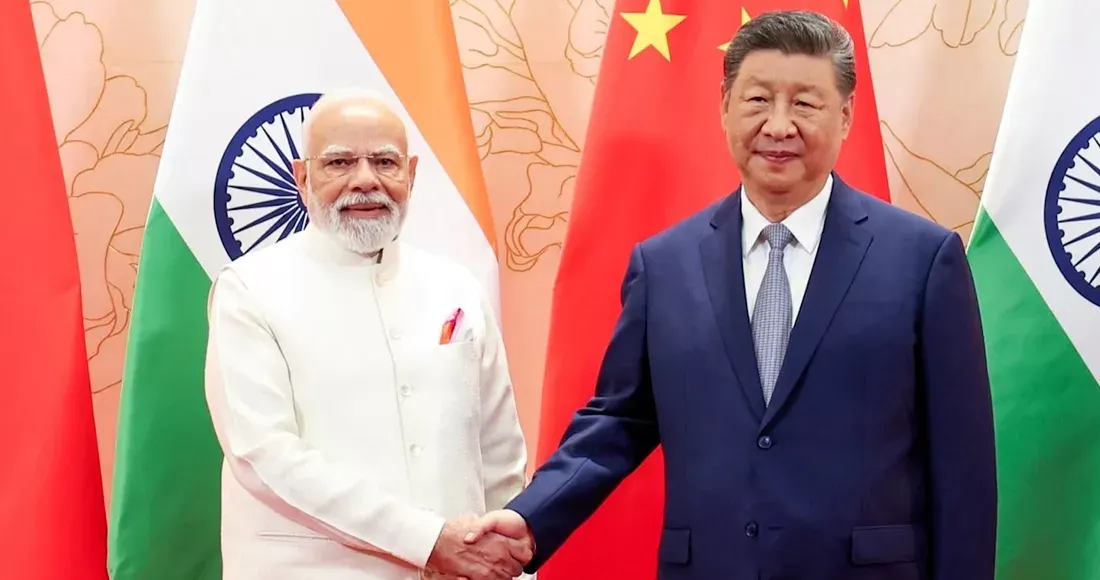
This brings us to the BRICS++ summit that just wrapped up in New Delhi on 12-13 September, and it delivered more or less exactly the kind of answer the hedging framework would predict. Xi did come, his first visit to India in nearly seven years, and he and Modi met at Bharat Mandapam, complete with a welcome ceremony and the customary handshake for the cameras. That in itself was notable. Just weeks earlier, it wasn't a given that Xi would show up at all rather than send Premier Li Qiang, as Beijing did for the 2023 G20. His arrival, with a delegation of around 400 officials, more than double the size of his 2019 visit, was read in Indian media as the clearest signal yet of genuine warming.
But look closely at what actually came out of the meeting. India's foreign ministry said the two leaders "expressed commitment" to working together to resolve the border dispute, not that they had resolved it. This followed the 25th round of Special Representatives' talks in Beijing on 25 August, where India and China agreed to set up two new military hotlines and two new commander-level meeting points along the LAC, and flagged an "early and substantial harvest" on boundary delimitation as the next step. These are real, incremental steps. They are also, notably, more process than outcome. Nobody announced a settled boundary. Nobody announced troop drawdowns beyond existing disengagement. The Brahmaputra dam and the WTO dispute over EV incentives didn't feature in any joint statement.
So even the single biggest, most symbolically loaded meeting between the two leaders in seven years produced more hotlines and more talks, not a treaty. That is not a knock against the summit. If anything, it makes the case rather than complicating it. A hedge is not meant to be resolved by one high-visibility handshake, however grand the arrival ceremony. It is meant to keep the door open without committing to walk through it. India isn't picking China over America, or vice versa. Instead, it is working hard to avoid choosing as long as possible. India's hedging finally comes as part of its wider ambit of multialignment policy, stretching from the Quad to Russia to BRICS and SCO, and finally to the India-China Reset. A multipolar world demands a multialignment strategy, which India is following in its foreign policy.
Vanshika Mishra is a Research Intern at NIICE. She is currently pursuing her Master's in International Relations at the South Asian University, New Delhi, India.
