
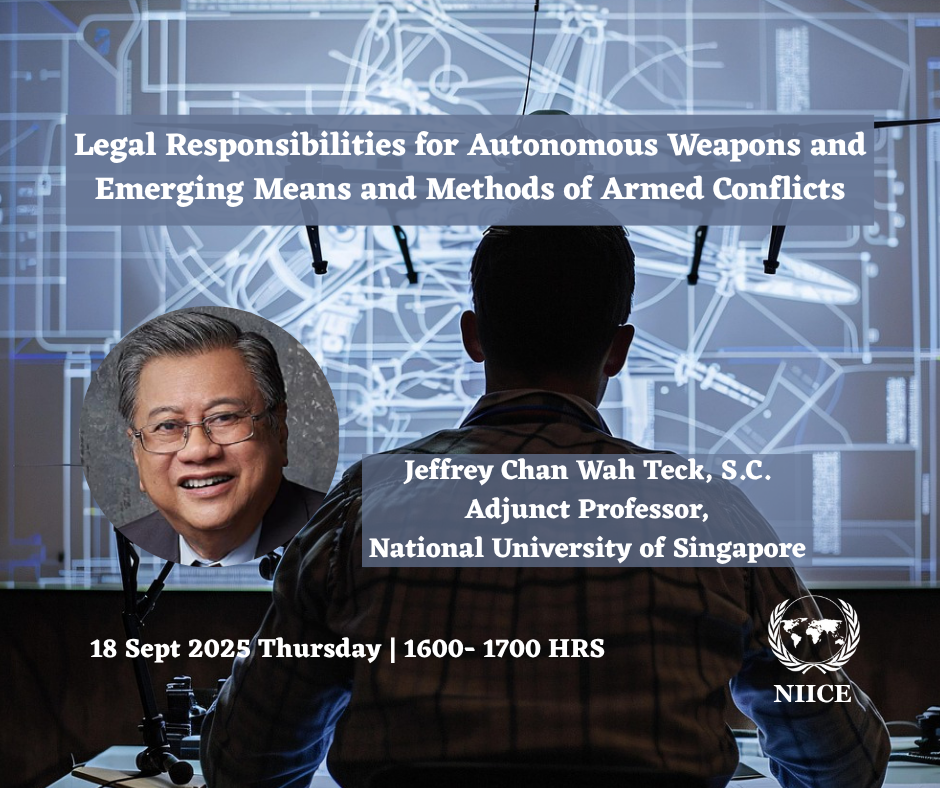
Legal Responsibilities for Autonomous Weapons and Emerging Means and Methods of Armed Conflicts
Watch on YouTube
On September 19th, the Nepal Institute for International Cooperation and Engagement (NIICE) hosted the Dialogue Series, focused on “Legal Responsibilities for Autonomous Weapons and Emerging Means and Method of Armed Conflicts.” The event brought together scholars, defense analysts, and security officials who joined virtually. The keynote speech was presented by Jeffrey Chan, a well-respected security expert with much background in defense and security studies.
Chan began his presentation with the idea that present wars may well no longer be mere state-against-state fights,they increasingly involve non-state actors with independent goals and differing levels of command and control. This shift, he argued, has blurred the traditional lines between war and peace, combatants and non-combatants, and even the boundaries within which battles are fought.
He then considered new means and methods of war, identifying a number of emerging areas. Cyber attacks have also been directed at critical infrastructure, including power grids and communications. Environmental weapons Involve Infra-structure Natural Systems The environment as a system of infrastructural natural systems can be modified or managed to create adverse conditions for an enemy’s populace or military. Medical and gene weapons pose very grave ethical issues they possibly could use pathogens or be engineered to target particular racial or ethnic groups. He also referenced the weaponisation of ordinary items, noting Israel’s alleged employment of exploding pagers and walkie-talkies against Hezbollah that serves as a reminder of how commonplace material can be converted into the means of war.
Chan responded to wide-ranging questions on responsibility, ethics and regulation during the Q&A session. He stressed that as drones and other autonomous tools increasingly shaped the battlefield, accountability needed to be understood not simply in terms of intention, but also in terms of who set the events in motion. On counter-IEDs and drones, he said advanced technologies such as jamming and quick mechanisms for sharing threat information among soldiers is needed.
On the question of how to balance technological advancement with ethics, Chan said that it would be important to ensure that human judgment remained at the heart of military decisions. He said all new systems should be subject to "rigorous scrutiny" and oversight to stop abuse. On the subject of the dizzying pace of machine learning and AI in weapons, he said regulatory regimes must be agile, evolving, and international in scope, like software, to be accountable and secure.
Conclusion
Chan said that although technology has rendered warfare more complex and unpredictable, the implications of technological diffusion could be managed through prudent regulation, robust international cooperation, and unremitting focus on responsibility and ethics. He stressed the critical importance of revised laws and ongoing global engagement to protect peace and stability in a period of rapidly evolving military technologies.
Recent Comments