
06 February 2026, NIICE Commentary 12304
E V A Dissanayake
Traditional concepts of maritime sovereignty are being challenged by a new form of “presence-based” geopolitics. In the South China Sea, the front line is no longer defined by naval destroyers but by state-subsidised industrial fishing fleets operating as a Maritime Militia. This article examines how these fleets facilitate a “silent takeover,” using “Gray Zone” tactics and sophisticated lawfare to effectively redraw maritime borders without triggering conventional military conflict. By establishing a de facto administrative presence in contested waters, these actors are eroding the rules-based order of UNCLOS and forcing a shift from legal maritime boundaries to those defined by sheer physical occupation.
The Architecture of Gray Zone Sovereignty
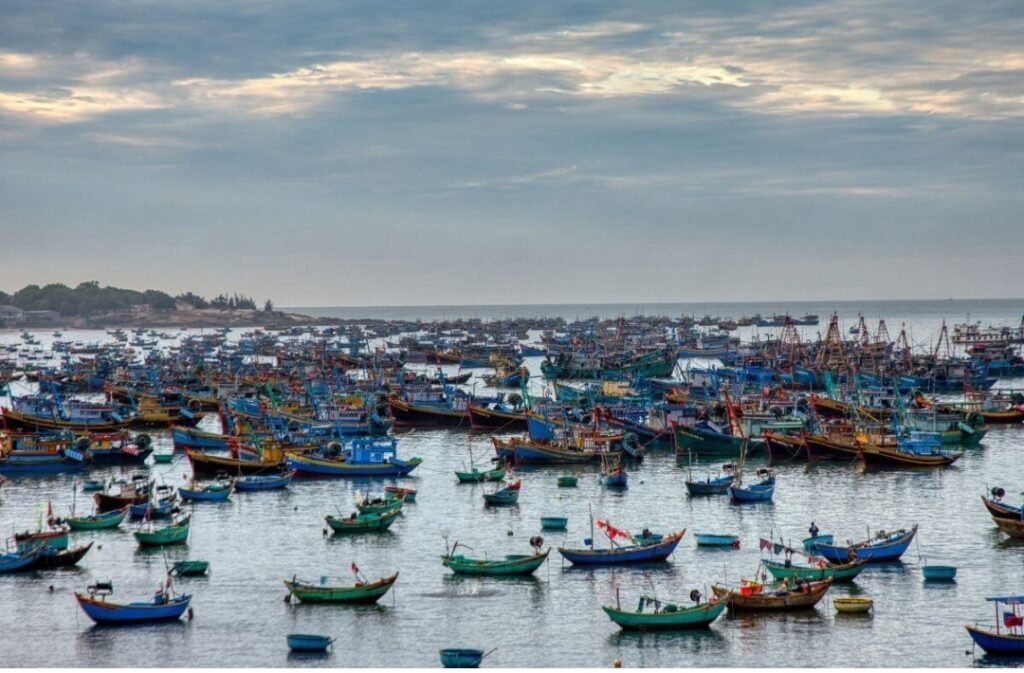
In the contemporary maritime landscape of the Indo-Pacific, the traditional “line in the water” is being blurred not by hulls of steel and naval batteries, but by wooden bows and nylon nets. The South China Sea has become the primary laboratory for a geopolitical experiment known as “Gray Zone” aggression—a space where state objectives are pursued through non-military means to avoid triggering a conventional military response. Central to this strategy is the deployment of massive industrial fishing fleets that serve as the vanguard for a silent takeover of contested waters.
It is imperative to recognise that these fleets are no longer merely commercial entities. They have been operationalized as instruments of “presence-based sovereignty,” where the constant physical occupation of a maritime space by civilian vessels is used to invalidate the Exclusive Economic Zones (EEZs) of littoral neighbours and redraw borders in real-time.
Weaponising the Commons: The Strategic Utility of the Fleet
The “Silent Takeover” relies on the deliberate ambiguity of civilian actors. By using fishing vessels to swarm disputed areas, a state can establish a “de facto” administrative presence that complicates the rules of engagement for regional coast guards. If a sovereign state attempts to expel these intruders, they risk being framed as the aggressor against “innocent fishers.” This creates a tactical paralysis among ASEAN members, who find their maritime borders effectively shifted inward without a single shot being fired.
This phenomenon is underpinned by the formalisation of the Maritime Militia. These are not independent actors but state-subsidized units equipped with reinforced hulls and high-end satellite communication systems that allow them to coordinate directly with naval command centers. The integration of these “dark fleets” into national security frameworks has effectively turned the South China Sea into a militarised commons where the boundaries between commercial enterprise and national defense have entirely evaporated.
The Legal Erosion: Lawfare and UNCLOS
The silent takeover is as much a legal battle as it is a physical one. Under the 1982 United Nations Convention on the Law of the Sea (UNCLOS), sovereign rights over resources are clearly defined within the 200-nautical-mile EEZ. However, the aggressive presence of industrial fleets seeks to establish “historical rights” that predate and supersede modern international law. This is a classic example of lawfare—the use of law as a weapon of war.
By maintaining a persistent presence, these fleets create a “new normal.” Over time, the continuous occupation of a reef or shoal, supported by industrial-scale extraction, is used to build a legal narrative of effective control. This challenges the 2016 Arbitral Tribunal ruling, which explicitly rejected “historical rights” as a basis for maritime claims. For small and middle powers in the region, this erosion of international law represents an existential threat to the rules-based order that has governed the oceans since the end of the Second World War.
The Economic Front: Displacement as a Policy Tool
While the geopolitical implications are clear, the economic mechanics of the takeover are equally devastating. Industrial fleets act as “economic blockades” that prevent smaller nations from accessing their own natural resources. When thousands of industrial-scale vessels loiter in the traditional fishing grounds of Vietnam or the Philippines, they effectively “starve out” local artisanal fishers.
This displacement is a deliberate policy tool. By making it economically unviable for local communities to fish in their own waters, the aggressor state removes the primary civilian presence of the rival claimant. As coastal communities collapse, the state’s claim to those waters weakens, allowing the industrial fleet to solidify its hold. The World Wildlife Fund notes that this cycle of economic exclusion and resource depletion is a major driver of regional migration and socio-political instability.
Technological Dominance and Maritime Domain Awareness
The ability to carry out a silent takeover depends on the “darkness” of the sea. Vessels involved in these operations frequently disable their Automatic Identification Systems (AIS) to avoid detection by international monitors. This “Dark Fleet” phenomenon is supported by state-level technological dominance, where the aggressor has the capacity to monitor all maritime activity while remaining invisible itself.
To counter this, regional powers must invest in advanced Maritime Domain Awareness (MDA). The use of satellite-based radar, AI-driven vessel tracking, and multilateral data sharing is the only way to “turn on the lights” in the South China Sea. However, the technological gap remains significant. As noted by the Stimson Center (2025), without a shared regional platform for tracking these “gray zone” actors, the silent takeover will continue to accelerate, hidden by the sheer scale of the ocean and the opacity of state-sponsored industrial fishing.
The Regional Response: From Passivity to Collective Security
The success of the silent takeover relies on the fragmentation of the response. When littoral states act individually, they are easily overwhelmed by the sheer mass of the industrial fleet. The path forward requires a shift toward collective maritime security. This involves not only joint patrols but also the internationalisation of the fisheries crisis.
By framing the issue as a threat to global food security and the freedom of the seas, regional actors can draw in broader international support. Saving the South China Sea requires a multilateral framework that treats maritime borders as legal certainties rather than negotiable zones of influence. Only through a unified front can the “slaughterhouse” model of extraction be replaced with a sustainable, rules-based blue economy.
Reclaiming the Horizon
The silent takeover of the South China Sea is a warning to the rest of the world. It demonstrates how civilian resources can be weaponised to achieve strategic ends without the “messiness” of kinetic warfare. If industrial fleets are allowed to redraw borders through presence and depletion, the very concept of maritime sovereignty will be permanently altered.
To reclaim the horizon, the international community must recognize that a fishing boat is often more than just a fishing boat. It can be a marker of sovereignty, a tool of lawfare, and a silent soldier in a war for the future of the oceans. The challenge for the coming decade is to ensure that the “blue heart” of the Indo-Pacific remains an open commons for all, rather than a private pond for the few.
E. V. A. Dissanayake is an Independent Researcher from Sri Lanka. She is a Robert Bosche Stiftung Fellow and a Visiting Scholar of Columbia University, USA.