
24 January 2025, NIICE Commentary 12290
Ankit Narwal, Dewang Ganesh Thosar & Izharulhaq Safi
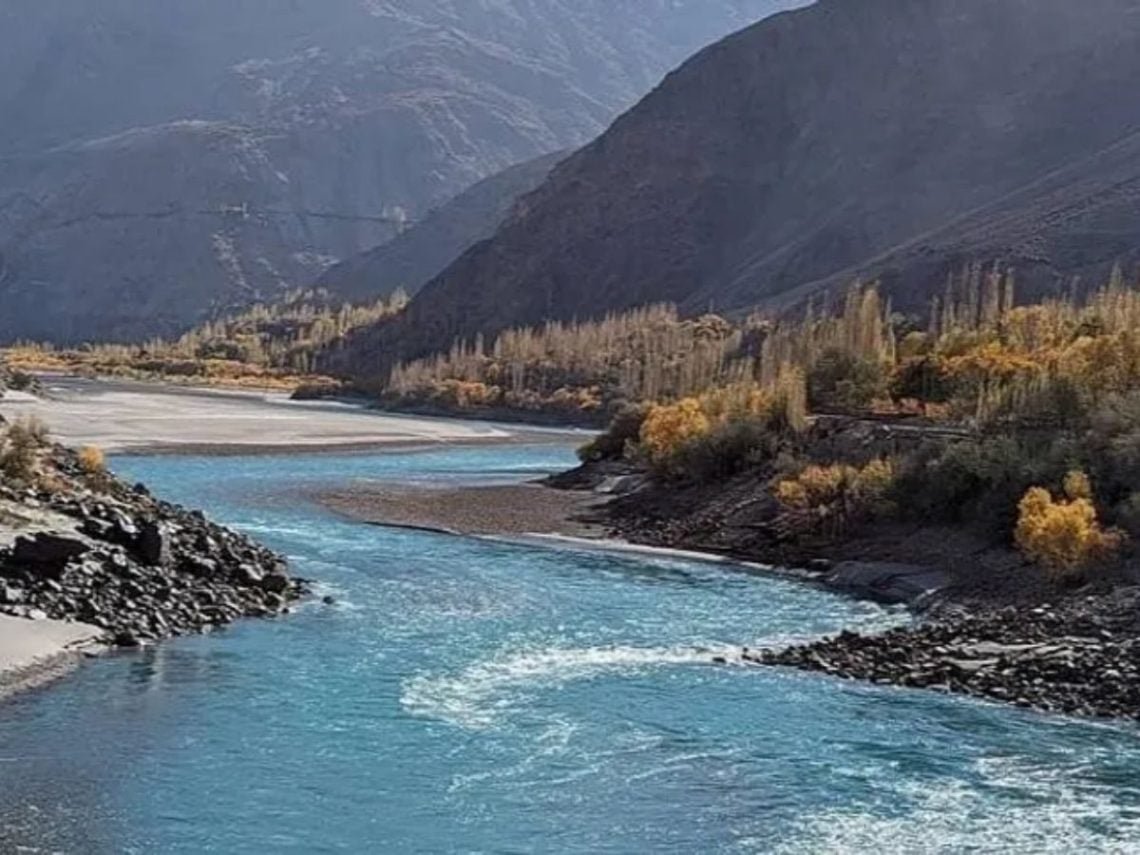
Water has long defined the political imagination of South Asia. The decision by the Taliban administration to construct dams on the Kunar River, a major tributary of the Kabul River, has revived debates on transboundary water rights and regional sovereignty. What makes this development significant is its timing. The announcement followed the visit of Afghanistan’s acting Foreign Minister Amir Khan Muttaqi to New Delhi, coming at a moment when India has placed the Indus Waters Treaty (IWT) in abeyance and Pakistan faces intensifying water stress. Together, these developments suggest that hydro-politics is fast becoming the new grammar of regional diplomacy, where rivers shape relationships as decisively as borders do.
The Economics of Water Sovereignty
The Taliban’s decision to dam the Kunar River can be seen as an attempt to translate Afghanistan’s underused natural capital into tangible economic self-reliance. Agriculture, which contributes around 34.7 percent of Afghanistan’s GDP according to the World Bank and sustains most of its population, depends critically on predictable irrigation. Harnessing the Kunar’s flow could expand cultivable land by almost half, improving yields and stabilising food supply. This in turn would reduce dependence on food imports and save crucial foreign exchange reserves and strengthen local markets and rural incomes.
Equally consequential is the hydropower potential. Afghanistan’s total exploitable hydropower capacity exceeds 20,000 MW, of which nearly 1,900 MW is concentrated along the Kabul–Kunar corridor. Reliable domestic power would lessen dependence on costly imports from Central Asia, freeing resources for health, education, and infrastructure. Controlled water storage could also enhance drinking water availability and urban resilience in eastern provinces such as Jalalabad and Kunar. The economic logic, however, carries geopolitical consequences. The Kunar contributes about three-fourths of the Kabul River’s flow into Pakistan, making it vital for
Pakistan’s agriculture and energy sectors. Any reduction downstream could exacerbate shortages in Khyber Pakhtunkhwa and affect Pakistan’s hydroelectric output. Thus, what appears as Afghanistan’s developmental assertion is simultaneously a strategic signal. It reflects a form of water nationalism, an effort to claim sovereignty over natural resources in a region where dependence has long equated to vulnerability.
Legal aspect and the governance vacuum
The absence of a formal legal framework compounds the fragility of the Kabul-Kunar basin. Unlike the Indus Waters Treaty that regulates India and Pakistan’s shared rivers, no bilateral agreement governs water-sharing between Afghanistan and Pakistan. The resulting legal vacuum leaves both countries exposed to unilateral actions and competing interpretations of entitlement.
Afghanistan’s status as a non-signatory to the 1997 UN Watercourses Convention weakens the applicability of international norms, yet principles like “equitable and reasonable utilization” (Article 5) and “no significant harm” (Article 7), rooted in customary law and the 1966 Helsinki Rules, still provide some legal basis for both states. However, the only treaty Afghanistan has concluded on transboundary water, the Helmand River Treaty of 1973 with Iran, offers little precedent and has itself been mired in dispute.
The Taliban’s refusal to acknowledge prior commitments further complicates continuity in international law. Without legal recognition or binding arbitration mechanisms, water becomes a matter of power rather than principle. For Pakistan, options remain limited to diplomatic engagement or third-party facilitation like the World Bank with respect to the IWT. In the absence of enforceable rules, the Kabul-Kunar basin risks turning into a theatre of coercive politics, where law trails behind the ambitions of statecraft.
From Strategic Depth to Strategic Distance
The most striking dimension of the Kunar episode is its geopolitical symbolism. The timing of the announcement following Amir Khan Muttaqi’s visit to India suggests an evolving calculus in Kabul. For years, Pakistan viewed Afghanistan as a zone of strategic depth, a buffer against India. That presumption now appears increasingly untenable.
The Taliban’s outreach to India, once an unlikely partner, demonstrates an emerging pragmatism that prioritises survival and legitimacy over ideological rigidity. By adopting a stance reminiscent of India’s approach to the Indus Waters Treaty, Kabul signals that it will act as a sovereign decision-maker rather than a client state. This shift erodes Pakistan’s privileged influence and introduces a measure of unpredictability into regional alignments.
India’s response has been cautious but purposeful. Reopening limited dialogue with the Taliban allows New Delhi to retain strategic visibility in Afghanistan while hedging against Pakistan’s leverage and China’s growing presence. For the Taliban, engagement with India offers both symbolic legitimacy and practical diversification of support at a time of strained ties with Islamabad, worsened by the presence of the Tehreek-e-Taliban Pakistan along the border.
This triangular dynamic reveals the deeper transformation of South Asia’s power balance. As water becomes a political resource, diplomacy too becomes hydraulic, shaped by flow, control, and negotiation. The Kunar River thus emerges not merely as an environmental asset but as an instrument through which sovereignty, strategy, and survival are simultaneously pursued.
Thus, the dispute over the Kunar River encapsulates South Asia’s shifting landscape of power. For Afghanistan, the project represents an assertion of sovereignty and a bid for self-reliance. For Pakistan, it marks the erosion of strategic assurance once derived from its influence in Kabul. For India, it offers a chance to re-engage a turbulent neighbour through pragmatic diplomacy.
Whether the Kunar River becomes a frontier of confrontation or a conduit of cooperation will depend on how regional actors interpret sovereignty, whether as unilateral control or as shared responsibility. In an era when rivers are fast replacing frontiers as the markers of political will, the challenge for South Asia lies not in owning water, but in managing its flow with reason and restraint.
