


From Colombo Dhaka to Kathmandu: The Fault Lines of South Asia
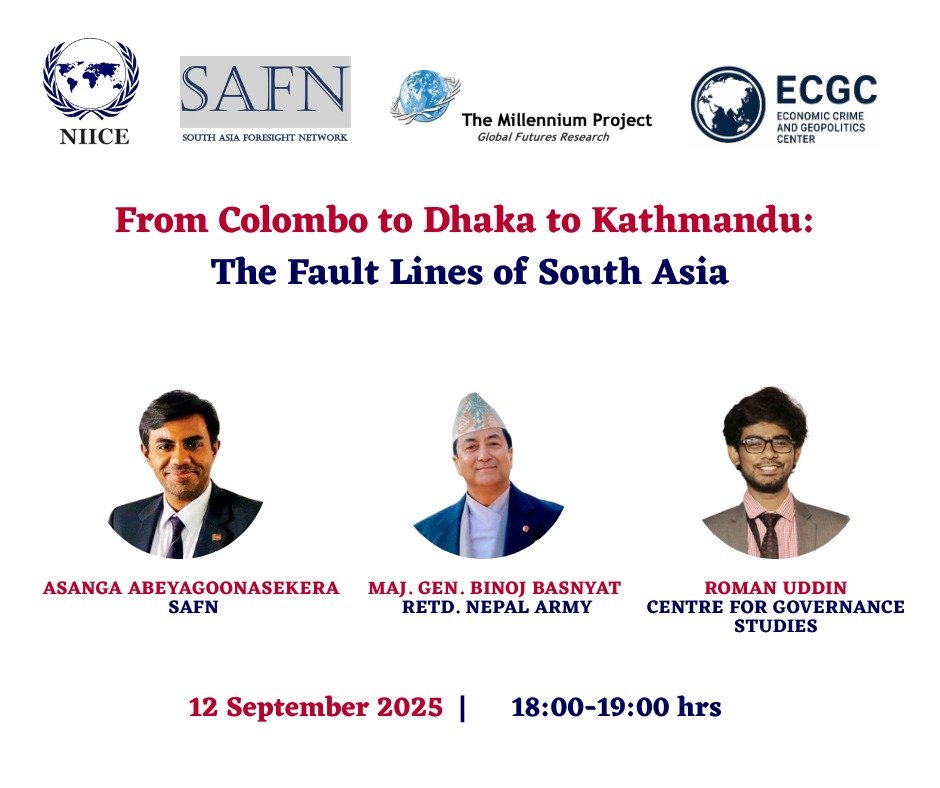
The Nepal Institute for International Cooperation and Engagement (NIICE) convened an online session on “From Colombo to Dhaka to Kathmandu: The Fault Lines of South Asia” on 12 September 2025. The discussion brought together three eminent speakers: Mr. Asanga Abeyagoonasekera (SAFN), Maj. Gen. Binoj Basnyat (Retd., Nepal Army) and Mr. Roman Uddin (Centre for Governance Studies, Bangladesh) to deliberate on the ongoing political transformations, youth-led protests, and governance challenges across Nepal, Sri Lanka, and Bangladesh.
Presentations by the Speakers
Mr. Asanga Abeyagoonasekera drew attention to the larger regional picture, linking Nepal’s recent Gen Z protests to trends across South and Southeast Asia. Referring to the ECGI Report on South and Southeast Asia, he explained how countries are categorised based on risks of civil disruption, with emphasis on economic and criminal vulnerabilities. He pointed out that in Nepal, as in Sri Lanka, foreign remittances remain the single largest contributor to the economy, accounting for nearly 33% of Nepal’s GDP. Such dependence, while sustaining livelihoods, also makes the economy fragile and prone to shocks. Drawing comparisons with Bangladesh and Sri Lanka, he stressed that one must fully grasp these complexities before they culminate in disruptive unrest. He argued that Nepal must take lessons from its neighbours to anticipate and manage risks effectively, rather than responding only after crises erupt.
Maj. Gen. Binoj Basnyat, a decorated researcher in Defence and Strategic Studies, analysed the internal structural issues in Nepal that preceded the protests. He observed that Nepal’s political landscape had long been stagnant, dominated by the same organisations and leaders with no renewal of ideas or faces. This lack of inclusivity eventually resulted in a leaderless movement. He highlighted how the traditional thought process of Nepal’s political leadership diverged sharply from contemporary realities, leading to decision-making that served party interests rather than public welfare.
General Basnyat further noted that corruption, entrenched within the three-tier governance system, had become institutionalised, exacerbating public frustration. Early warning signs, visible in academic debates and frequent small-scale protests, were overlooked by the political establishment. Consequently, the present instability was neither sudden nor unexpected. He outlined three major developments: (1) the legitimacy of the government has sharply eroded, (2) the credibility of security forces has weakened, and (3) Nepal’s Gen Z has mobilised as a collective force, demanding accountability and responsibility for the nation’s future.
He identified three key stakeholders in the present crisis: the President’s office, which represents constitutional authority; the Nepalese Army, responsible for strategic security; and the Gen Z youth, who have demonstrated high levels of responsiveness and activism. While the Chief Justice has become a figure of hope, the parliament remains mired in political controversy, particularly following its dissolution. General Basnyat stressed that Nepal requires an interim government composed of professionals, guided by anti-corruption principles, and supported by a human rights commission to investigate violations. He also flagged that suspicions and conspiracy theories continue to circulate regarding the causes and direction of the protests, complicating efforts to stabilise the situation.
Mr. Roman Uddin turned to the case of Bangladesh, drawing lessons for Nepal. He recounted how recent protests in Bangladesh had created immense difficulties for civilians, but also led to significant political change. He noted that although the interim government was led by civil society members, it lacked experience in policymaking. Despite this limitation, the government initiated 11 key reforms, including amendments to the constitution, reforms to the electoral system, and anti-corruption measures. Crucially, the interim government also announced fresh election dates, while universities began holding campus elections; signalling a revival of grassroots democratic practice.
Roman Uddin, however, warned that misinformation and fake news had complicated the situation during the protests. Such narratives not only destabilised the domestic environment but also spread internationally, potentially straining Bangladesh’s foreign relations even after the situation had begun to normalise. He encouraged Nepal’s youth to remain decisive, while cautioning that the post-protest phase requires careful handling to avoid repeating Bangladesh’s mistakes.
The interactive session offered deeper insights into how South Asian states might navigate youth-led political upheavals.
On Sri Lanka, the panel noted that relative stability had returned. The government had taken bold anti-corruption steps, including bringing back a former president and initiating arrests, while also distancing itself from judicial manipulation that historically marred over 50 cases with political influence. These measures resonated with Gen Z’s demand for accountability. The Sri Lankan example underscored the role of early aid from India, arriving even before IMF support; and the importance of transparent communication. However, the speakers emphasised that violent activities must cease and that a thorough analysis of protest trends remains essential. Nepal, they suggested, might eventually follow a similar trajectory.
On Nepal’s future, speakers agreed that immediate stabilisation efforts are critical. Within the next 24 hours, they argued, steps must be taken to dissolve parliament, form an interim government of professionals, and focus on national normalisation with the Nepalese Army’s support. Only then could the process of reconciliation and reform move forward.
On Bangladesh’s movement, panelists explained that the previous government’s destruction of the electoral process, censorship, and corruption had pushed people towards protest. While the overthrow of the authoritarian regime was a victory, the current government’s inexperience has complicated the balance of security and governance. The speakers highlighted that when activists assume political power, public perception often shifts, risking the dilution of the movement’s spirit. They advised that Nepal’s youth should avoid direct participation in government at this stage. Instead, they should protect the integrity of their activism by demanding immediate elections, creating platforms for coordination, and presenting themselves as the collective voice of the people.
Conclusion
The session illuminated the shared vulnerabilities and interconnected trajectories of Nepal, Bangladesh, and Sri Lanka. Across these cases, three themes stood out: the mobilisation of youth, the persistence of entrenched corruption, and the decisive role of interim governance in shaping outcomes. While Sri Lanka demonstrated that pragmatic anti-corruption measures can restore legitimacy, Bangladesh highlighted both the promise and pitfalls of civil society–led governments. Nepal, now at a turning point, was urged to adopt preventive reforms, empower professional interim leadership, and preserve the spirit of its youth movement through democratic processes.
The discussion reaffirmed that South Asia’s stability depends not only on institutional reforms but also on the ability of its societies to balance activism, governance, and democratic legitimacy.
Recent Comments