27 February 2026, NIICE Commentary 12328
E V A Dissanayake
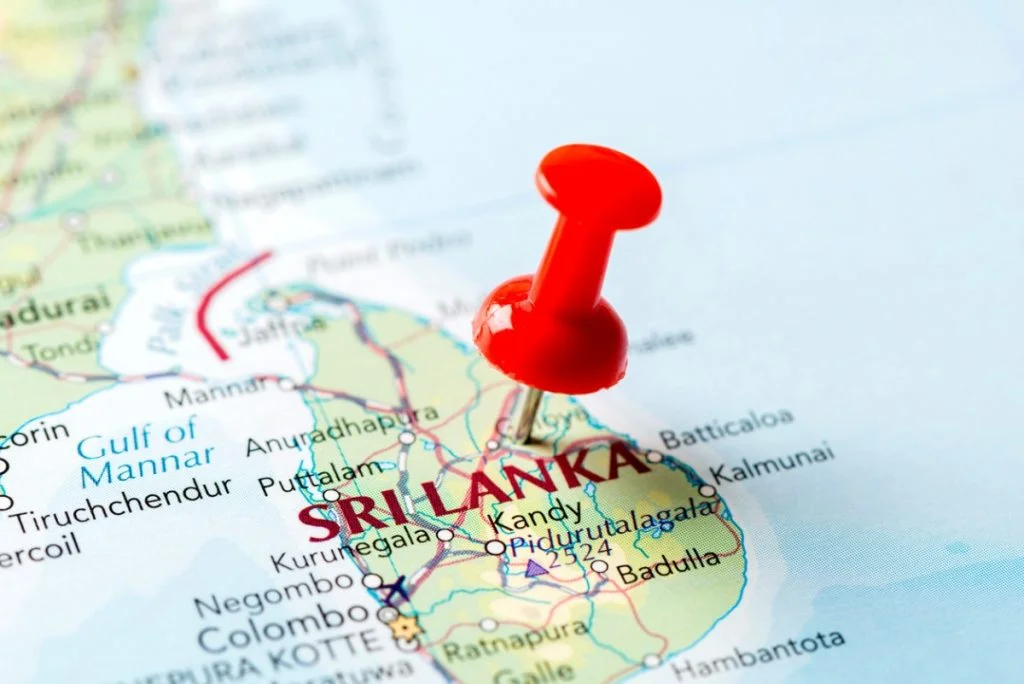
Sri Lanka occupies a strategically central position in the Indian Ocean, located near one of the world’s busiest maritime trade routes connecting the Middle East, South Asia, and East Asia. Its location, coupled with natural deep-water harbors and energy infrastructure, has attracted the attention of major powers, including China, India, the United States, Japan, and Australia. This article analyzes the geopolitical significance of Sri Lanka, the strategic interests of competing powers, and how the island navigates its external environment through multi-alignment and hedging, offering a concise overview of its maritime importance and implications for regional security and diplomacy.
Sri Lanka’s Strategic Geography
Sri Lanka’s geographic location is the foundation of its strategic relevance. Situated approximately 10 nautical miles south of India, the island lies near the main east-west maritime routes connecting the Strait of Malacca to the Suez Canal, through which a significant proportion of global seaborne oil trade passes. The strategic importance of this position is amplified by the island’s natural deep-water harbors, including Colombo, Hambantota, Trincomalee, and Kankesanthurai.
Colombo serves as South Asia’s primary transshipment hub, handling a significant portion of regional container traffic. Hambantota, developed under China’s Belt and Road Initiative (BRI), lies near major shipping lanes and has been leased to China Merchants Port Holdings, drawing international strategic attention. The Trincomalee Harbor, with its natural depth and shelter, has historically served as a major naval base and continues to hold strategic energy and security value. Kankesanthurai Harbor, located in northern Sri Lanka, enhances regional connectivity with India and serves as a potential logistics hub for maritime operations.
Beyond ports, energy infrastructure further enhances Sri Lanka’s strategic relevance. The Trincomalee oil tank farm, comprising nearly 100 storage tanks, provides critical petroleum storage capacity. The offshore exploration in the Mannar Basin and renewable energy development also contribute to Sri Lanka’s strategic calculus.
Competing Powers’ Interests.
Sri Lanka’s strategic location has attracted the attention of multiple external actors, each pursuing overlapping and sometimes competing objectives. China views Sri Lanka as a vital node in the Belt and Road Initiative. Investments in Hambantota Port and the Colombo Port City aim to facilitate trade, energy logistics, and regional influence. However, domestic, political, and economic factors in Sri Lanka shape outcomes as much as Chinese strategy.
India considers Sri Lanka central to its maritime security strategy under the MAHASAGAR (Mutual and Holistic Advancement for Security and Growth Across Regions) doctrine. India’s interests in Sri Lankan waters focuses on infrastructure development, energy cooperation in Trincomalee, and capacity-building at Kankesanthurai Harbor. Sri Lanka’s proximity to the Southern Indian coastline makes Sri Lanka highly sensitive to external influence, prompting New Delhi to maintain close security and economic ties.
The United States emphasizes a “free and open Indo-Pacific” in which maritime security, freedom of navigation, and rules-based order are priorities. While the U.S. does not maintain permanent bases in Sri Lanka, strategic dialogue, naval exercises, and port visits integrate Sri Lanka into a broader regional security planning.
Japan and Australia engage with Sri Lanka primarily through development assistance, maritime security cooperation, and regional connectivity initiatives. Japan’s free and open Indo-Pacific policy emphasizes, quality infrastructure and secure sea lanes, while Australia participates in maritime training and activities of the Indian Ocean Rim Association (IORA).
Collectively, these powers recognize Sri Lanka as a strategic hub where energy, trade, and naval considerations intersect. Their engagement reflects overlapping economic, strategic, and normative motivations, illustrating the complex multi-polar dynamics of the Indian Ocean Region.
Sri Lanka’s Strategic Choices
Despite external pressures, Sri Lanka demonstrates agency through multi-alignment and hedging strategies. Small-state theory suggests that strategically located states can leverage competition among larger powers to maintain autonomy and extract benefits. Sri Lanka engages multiple powers simultaneously, securing investment, infrastructure development, and maritime cooperation without formal military alignment.
Hedging is evident in its simultaneous engagement with China, India, the United States, Japan, and Australia. This approach mitigates dependence on any single actor while maintaining flexibility in foreign policy. Multi-alignment extends this logic, allowing Sri Lanka to balance economic development with geopolitical sovereignty. However, fiscal vulnerabilities, such as the 2022 balance-of-payments crisis, highlight the risks of overreliance on external financing, emphasizing the need for prudent governance in infrastructure agreements.
Infrastructure diplomacy is central to Sri Lanka’s strategy. Strategic ports, energy facilities, and connectivity projects serve dual purposes-facilitating economic development and signaling geopolitical relevance. By leveraging competition among major powers, Sri Lanka maximizes developmental and diplomatic returns while avoiding entanglement in direct conflict.
Implications for Regional Security
Sri Lanka’s geography and infrastructure influence broader regional security dynamics. The island contributes to maritime governance, monitoring Sea Lines of Communication (SLOCs), and non-traditional security initiatives, including disaster response and humanitarian logistics.
The strategic positioning of Sri Lanka’s ports and harbors affects perceptions of power projection in the Indian Ocean. While China’s presence is often scrutinized, coordinated infrastructure development, naval exercises, and multilateral cooperation demonstrate how Sri Lanka integrates into regional security architectures while maintaining neutrality.
Small State, Big Influence
Sri Lanka exemplifies how a small, strategically located state can influence regional geopolitics. Its geography, natural harbors, energy infrastructure, and multi-alignment strategy enhance its relevance in the Indian Ocean and Indo-Pacific. Competing powers, including China, India, the United States, Japan, and Australia, recognize the island as a critical node for maritime trade, energy logistics, and regional security. By carefully balancing engagement, hedging risks, and leveraging infrastructure diplomacy, Sri Lanka maximizes its strategic advantage while preserving autonomy. Its experience underscores the enduring importance of geography, infrastructure, and small-state agency in shaping regional geopolitics.
E. V. A. Dissanayake is an Independent Researcher from Sri Lanka. She is a Robert Bosche Stiftung Fellow and a Visiting Scholar of Columbia University, USA.