
30 August 2026, NIICE Commentary 12681
Kyle Dane Ballogan
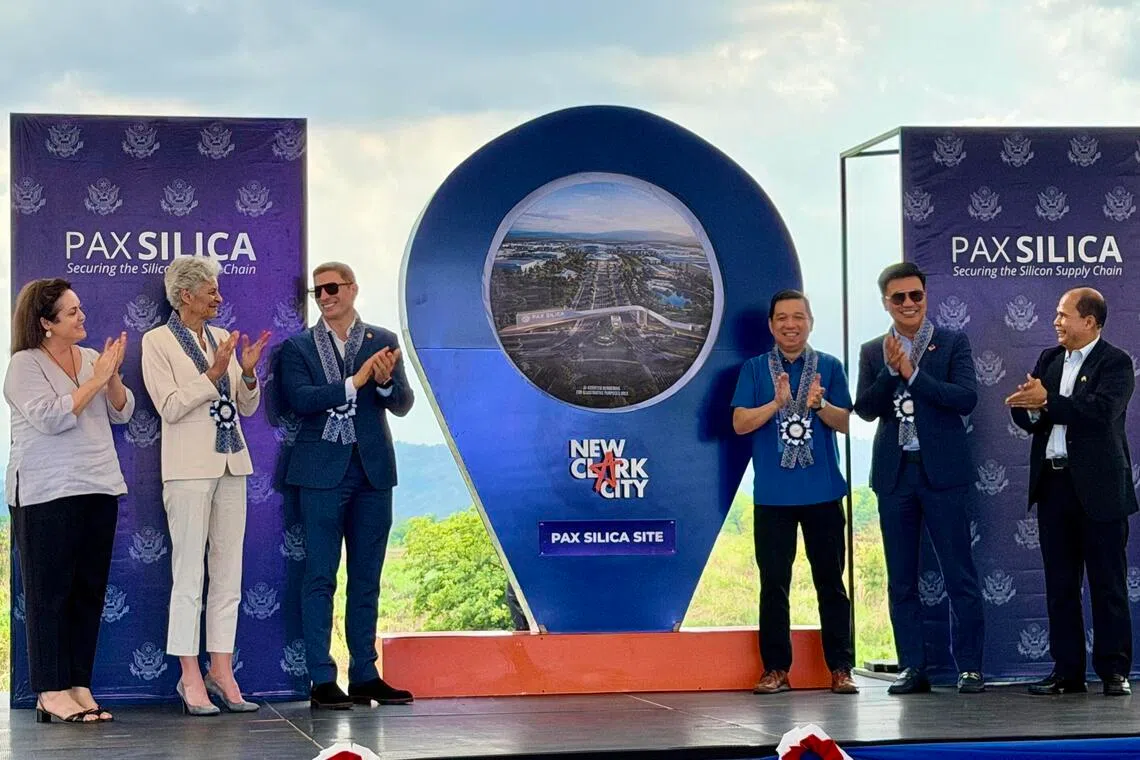
For many Filipino spectators, Pax Silica is simply a hub or a center that the government will erect to process chips and minerals. To many, it is an international investment initiative that will create tech jobs in the Philippines. Both are true, but may not be the whole story. Beyond the image of economic partnership and supply chain sits a broader contest over who gets to set the rules of AI and semiconductor order — and where the Philippines, as a frontline host rather than a mere signatory, actually sits within it.
According to the US State Department, Pax Silica is its flagship initiative “to build a secure, prosperous, and innovation-driven silicon supply chain—from critical minerals and energy inputs to advanced manufacturing, semiconductors, AI infrastructure, and logistics.” This will happen by uniting economies or countries with advanced tech companies and by establishing an “economic order”. Accordingly, it aims to (1) reduce excessive dependencies, (2) protect the materials and capabilities fundamental to AI, and (3) ensure aligned nations can develop and deploy transformative technologies at scale.
Since December 2025, the Pax Silica Declaration, the founding document of the initiative, has continuously gained supporting partners worldwide, with Australia, Israel, Japan, Singapore, South Korea, the UK, and the US as first signatories. To date, there are 24 total signatories composed of US-aligned and non-aligned market economies. The State Department further launched the Pax Silica Fund consisting of $250 million in foreign assistance funding, which the US Congress must still approve. The fund is expected “to catalyze trusted capital from large sovereign wealth and private sources … to build greater investments in supply chain security."
The Philippines Signed On
When the Philippines formally joined Pax Silica in April 2026, it did so on notably different terms. Unlike the other signatories who merely conform to the initiative, the US-Philippines participation is on a closer level. First, the two governments will jointly govern the development of a zone that will facilitate the initiative. Second, the two sides will also employ “enhanced operations” by pairing American expertise and finance with Filipino workforce, natural resources, and strategic location. Compared to other signatories, the US-Philippines has a more concrete role in Pax Silica, and they may need a binding obligation or formal trade agreement on that matter.
More reinforcing is that during his Presidential address, President Ferdinand Marcos Jr. already made a favorable statement on the initiative: that “it will bring quality jobs to our people, accelerate our industrial competitiveness, and revitalize our economy” and that it “will be an advanced manufacturing and logistics center in the global AI and technology value chain.” Therefore, the position of the Philippine government is unambiguous. Yet however unambiguous the government’s framing is, it only represents the domestic half of the picture. To digest what Pax Silica really means for the country, it helps to zoom out to the initiative's global design.
Beyond the Declaration
To be fair, US official statements, especially from Undersecretary Helberg, made it clear that "Pax Silica isn't primarily about China” and that the “aim is to safeguard … supply chains." As far as the Philippines is concerned, in his official visit to the Philippines, the Undersecretary leveraged the country for its workforce demographics, mineral resources, and alliance, making it fit for the hub. These statements guarantee the public that the initiative is not another sort of hostile warfare between two competing powers. One could even say that the fact that the State Department’s Economic Affairs organized the initiative rather than the Defense Department is conclusive of the prospects of the initiative for economic and industrial cooperation.
But is that really the full picture of the initiative? The wider prospects of the Pax Silica can be indicated through four key points:
- Membership: Judging from its member signatories, it is not difficult to understand where the initiative is heading. The initiative is composed of “trusted” “reliable” partners, which is a membership filter in itself. If trust is sacrosanct in the initiative, then it cannot include competitors such as China and Russia, who also do not trust the US.
- Agenda: While the Declaration avoids a confrontational tone, its strategic direction in mentioning “reliable supply chains”, “reduce excessive dependencies”, and “trustworthy systems” in tackling AI and supply chain security seems to exist because of China’s position on these markets and other countries' reliance on China. Speaking of reducing “excessive dependencies”, this strongly relates to the U.S.-China Economic and Security Review Commission’s findings on “Beijing’s Weaponization of Supply Chains”.
- China’s version: In July 2025, China announced its own World Artificial Intelligence Cooperation Organization (WAICO). In July 2026, China launched the organization as a “major move by China to answer the call of the Global South and unite the international community together to vigorously promote AI development and governance”. WAICO has signatories such as Russia, Cuba, and Venezuela, rarely from Pax Silica signatories (to date, only Kazakhstan has signed both). Expect these two clubs to unfold a messier reality on tech competition.
- The Philippine location: Of all qualified countries for a data center, the Philippines is chosen for a special reason–- not only is it an old ally of the US or because of Philippine natural resources, but also for its geopolitical convenience to balance the supply chain in front of China. The US knows that the Philippines has a strategic value it can’t get anywhere in the Indo-Pacific.
- The Designer: the initiative was designed by Undersecretary of State for Economic Affairs, Jacob Helberg. Based on his profile, he has knowledge and experience in technological warfare and geopolitics— he authored a book, The Wires of War; he served as an adviser at the Center on Geopolitics and Technology; he spent years leading Google's effort to combat disinformation; and he conceptualised China’s “civil-military fusion” in contrast to US’s “civil-military confusion”. Interestingly, he also offers a stronger technological control on China.
The overlap of these points, I believe, pinpoints a global race of who brings the most benefits and development in chips, minerals, data centers, and AI. This is a breakdown between US-led Pax Silica built on trustworthiness and resource partnerships, and the China-led WAICO built on development implementations in the Global South. Will this grouping with low-key competition be a boon or bane for the Philippines? Having laid out the global picture, here's what this initiative may mean for the Philippines.
Opportunities
Geoeconomic leverage: Through technology transfer (technical capacities and expertise) and harnessing the signatories of the Declaration (diversified investment resources), the Philippines would no doubt be able to upgrade its technological sector and regional positioning. Recall that in 2024, the Philippines’ Finance Secretary Ralph Recto underscored that “economic security for the Filipino people—which is a cornerstone of national security” [similar to Helberg’s “economic security is national security”] and that the Luzon Economic Corridor in the Philippines will be the first corridor in the Indo-Pacific that will attract jobs and investments in the region. In line with these prospects, Pax Silica can be the answer. It is a major leverage for the capitals of the signatories for innovations and adaptations that would lead to industrial upgrades and higher technological positioning in the region.
Leveling with the East Asian technohub: Despite Taiwan’s competitive edge in microchips and its giant Semiconductor Manufacturing Company (TSMC) making it a more fitting location for the hub, Taiwan and US carefully chose to be discreet about the initiative for geopolitical and sensitive security reasons with China.
Why does this matter for the Philippines? For the Philippines, which was given a special role in the initiative, optimists should view this as a new microchip or industrial opportunity in the global supply chain in complementarity with Taiwan, Japan, and South Korea, who are key players in the geopolitics of microchips and semiconductors. The Philippines should see hosting a hub like this as a privilege and unprecedented opportunity more than worrying about alignments and threats. This is about inserting the Philippines in the value chain by moving beyond low-value hosting roles.
As a high-exposure gamble, the Philippines may also have a chance to be a template to draw in other countries to participate (especially in Southeast Asia and the Global South) through the physical hub. It would have a chance to influence how countries position themselves in the US-China tech rivalry.
Costs
Having established the upside of the Philippines' frontline role, it's worth being equally open about what the costs can be.
Frontline state risk: The physical hub in the Philippines, with worldwide signatories, would make the country a target of adversarial attacks from any adversarial forces. Being the physical face of the initiative, the Philippines absorbs risks that the other signatories — whose contributions remain largely financial, policy alignment, or technological, rather than territorial — do not have to carry. The Philippines will serve as the frontline state that may bear cybersecurity attacks, supply route harassments, and economic coercion because it hosts a huge tech initiative that is international in nature.
However, this will still depend on the surrounding circumstances of the hub. Whether it functions as an ordinary manufacturing facility, stores sensitive data, or manufactures critical infrastructure, among other considerations.
Regulatory Blindspot: Additionally, the Philippines has yet to enact a national law that will regulate the use of AI. High-risks AI in the case of Pax Silica is an equally important concern when we talk of sensitive technologies and critical infrastructures. To date, the Philippine government has yet to tackle the risks of AI at home like other signatory countries did in the previous years. This makes the country vulnerable to institutional, opportunistic, and geopolitically motivated attacks. I dare say, the Philippines cannot delve into AI gains and opportunities without having a serious understanding of its risks and dangers.
The signatories of the Pax Silica clearly joined the initiative because they are countries who have comprehensive frameworks, strengthened their domestic controls on AI, and confident of their AI governance autonomy, only stacking it with international opportunities such as Pax Silica. The Philippines don’t have the two either. What is more in hosting a hub?
Joining while maintaining autonomy: While the Philippines remains a strong ally to the US and openly accepts a bigger role in the Pax Silica, it must also be ready to offer strong words on rule-making and distribution of development opportunities. Relatively, with the absence of a hard law to AI, Philippine Congress should wrap up a national AI law to solidify its AI governance stance and influence on the Pax Silica as a signatory. As a host, the Philippines should be fast in legalizing its national security oversight and data sovereignty within the LEC before the US Congress approves the Pax Silica Fund or before the signing of an agreement for the hub. The Congress should also review how a national AI law complements or contradicts with the initiative’s implementation. So there are calculations that the Philippine Congress needs to do in the interest of the country.
Should Congress fail to legislate a comprehensive AI law, President Marcos’ government must at least require that the initiative operating within its territory be auditable, explainable, and transparent. Overall, whether Pax Silica strengthens or weakens the geopolitical standing of the Philippines depends more on how Manila leverages its frontline role. Its supporters may market it as a neutral economic cooperation, but its architecture– who is in, who is out, and why- suggests future competing blocs. The Philippines has a serious task of converting its exposed frontline position into leverage before the initiative and the blocs mature into a deeper competition.
Kyle Dane Ballogan is a young political scientist from the Philippines. His writings and research interests focus on international relations, statecraft, and international law.
