
28 August 2026, NIICE Commentary 12677
Althea Rivera & Ralph Romulus Arias Frondoza
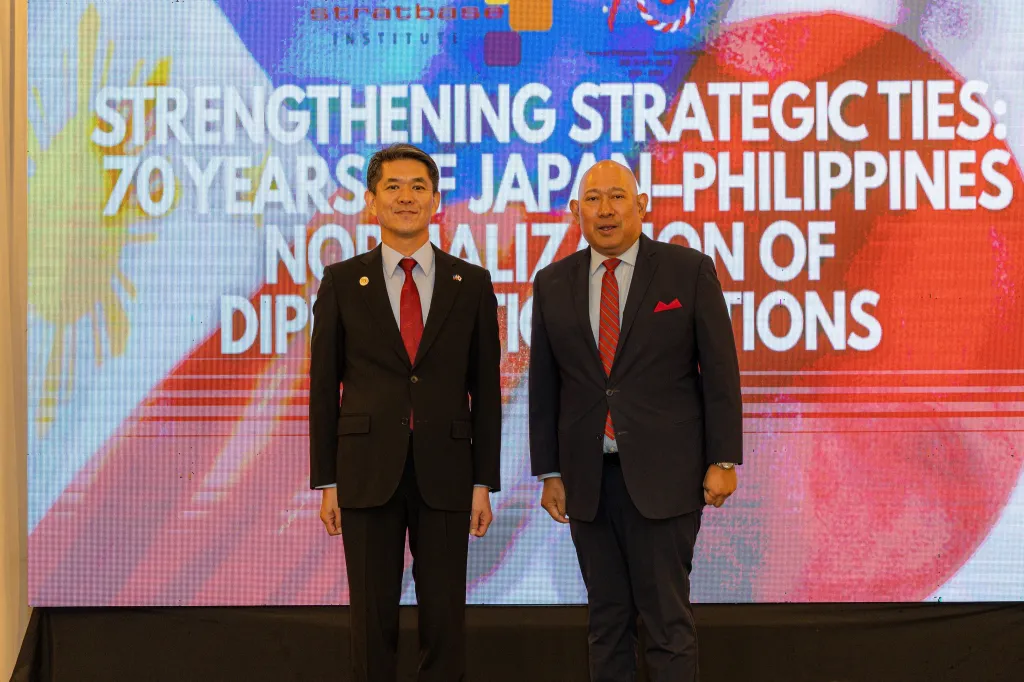
Last July 23, the Philippines and Japan commemorated the 70th anniversary of the normalization of diplomatic relations. The milestone is more than a celebration of seven decades of cooperation. It also marked a strategic inflection point. As geopolitical competition intensifies across the Indo-Pacific, the future of the partnership will depend not only on military capabilities or economic cooperation, but also on how regional actors perceive one another's intentions.
Much has changed since 1956. Japan has become one of the Philippines' most trusted strategic partners, supporting infrastructure development, maritime capacity-building, humanitarian assistance, and regional security initiatives. More recently, both countries have deepened defense cooperation through reciprocal access arrangements, intelligence exchanges, and coordination with other like-minded partners committed to a rules-based regional order.
These developments are often explained through the familiar language of deterrence, balancing, or alliance politics. Yet these frameworks capture only part of the picture. Equally important is the political psychology that shapes how states interpret each other's actions. Strategic decisions are never made in an emotional vacuum. They are filtered through historical memory, national identity, leadership perceptions, and domestic political narratives.
This psychological dimension is becoming increasingly significant as Manila and Tokyo strengthen their strategic partnership. For the Philippines, closer cooperation with Japan reflects a pragmatic response to an increasingly contested maritime environment. Shared concerns over coercive activities in the West Philippine Sea have reinforced the value of Japanese support in maritime domain awareness, coast guard modernization, and defense capacity-building. Japan's postwar identity as a responsible and largely restrained security actor has also made deeper cooperation politically acceptable both domestically and regionally.
Yet strategic alignment also introduces new policy challenges. As trilateral and minilateral security arrangements involving Japan, the Philippines, and other regional partners continue to expand, Manila must carefully manage the risks associated with strategic proximity. Stronger partnerships undoubtedly enhance deterrence, but they may also increase the Philippines' exposure to contingencies beyond its immediate national interests, particularly in relation to cross-Strait tensions. The central challenge is therefore not whether to strengthen alliances, but how to do so without sacrificing strategic flexibility.
Political psychology helps explain why these dynamics matter. Regional leaders do not simply evaluate military capabilities or legal arguments. They also interpret signals through deeply embedded historical experiences. National narratives influence how governments assess threats, assign intentions, and determine acceptable levels of risk.
China's interpretation of Japan's evolving defense posture illustrates this reality. Developments such as Tokyo's gradual relaxation of postwar security constraints or its expanding defense partnerships are not viewed solely through contemporary strategic calculations. They are also understood through the historical memory of Japanese imperial expansion and the enduring legacy of the Second World War. These historical experiences continue to shape Beijing's perception of vulnerability and influence how Chinese policymakers interpret Japanese security initiatives today.
Similarly, the Philippines' expanding partnership with Japan is not simply an exercise in external balancing. It also reflects a strategic calculation shaped by confidence in Japan's international identity. Decades of economic cooperation, development assistance, and consistent diplomatic engagement have fostered a level of trust that distinguishes Japan from other major powers operating in the region. This accumulated political capital enables closer cooperation without generating the same domestic sensitivities often associated with larger alliance relationships.
Taiwan likewise occupies an important psychological space within this evolving regional landscape. Its interest in maritime delimitation discussions reflects more than legal concerns; it also demonstrates how smaller actors seek reassurance that changing regional arrangements will not marginalize their strategic interests. The subsequent diplomatic assurances provided by both Tokyo and Manila illustrate the importance of perception management alongside formal negotiations.
These examples underscore a broader reality. Emotions such as trust, fear, pride, and historical grievance should not be dismissed as irrational influences on foreign policy. Rather, they shape how states define their interests, interpret ambiguity, and respond to perceived threats. Political psychology therefore complements traditional theories of international relations by helping explain why similar strategic actions can produce markedly different reactions among regional actors.
For Philippine policymakers, this insight carries practical implications. The Philippines should continue strengthening its strategic partnership with Japan while preserving sufficient strategic autonomy to maintain diplomatic flexibility. As an increasingly active middle power in the Indo-Pacific, Manila's comparative advantage lies not in choosing between competing blocs but in maintaining constructive relationships across multiple security and economic architectures. Strategic credibility will increasingly depend on the country's ability to deter coercion without appearing as merely an operational extension of broader great-power competition.
This balanced approach also serves Japan's long-term interests. A resilient partnership built on mutual trust, institutional cooperation, and respect for regional sensitivities is more sustainable than one driven solely by immediate security imperatives. As both countries navigate an increasingly complex Indo-Pacific, strategic reassurance will become just as important as strategic deterrence.
Seventy years after establishing diplomatic relations, the Philippines and Japan have built one of Asia's most durable bilateral partnerships. The next seventy years, however, will demand more than expanded defense cooperation or stronger economic ties. They will require policymakers to recognize that the Indo-Pacific is shaped not only by material power but also by perceptions, identities, and historical memory. Successful statecraft in this century will belong to those who can manage both.
Althea Rivera is Non-Resident Fellow of the International Development and Security Cooperation (IDSC) specializing in Philippine and Japan Studies and Political Psychology of state leaders & Ralph Romulus Arias Frondoza is the International Development and Security Cooperation (IDSC) Vice President and Non-resident fellow, specializing in geoeconomics, strategic risk, and critical and emerging technologies.
