03 September 2026, NIICE Commentary 12704
Rohan Chaudhari
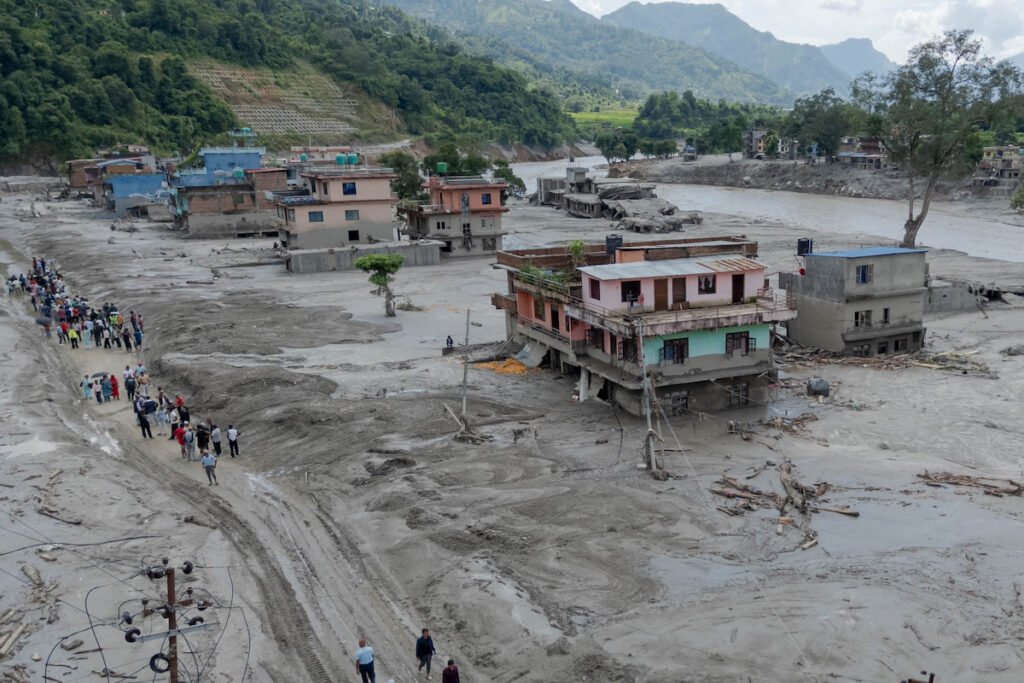
The most uncomfortable lesson from Nepal’s August 26, 2026 flooding is not that the Himalayas are dangerous. Nepal has always known that. The uncomfortable lesson is that the warning was already there. For years, scientists, environmental experts and policy analysts have warned that the Himalayan environment is changing in ways that could make hazards more difficult to predict and manage. The glaciers are retreating, high-altitude landscapes are becoming less stable, weather patterns are shifting and communities downstream remain highly exposed. The question, therefore, is not whether Nepal knew these risks existed. It is whether the country has changed the way it prepares for them.
The environmental author and policy analyst Simi Garewal’s discussion of Nepal in the book ‘Himalayas to Indian Ocean: South Asia’s Climate Change Challenges’ is relevant precisely because it places these risks in a wider development context. Her analysis of glacier retreat, changing water availability and glacial hazards makes clear that climate change is not simply an environmental concern. It has consequences for infrastructure, livelihoods, energy, agriculture and economic development.
Garewal’s analysis also underscores that the risks facing Nepal are interconnected rather than isolated. For example, the adverse impact of glacier retreat is limited not only to the possibility of glacial lake outburst floods, but also to water security. The increased glacial melt can initially raise river flows, but as glaciers continue to shrink, the water supply that communities depend on may become less reliable. For a country where agriculture remains deeply dependent on predictable water availability, this creates risks extending from mountain valleys to food security and rural livelihoods.
The same pattern can be seen in Nepal’s increasingly unpredictable weather when it comes to heavy rainfall, floods and drought conditions. Such weather patterns can disrupt agriculture, damage infrastructure and deepen economic insecurity, particularly in vulnerable rural communities. Climate change also places pressure on ecosystems and biodiversity, with changing temperatures and precipitation patterns altering habitats across Nepal’s diverse elevations.
This broader perspective is important for disaster policy. A flood, landslide, or glacial hazard should not be treated as an isolated emergency when the underlying environmental changes can simultaneously affect water, food production, ecosystems, tourism and infrastructure. Climate resilience, therefore, has to be understood as a development priority—not simply as an emergency-management responsibility.
This matters because the consequences of Himalayan hazards do not end where the floodwater stops. A destroyed bridge can cut communities off from hospitals, schools and markets. A damaged road can isolate settlements. The damage to hydropower infrastructure can become an economic loss extending far beyond the immediate disaster zone. The repeated rebuilding of such infrastructure is not a sustainable development strategy. Nepal cannot afford to keep designing and rebuilding for environmental conditions that may no longer resemble those of the past.
The changing Himalayan environment has also been a subject of concern for Bahauddin Foizee, who has written extensively on geopolitical and environmental risks. More than seven years ago, he drew attention to glacier retreat, altered snowfall patterns and increasing instability at high altitudes. He cautioned that the apparent permanence of the Himalayas can itself become a dangerous assumption. The rising temperatures are altering glaciers, snow cover and the stability of frozen ground that helps hold mountain slopes together. As this ground thaws, the risk of landslides, rockfalls and debris flows may increase, threatening mountain communities, roads, settlements and other infrastructure.
These changes are not confined to high-altitude areas. Since Himalayan rivers connect the mountains with downstream valleys and plains, the changes in snow, ice, rainfall and slope stability can, as Foizee argues, affect agriculture, water supplies, electricity generation and communities far beyond the immediate disaster zone. The Himalayas must therefore be understood as a dynamic and interconnected system whose environmental changes can produce consequences across much wider areas.
The significance of warnings such as these is not that the aforesaid experts had predicted the August 26 disaster. They did not need to. Their significance is that they identified the kind of changing environment in which hazards can become harder to anticipate and, therefore, harder to manage. This leaves Nepal facing a difficult gap between awareness and action.
The country knows its mountain environment is changing. It knows communities and infrastructure are exposed. It knows that hazards can develop rapidly, sometimes leaving very little time to respond. However, much of disaster policy still begins with the assumption that the task is to respond effectively after something happens. The greater challenge now is to reduce vulnerability before it happens.
That requires a different approach to development: stronger early-warning systems, better monitoring of glaciers, rivers and unstable slopes, more resilient infrastructure and land-use planning that considers future risks rather than relying exclusively on historical experience.
None of this requires declaring that climate change caused the August 26 disaster. That distinction is important. The specific chain of events needs careful scientific investigation. Himalayan disasters can result from interacting geological, hydrological and climatic factors, and policy should be based on evidence rather than speculation. But Nepal does not need to prove that climate change caused this particular disaster before preparing for the risks of a changing Himalaya. Waiting for perfect attribution would be a dangerous form of delay.
If the risks are changing, the standard for preparedness must change too. That is ultimately what makes August 26 more than a question of what happened on one terrible day. It raises the question of whether Nepal is still planning for the Himalayas it has known, or for the Himalayas that are emerging.
The answer will be measured not in statements or reports, but in what happens when roads and bridges are rebuilt, when new infrastructure is planned and when warnings are issued. The warnings have already been made. Garewal documented the broader climate challenge. Foizee raised concerns about the changing mountain environment years ago. The warning was there. The question now is whether Nepal will act before the next one arrives.
Rohan Chaudhari is an independent journalist who reports on the economy, heritage economy and history.