01 July 2026, NIICE Commentary 12594
Indrajeet Shukla & Meher Pandit
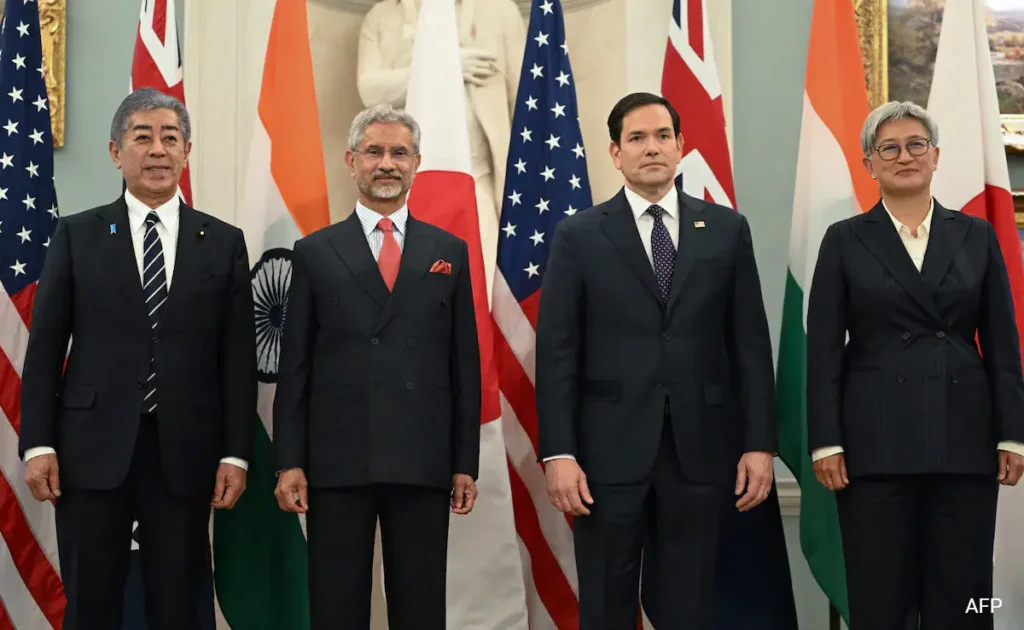
In an era marked by geopolitical tensions, technological advancement, and an energy crisis, the Quad has emerged as one of the strategic groupings in the world. On May 26 2026, the 11th Quad’s foreign ministers meeting was hosted in New Delhi, India. In the meeting, they have discussed the West Asia crisis, South China Sea dispute, denuclearisation of North Korea, Myanmar conflict, and reaffirmed their aim of a free, open, and inclusive Indo-Pacific. The Quad remains committed to working with regional partners by strengthening its partnership with ASEAN. It highlighted the four pillars of the Indo-Pacific, which include the maritime domain, transnational security, and practical initiatives to counter challenges.
Quad establishes the sovereignty of the Indo-Pacific region and increases the surveillance capabilities facilitated through proactive measures. The Indo-Pacific Maritime Domain Awareness (IPMDA) initiative addresses issues such as drug trafficking, identifying shadow fleets, and enforcing maritime laws. The development in maritime domain awareness includes initiatives such as live data sharing, quad-at-sea ship observer mission, 5G, 6G, AI, pax silica, surveillance, and CTWG. Furthermore, Quad recognises that digital resilience is critical to national security and is working on Internet connectivity and resilience by protecting the undersea cable infrastructure, which is the backbone of digital communication. Now the question arises: How can India leverage the emerging geopolitical landscape? What does the future hold for Quad?
The Neorealist Mechanics of Quad Minilateralism
To understand the rapid evolution of the Quad and India’s strategic behavior within it, policymakers and analysts must look through the lens of International Relations theory, specifically Neorealism (Structural Realism), as formulated by Kenneth Waltz. Neorealism posits that the international system is fundamentally anarchic, lacking a centralized global authority. Consequently, states are rational actors driven by a struggle for survival, security, and the accumulation of relative power. Within this framework, the emergence of the Quad is not merely a product of shared democratic values, but a structural response to a shifting balance of power caused by China’s rapid material and military expansion in the Indo-Pacific.
From a Neorealist perspective, the Quad represents a highly sophisticated mechanism for external balancing. In a multipolar or transitioning system, states avoid rigid, binding bilateral military alliances that might drag them into unwanted conflicts or compromise their sovereignty. Instead, they form flexible minilateral groupings. Through the Quad, India engages in balancing behavior to offset regional asymmetries while maximizing its own capabilities. By focusing on “collaborative resilience,” India uses the material wealth, satellite data, and technological edges of the U.S., Japan, and Australia to boost its own defense power without entering a formal defense pact. This allows New Delhi to manage systemic threats while preserving its independent foreign policy.
India’s Strategic Leverage within the Quad Framework
For India, the Indo-Pacific region is a regional security complex where the security of one state is interlinked with its neighbors; having an isolationist policy will not help. This explains the “spillover effect”, where the instability in the Afghanistan-Pakistan border can reach the maritime of Southeast Asia. This challenge can be tackled through a “multi-aligned” foreign policy.
Terrorism is the major emerging threat in the Indo-Pacific region; it requires a collaborative effort rather than a traditional military standoff. Quad strictly condemns terrorism in all forms of its manifestation. In the recent meeting, they talked about the Pahalgam attack and the boondi beach attack (Australia), addressing the non-traditional security threat. In the 21st century, networks of terrorism have undergone a major metamorphosis with an increase in digital connectivity and technology. Terrorism has a multidimensional effect; it has an impact on economic stability, public psychology, infrastructure damage, and political instability. There are various causes of terrorist attacks, for example, they can originate from ethno-nationalist movements or transnational terrorist groups like ISIS, or state-sponsored terrorism using these attacks as a proxy war. Countries that are highly affected by terrorism are in the Southeast Asia region.
The joint statement released from the Quad foreign ministers’ meeting in New Delhi emphasised the operational role of India in the Indian Ocean region through the Quad. The CTWG of the Quad initiative complements the “PRAHAAR” domestic strategy of India to counter terrorism on the national level. For India, this mechanism provides high-grade intelligence, which helps to strengthen the national security while maintaining regional stability. This diplomatic partnership works on countering the unmanned aerial vehicles (UAVs), terror funding, and digital extremism through CTWG ( counterterrorism working groups). The CTWG is vital for India as it provides a platform for highlighting the menace of cross-border terrorism, aligning with the USA, Japan, and Australia.
The evolution of the Quad presents India with significant strategic opportunities. More importantly, it allows New Delhi to transform its geographical advantages into geopolitical influence. India’s location at the centre of the Indian Ocean gives it a unique position in securing critical sea lanes that connect the Middle East, Africa, and East Asia. As global strategic competition intensifies and the United States increasingly balances commitments in Europe and West Asia, India is well-positioned to emerge as the principal net security provider in the Indian Ocean Region.
The concept of India as a net security provider has gained increasing relevance over the past decade. Through humanitarian assistance, disaster relief operations, anti-piracy missions, and maritime capacity building, India has demonstrated its willingness to contribute to regional stability. The Quad further strengthens these capabilities by providing access to advanced technologies, intelligence-sharing mechanisms, and defence cooperation frameworks. Defence and technology partnerships with the Quad nations provide India with strategic advantages, and such cooperation enhances India’s ability to respond to both conventional and non-traditional security challenges. India’s maritime diplomacy has also acquired greater significance. Through initiatives such as MAHASAGAR (Mutual and Holistic Advancement for Security and Growth for All in the Region), the Indo-Pacific Oceans Initiative, and increasing engagement with island nations, New Delhi seeks to build an inclusive and cooperative regional order. The Quad complements these efforts by strengthening India’s diplomatic outreach and expanding opportunities for regional capacity building.
Equally important, the Quad enables India to pursue its strategy of multi-alignment while preserving strategic autonomy. Unlike formal military alliances, the grouping allows New Delhi to engage with like-minded democracies without compromising its independent foreign policy. This flexibility represents one of the greatest strengths of India’s approach to contemporary geopolitics. As the strategic center of gravity shifts towards the Indo-Pacific, India possesses the potential to become the physical anchor of the region, a pivotal actor capable of connecting technological capabilities, maritime security, and regional diplomacy. At the same time, this collaborative, multilateral approach helps ensure that the broader Indo-Pacific remains stable, rules-based, and genuinely multipolar, balancing great power competition with inclusive regional growth.
Way forward
Non-traditional security threat like terrorism requires an integrated response of hard security and soft prevention policies, mitigating terrorism through preventing funding and social de-radicalisation. This aims at preventing the vulnerable population from getting involved in terrorism and reversing the radicalisation that happened through social media. Furthermore, the expansion of the Quad and collaboration with ASEAN can increase its effectiveness, with engagements with countries like Indonesia and Vietnam. Quad will be able to influence a wider range of areas, which will allow India to strategically influence and promote regional solidarity.
It also needs to automate its new Indo-Pacific Maritime Surveillance Collaboration (IPMSC). By using AI to combine U.S. satellite data with commercial tracking at India’s maritime hubs, member countries can share a live, accurate map of the oceans. This makes it easy for coast guards to spot and stop shadow fleets, drug traffickers, and arms smugglers instantly and secure the maritime security architecture. Additionally, India should upgrade its domestic anti-terrorism strategy, PRAHAAR, by embedding advanced digital tracking capabilities. This will empower the government to intercept and freeze illicit cryptocurrency and dark-web transactions, effectively cutting off financial lifelines before they reach terror networks.
In a global environment shaped by systemic rivalry and rapid technological change, the Quad has cemented its position as a central pillar of regional stability. It not only aims to ensure a free, open, and inclusive Indo-Pacific but also to make the region stable. For India, this structure serves as a massive geopolitical asset where major powers, the US and China, are striving for greater assertion in the Indo-Pacific. The Quad’s focus on maritime security, counter-terrorism, and digital resilience aligns with India’s strategic interests and complements the domestic security policy. Through the Quad, India leverages its geographical advantages to become a net security provider in the Indian Ocean region, enhancing its defence capabilities and regional influence while preserving its strategic autonomy. Quad also tackles futuristic challenges, for example, the AI monitoring and networking, which serves as a critical component for globalisation. It reinforces India’s role as the indispensable physical anchor of the Indian Ocean, ensuring a free, open, and secure maritime order for the future. In conclusion, Quad is moving towards a resilient Indo-Pacific by protecting and promoting its sovereignty.