
15 January 2025, NIICE Commentary 12252
E. V. A. Dissanayake
The visit of German Federal Chancellor Friedrich Merz to India on January 12–13, 2026, took place against an unusually unsettled global backdrop. Europe remains deeply affected by the Ukraine–Russia war, transatlantic relations continue to experience uncertainty following shifts in U.S. domestic politics, and global supply chains are under strain amid rising geopolitical fragmentation.
Within this context, Berlin’s engagement with New Delhi reflects more than routine diplomacy. It represents Germany’s quest for strategic anchors—reliable partners that can provide economic resilience, technological cooperation, and geopolitical balance in an increasingly turbulent international system.
Chancellor Merz’s visit, his first to India and among his earliest high-level engagements outside Europe and the United States, underscored the priority Germany attaches to India in its evolving foreign policy calculus. Chancellor Merz’s leadership marks a distinct departure from the cautious Zeitenwende era of his predecessor, ushering in a more business-centric and security-focused approach to foreign policy. By prioritizing transactional pragmatism over purely value-driven diplomacy, Berlin is now signaling a greater willingness to engage in high-stakes defense and technological transfers with India.
Accompanied by senior ministers and business leaders, the Chancellor’s itinerary blended symbolic gestures—such as visits to Sabarmati Ashram and Dandi Kutir—with substantive discussions on trade, defense, technology, and global governance. This combination highlighted Germany’s intent to deepen a long-term partnership with India while navigating an increasingly multipolar world.
Economic and Technological Anchors in Germany–India Relations
Economic imperatives lie at the core of Germany’s strategic engagement with India. As Europe’s largest economy, Germany has faced prolonged stagnation since the outbreak of the Ukraine war, compounded by energy disruptions and declining competitiveness in key manufacturing sectors. At the same time, Berlin has sought to reduce excessive dependence on China through a diversification strategy often described as 'China plus one' or 'China plus X'.
India figures prominently in this diversification effort. Bilateral trade between India and Germany crossed USD50 billion in 2024–25, making Germany India’s largest trading partner within the European Union. During the Chancellor's visit, the two countries announced multiple agreements and joint declarations covering semiconductors, critical minerals, the bio-economy, digital cooperation, and advanced manufacturing. These initiatives aim to strengthen supply-chain resilience and reduce vulnerabilities arising from geopolitical shocks.
Support for the long-pending India–EU Free Trade Agreement (FTA) also featured prominently. Germany has consistently advocated for the deal, viewing India’s expanding market as an important destination for German exports and investment. For India, closer economic ties with Germany offer access to advanced technologies, capital, and European markets. This mutual economic logic positions India as a stabilizing economic anchor for Germany at a time when traditional trade relationships are increasingly uncertain.
Defense, Security, and Strategic Convergence
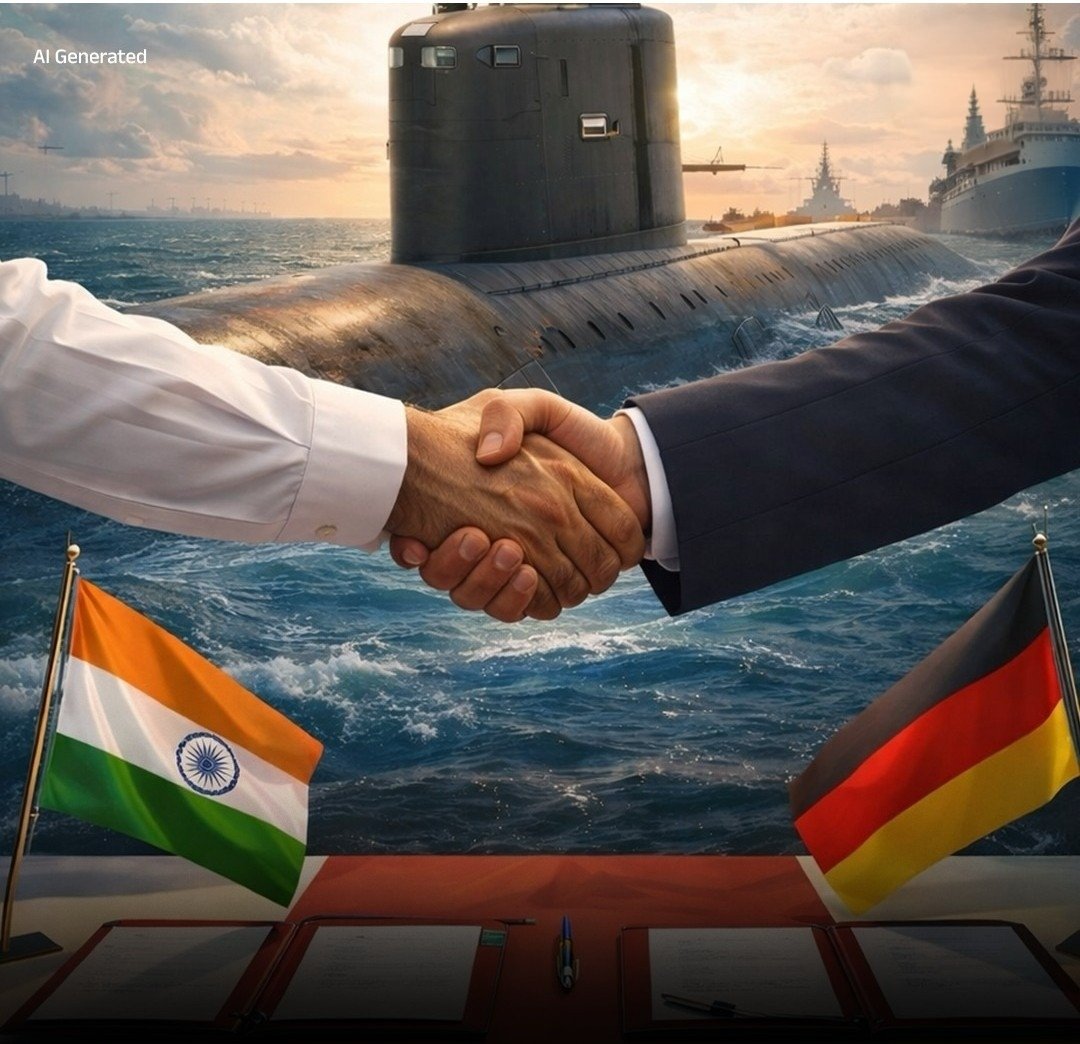
Beyond economics, defense and security cooperation emerged as a significant component of the German Chancellor's engagement with India. The visit resulted in a Defense Industrial Cooperation Roadmap, designed to promote joint production, technology partnerships, and collaboration in defense equipment. Discussions also continued on India’s proposed acquisition of six next-generation submarines from Germany, a deal estimated at approximately USD 8 billion, which would mark one of the most substantial defense partnerships between the two countries to date.
While Germany and India do not share identical threat perceptions, there is growing convergence on the need to uphold a rules-based international order, maritime security, and freedom of navigation. Germany’s interest in the Indo-Pacific has increased in recent years, even as Berlin maintains substantial economic ties with China. India, for its part, values diversified defense partnerships that enhance its strategic autonomy. At the same time, differences persist, particularly regarding the Ukraine conflict and India’s continued defense and energy engagement with Russia.
During the visit, German remarks suggesting that closer defense ties could reduce India’s reliance on Russian hardware were publicly clarified by Indian officials, reaffirming New Delhi’s independent foreign policy stance. These divergences illustrate that Germany’s quest for strategic anchors in India is pragmatic rather than ideological, focused on cooperation where interests overlap rather than full alignment.
Human Capital, Mobility, and Long-Term Strategic Depth
One of the less visible but strategically significant pillars of Germany–India relations is cooperation in human capital and mobility. Germany faces acute demographic challenges, including labor shortages in engineering, healthcare, and advanced manufacturing. India’s large pool of skilled professionals and students has therefore become increasingly important to Germany’s economic future.
The Migration and Mobility Partnership Agreement (MMPA), signed in 2022, established formal pathways for Indian students, researchers, and skilled workers to live and work in Germany (MEA, 2026). As of 2025, more than 60,000 Indian students were enrolled in German universities, making India one of the largest sources of international students in the country. Indians are also among the largest beneficiaries of Germany’s EU Blue Card scheme for highly skilled professionals.
During his visit, Chancellor Merz explicitly acknowledged the contribution of Indian talent to Germany’s economy, noting that many German companies depend on Indian skilled workers and innovation. These mobility frameworks enhance not only Germany’s economic resilience but also the long-term societal and people-to-people foundations of the bilateral relationship, reinforcing India’s role as a strategic anchor beyond traditional diplomacy.
India, Strategic Autonomy, and Global Governance
India’s appeal as a strategic partner for Germany lies significantly in its strategic autonomy. Unlike treaty-bound alliances, India maintains balanced relations across major power centers, including the United States, Russia, and Europe. For Germany, this autonomy enhances India’s value as a stable interlocutor in an era of geopolitical polarization.
During Chancellor Merz’s visit, both nations emphasized shared interests in reforming global governance institutions, particularly the United Nations Security Council, which they view as insufficiently representative of contemporary power realities. Germany’s support for India’s greater role in global decision-making aligns with its broader vision of a multipolar, rules-based international system.
Nevertheless, limits to convergence remain evident. Germany’s continued economic dependence on China - its largest trading partner with bilateral trade exceeding USD280 billion - highlights the constraints of diversification. Additionally, unresolved bilateral issues, such as the Ariha Shah Child custody case, underscore the need for sustained diplomatic engagement beyond strategic declarations.
Furthermore, Germany’s strategic pivot toward India is likely to have a stabilizing effect on the broader South Asian region, offering a European alternative to existing regional power dynamics. By strengthening this axis, both nations are positioning themselves as a bridge between the West and the Global South, championing a multipolar order that emphasizes economic resilience over geopolitical confrontation.
Anchoring Strategy in an Unsettled World
Chancellor Friedrich Merz’s visit to India reflects Germany’s deliberate effort to anchor its strategic interests in a world marked by uncertainty, economic disruption, and geopolitical flux. The Diplomatic discussions that encompassed trade diversification, defense cooperation, human capital mobility, and shared perspectives on global governance, signaled strengthened relations.
While Germany and India do not align on all international issues, their partnership is increasingly defined by pragmatic convergence rather than ideological conformity. Whereas for Germany, India represents a stabilizing partner capable of supporting economic resilience, technological advancement, and strategic balance in Asia, and a deeper engagement with Germany strengthens India's ties with Europe while preserving strategic autonomy. In this sense, Germany’s quest for strategic anchors does not seek certainty through alliances alone, but through durable partnerships capable of withstanding turbulence in the international order.
E. V. A. Dissanayake is an Independent Researcher from Sri Lanka. She is a Robert Bosche Stiftung Fellow and a Visiting Scholar of Columbia University, USA.
