
Ranjit Rae (2025), Shared Bonds, Strategic Interests: India-Nepal Relationship in a Turbulent World. Simon and Schuster India.
Sidhant Kumar
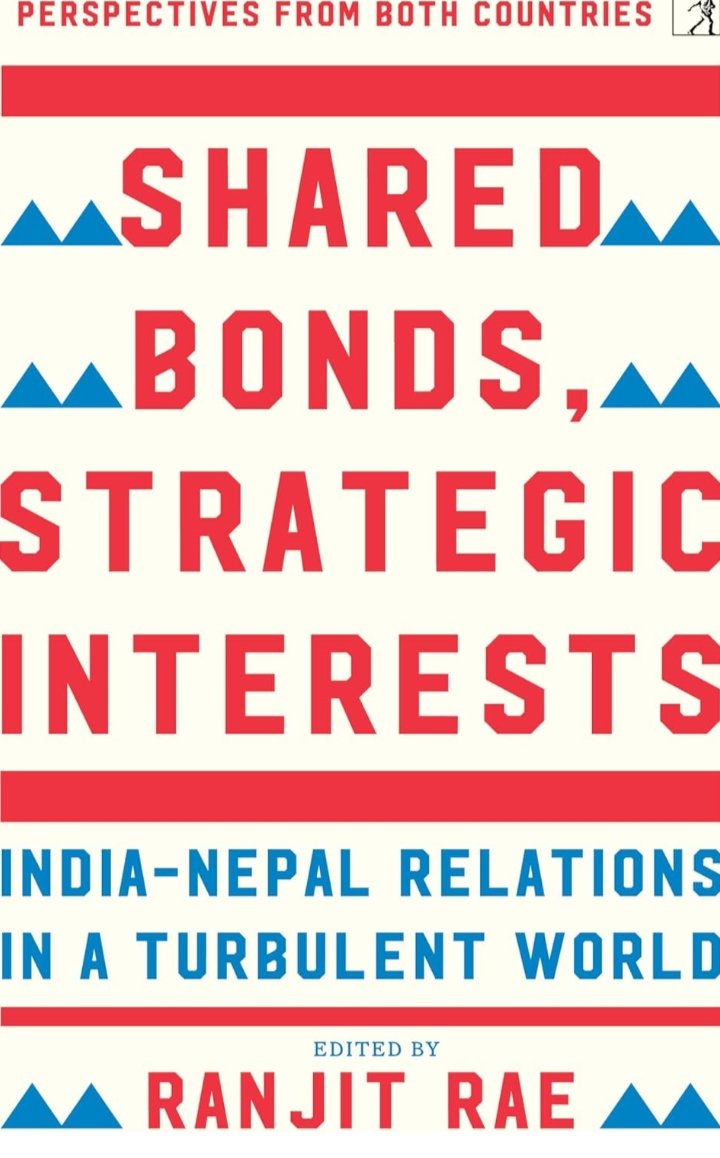 India-Nepal relationship is age-old, and encompasses several areas due to its cultural and geographical affinities. The relationship is also complex due to several constant flashpoints, including misinterpretations of the open border, India’s influential role in Nepal, and the consequent anti-India sentiments in Nepal, as well as border disputes. The book under review seeks to “reprioritise” the relationship by focusing upon key areas of potential mutual benefit, including enhancing cultural connectivity and economic interdependence.
The book’s editor, Ambassador Ranjit Rae, who has served as the ambassador of India to Nepal, wrote that the book does not want to be just another book on the India-Nepal bilateral relationship. Amb. Rae’s emphasis is on identifying areas and strategies where the India-Nepal relationship can be strengthened. In doing so, the edited volume provides strategies from both Indian and Nepali authors, which are relevant for policymakers and India-Nepal enthusiasts to strengthen the relationship. Primarily, moving away from the predominant state-to-state relationship, the chapters underpin cross-border communities, their interrelated practices, soft issues of interactions such as Bollywood and student exchanges and hydropower and energy potential in the region.
In the past, the India-Nepal relationship has been overshadowed by state-dominant interests of securing neat sovereign boundaries. But the communities at the India-Nepal border defy these neat sovereign spaces and transcend them by the everyday movement of people and goods. For instance, the book highlights how the Rung community living at the interstices of the Mahakali river valley navigate the border permits and exchange goods such as honey from Nepal to the Rung people.
Likewise, the religious sites located at the India-Nepal border that are common and shared among both the people of India and Nepal have been the linchpin of civilisational linkages. Sites such as Janakpur, where devotees descend regularly, generate inter-cultural understanding, and a Janakpur-Ayodhya circuit focused on Hindu pilgrimage would go a long way in bolstering the India-Nepal relationship. Prime Minister Narendra Modi has strongly emphasised these religious sites. Here, it is important to note that these religious sites are susceptible to engineering by groups that control the State for its own electoral benefits.
Nepali-speaking inhabitants of Sikkim, Darjeeling and Siliguri are the closest example of the civilizational linkage between India and Nepal. The inhabitants of this region have been the active carriers of the Indian and Nepal heritage. However, in a multi-ethnic society of India, the Nepali-speaking inhabitants have felt estranged by state authorities due to their closeness and racial similarity with the Nepalese.
In the vein of thinking beyond obsessive sovereign boundaries, the book also calls for looking at the Himalayas as a single space where religions like Buddhism, Hinduism, Jainism and so on flourished. In fact, the climate change challenges facing the Himalayas are far-reaching and impact the inhabitants both in the hills and plains. This requires considering the Himalayas as a holistic space of state cooperation and a melting pot of communities and cultures.
Yet, the Himalayas have been susceptible to geopolitical competition by big powers. For statesmen of India, the Himalayan state of Nepal has been represented as a “frontier” against foreign powers, to be defended and secured. The US sees Nepal in their larger Indo-Pacific vision of a free and liberal democratic order and provides assistance to build liberal-democratic institutions. However, this is being threatened by the US President Donald Trump’s protectionist policies. The book's chapters on geopolitics would have benefited from including the impact of Trump’s protectionist policies and the cancellation of US-AID projects in Nepal. Whereas China is interested in seeking influence to cease Tibetan dissident activities and expand its regional economic vision through the Belt and Road Initiative. Chinese investments in Nepal are also booming, and they have been interested in investing in youth and soft power. This presents a challenge as well as an opportunity for India to raise its investments in Nepal.
Most importantly, the book chapters highlight that the cornerstone of the India-Nepal relationship is economic interdependence. Nepal is still heavily dependent upon India for most of its trade and goods, yet it has a lot to offer. Nepal has surplus electricity that India is buying and exporting to Bangladesh and Southeast Asia. A free market and favourable trade regimes, as well as regulation, would bring prosperity to this rather impoverished region and enhance connectivity. Strides have been made in railway connectivity and high-power transmission lines for electricity, but there is still a long way to go.
Bollywood is the quintessential bridge in India-Nepal relations. Due to Bollywood songs, movies and TV soap operas, almost everyone in Nepal can speak Hindi. One of the chapters in the book argues that there is a need for collaboration between Bollywood and Nepali cinema through the exchange of artists, co-production of films and non-racial representation of Nepalis in Bollywood. Almost 40% of Nepal’s population is between the ages of 16 and 40. This age group is aspirational and was represented in the protests of September 2025. Tapping this through student exchanges and scholarships provides great dividends for both India and Nepal.
Furthermore, of all countries in South Asia, the Indian and Nepali armies have shared a greater understanding due to the recruitment of Gorkhas in the Indian army. Several ex-Gorkha recruits’ families in Nepal rely on the pension of the Indian army. The book sheds light on Indian and Nepali armies' collaboration in several spheres, including intelligence sharing, joint exercises and disaster mitigation. However, more recently, with the Agniveer scheme, the recruitment of Gorkhas has been stopped. The recruitment of Gorkhas has become a thorny issue, and there is a lack of political willingness to resolve this issue. In addition, there is an interesting personal recollection by an ex-Lt. General of the Indian army on disaster relief measures carried out by the Indian army as part of Operation Maitri during the 2015 earthquakes in Nepal.
To sum up the edited book, packs a lot, and has been compiled with great intent to “repriotise” and mend the India-Nepal relationship. The readers will benefit from the multifarious lens that this book navigates through, and it has interesting personal anecdotes from the authors. The language of the book is lucid and will become a tour de force on understanding the India-Nepal relationship.
Sidhant Kumar is a Visiting Fellow at NIICE and a PhD Candidate at Jawaharlal Nehru University, New Delhi, India.
