
9 January 2025, NIICE Commentary 12238
Reeba Khan
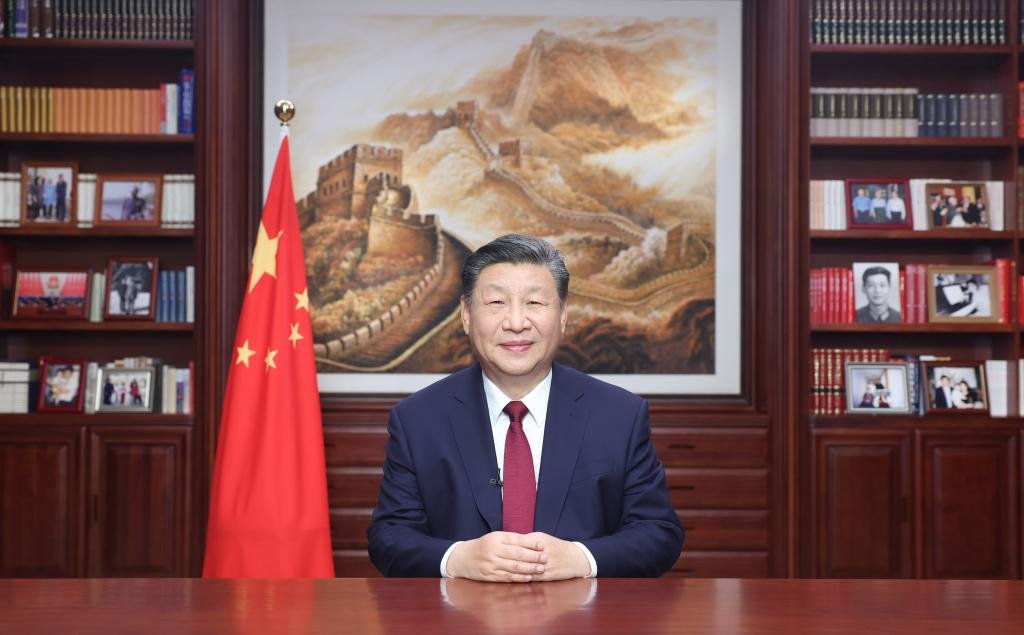
As the eve of 31st December set in, President Xi Jinping sent his wishes all across China from Beijing. President Xi’s 2026 New Year's Address touched on several achievements of the People's Republic of China in 2025. As 2025 marked the conclusion of the 14th Five-Year Plan (2021-2025), Xi highlighted the framework and praised the economic and social stability achieved by the 14th Five-Year Plan, which he defined as a solid foundation in hopes of building a path to Chinese Modernization. As Xi praised the economic output, he anticipated that the Chinese economy would reach RMB 140 trillion yuan(approximately 19.65 trillion USD). “Our economic strength, scientific and technological abilities, defence capabilities, and composite national strength all reached new heights.” President Xi continued to highlight the recent achievements and thanked the Chinese people for their efforts, which resulted in five prosperous years for the PRC.
“Unstoppable” Reunification Goal
Xi’s assertive statement, “The reunification of our motherland, a trend of the times, is unstoppable.” Sparked a trigger as his address comes just after an intense military drill around Taiwan. On 29th-30th December 2025, China’s People’s Liberation Army launched live-fire military drills around Taiwan, simulating a blockade of main ports and sending its navy, air force, rocket force, and coast guard to encircle Taiwan’s main island. “Justice Mission 2025,” the live-fire drills involved at least 89 warplanes and simulated a blockade of Taiwan’s main ports. While Beijing holds a resolute attitude towards ‘One China, Two Systems”, integrating Hong Kong and Macao with the Mainland, again hoping the same with Taiwan, which directly threatens the sovereignty of the Republic of China. Taiwan’s president, Lai Ching-te, in his New Year's address, defended Taiwan’s sovereignty and opposed Beijing’s stance on the reunification of China and Taiwan.
High-quality Development and Expanding China's Technological Influence
President Xi underscores the importance of innovation in realizing high-quality development. Xi applauds China’s achievements in AI and the chip industry, as China leads the path in technological innovations. In January, Deepseek caused turbulence in Silicon Valley as it emerged as a competitor to the US company OpenAI. He touted that the Tianwen 2 probe began its journey, emphasizing the advancement of China’s aerospace industry.
Global Governance Initiative and “Embrace the World with Open Arms.”
Beijing has consistently advocated for a multilateral international order, emphasizing cooperation among countries, respect for sovereignty, and opposition to unilateralism and power politics. Beijing proposed the Global Governance Initiative to address challenges within the existing international system.
In his New Year’s address, Xi used “embrace the world with open arms” to reflect upon the 2025 multilateral diplomatic forums and summits held in China. President Xi emphasized the success of the SCO summit, a clear signal that China is advocating for a multilateral global order. China’s efforts to achieve its underlying ambition are people-centred, focusing on the SCO and the Global South, and establishing new platforms, which signals a strategic shift in China’s diplomacy, where it actively engages in establishing a multipolar world order, rather than sitting on the sidelines and watching; Beijing is reshaping the existing world order. It is noteworthy to mention that the leading pillar of China’s foreign policy, "Building a Community with a Shared Future for Mankind," aims to propose a new model for global governance and international relations in an era of volatile world order.
China’s 15th Five-Year Plan: The Blueprint of Chinese Modernization
“The year 2026 marks the beginning of the 15th Five-Year Plan. We should take solid steps to promote high-quality development, further deepen reform and opening up across the board, deliver prosperity for all, and write a new chapter in the story of China's miracle,” as 2026 sets in, Xi calls for High-Development Growth, thereby underscoring the significance of China’s 15th Five-Year Plan. President Xi emphasized on “long term” economic growth, which links to “Chinese style of modernization”- a long-term vision of building a “great modern socialist country”. President Xi emphasized that the CPPCC should concentrate its consultative and deliberative work on formulating and implementing the 15th Five-Year Plan, garnering extensive support and strength for advancing Chinese modernization.
As China sketches out its strategy for the next five years(2026-2030), the Chinese leadership has called this plan a “crucial link” in the country’s path toward fundamental modernization by 2035. The 15th Five-Year Plan presents itself as China’s hope in navigating the economy in today’s turbulent times. While the CCP has pledged to achieve a per capita gross domestic product at the level of a “moderately” developed country by 2035, the Chinese economy remains under strain from the recent trade war with the US and is facing domestic problems: slowing of GDP growth, mounting debt burden, demographic shifts, and technological competition. Beijing's intentions in achieving its high-reaching economic goals stand at odds with external challenges and domestic problems. China seems to manage the rising uncertainties through strategic planning, economic reforms, and international collaboration, where the 15th Five-Year Plan will pave the way for the growth of the Chinese economy in the near future.
Reeba Khan is a Research Intern, NIICE Nepal, currently pursuing her Bachelor's of Arts (Chinese Studies) at Jawaharlal Nehru University, India.
