
6 December 2025, NIICE Commentary 12006
Lipun Kumar Sanbad
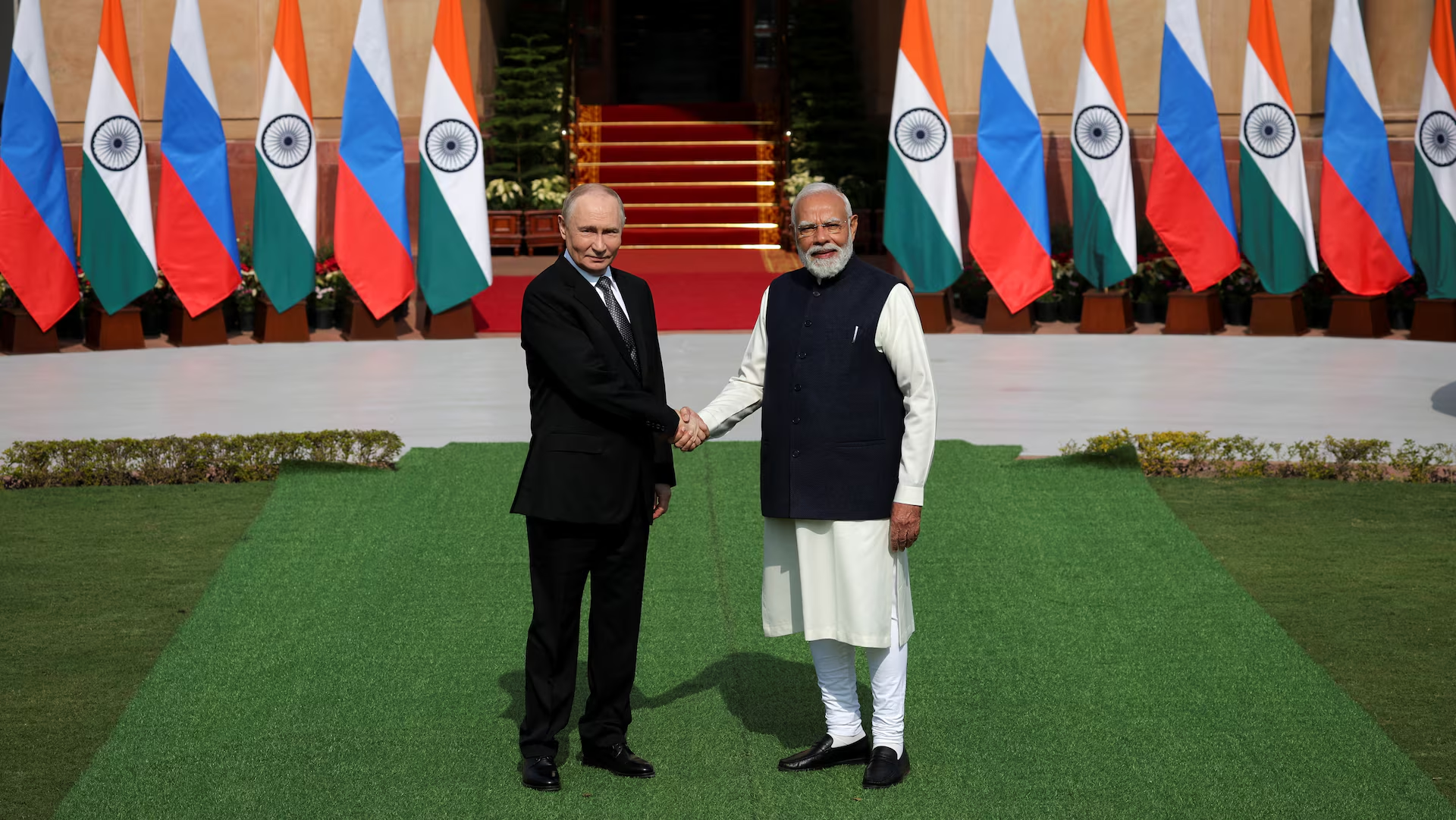
The 23rd India-Russia Annual Summit (4-5 December 2025) was held at an opportune time in both geopolitics and trade realignment of the world, as well as energy uncertainties. Under increasing pressure of the Western forces and the changing world order, the Modi-Putin summit led to a series of agreements and intentions in the spheres of defence, commerce, energy, health and strategic cooperation - reestablishing an old ally. The results are an indication that both countries are working together to strengthen their collaboration and withstand foreign influences. This paper critically examines the deliverables of the summit, evaluates how the agreements can further the Indian interests in the evolving world order and ponders on the future path of India-Russia strategic relationship.
Major Agreements and Declarations
On the top, India and Russia signed sixteen agreements in the areas of defence, trade, economy, healthcare, culture, academics and media. The communique that was delivered by the two countries stressed the Special and Privileged Strategic Partnership and the reaffirmation of mutual commitment in addressing shared global challenges such as terrorism, transnational organized crime, illicit financing, and drug-trafficking. The two countries had an agreement on an Economic Cooperation Programme up to 2030 on the economic front, with both countries having a vision of increasing the bilateral trade to US $ 100 billion within the period of 2030. Another initiative that was resumed was the Eurasian Economic Union (EAEU) India Free Trade Agreement (FTA), and it focused on the removal of tariff and non-tariff barriers, enhancement of logistics, and facilitation of payment, insurance and reinsurance systems. Mobility of skilled workers, trade of minerals and critical resources, energy relations, and joint industrial and technological ventures are also on the agenda.
Russia in the energy sector also reiterated its intentions to deliver continuous oil shipments to India, which is one of the major promises against Western sanctions against Moscow. Infrastructure and connectivity included maritime and overland connections (e.g. Chennai-Vladivostok link and the International North-South Transport Corridor) to reduce the cost of logistics and increase access to trade. Defence collaboration was emphasized as strong, with Russia supporting India to its Make in India initiative as well as joint production, technological collaboration, and possibly even developing next-generation platforms together. Other non-tradable industries covered at the summit include healthcare, pharmaceuticals, and potentially vaccine and cancer-therapy partnerships. The common declaration also stressed collaboration in science and technology, nuclear energy, space, culture, humanitarian exchange, an indication of scope and desire beyond tactical or ad hoc agreements. Lastly, reaffirming commitment to multilateral cooperation was reiterated, and the need for the multipolar world, stronger cooperation in countering terrorism and transnational crime, and mutual assistance in global reform processes were all called for by both sides.
How do these Agreements Assist India in the Expanding World Order?
Diversification of Trade and Economic Resilience
The Economic Cooperation Programme and the target of huge trade are a strong indication that India is diversifying its trade and investment relationships with non-conventional Western-dominated markets. When the treaty with the EAEU is finally concluded, it may open up a huge bloc with Russia and other economies of the Eurasian region, providing Indian exporters with new markets. This is especially so with the increasing protectionism in other parts of the world and the geopolitical tensions that have threatened world supply chains. India seeks to minimize the costs of transactions and enhance the competitiveness of exports by cutting tariff and non-tariff barriers and enhancing logistics and trade corridors. In the domestic economic path of India, which has a huge target of becoming the 3rd -largest economy in the world, such deals create more resilience to global economic shocks, commodity price fluctuations and dependence on a single market. Supply-chain vulnerability can also be mitigated through cooperation in the vital minerals, energy, and raw materials, especially in strategic sectors like technology and defence production.
Energy Security in the Wake of the Geopolitical Crisis
Among the most far-reaching guarantees was a promise by Russia to keep supplying oil to India without interruptions, even under Western sanctions on Moscow. This provides India with a dependable, cheap supply of oil when the oil markets of the world are insecure, supply chains are disrupted due to the conflicts (particularly in Eastern Europe and the Middle East), and energy security is becoming a recurring strategic issue. Long-term energy relations and investments, potentially including association with nuclear or clean energy relations, can be used to cushion the Indian energy requirements and shield it against external pressures. The energy-resource cooperation that is discussed in the summit is therefore not only transactional but a part of the overall resource security of India planning.
Defence, Strategic Autonomy, and Building the Capability of Aboriginal
Defence co-operation is kept at the centre. The summit renewed strong military-technical collaboration, production together within the framework of the Indian program Make in India, as well as potential co-development of the next-generation platforms. India will have the ability to cut short on imports, increasing domestic manufacturing capabilities, and speeding up technological independence by enhancing the indigenization of manufacturing. India has been on a path of strategic independence, and its policy of strategic autonomy is once again being reinforced by its continued strategic alliance with Russia in a time of changing alliances and geopolitical rivalry, particularly in the tensions between Russia and the West, as well as the Western powers and emerging Asian powers. The top has sent a strong diplomatic message, which states that India will never be bullied into making decisions that would compel it to take sides, despite its efforts to develop relations with the Western powers.
Cooperation in health, Science and Technology
The healthcare and scientific cooperation components of the summit signify the new realization of the concept of strategic partnership in India, as it is diversified not only in the traditional fields. The partnership in the pharmaceutical and vaccine development, and perhaps, cancer-therapy and other sophisticated interventions, can enhance the healthcare infrastructure and capacity of India. Considering the size of the Indian population and their requirements for public health, this type of cooperation could enable India to skip-jump into levelled biomedical research, lessen reliance on external supply chains, and develop technology transfer. Scientific and technological co-operation- in terms of critical minerals, energy, space and nuclear co-operation- can also assist in the shift of India towards high-technology industries, clean energy, long-term industrial modernization, etc.
Geopolitics and Strategic Indicators
The renewed India-Russia alliance, when the Western nations are putting economic and diplomatic pressure on both, goes to show how ineffective efforts to isolate Russia are becoming. According to analysts, the visit sends a clear message of the fact that Western attempts to isolate Russia have not succeeded. In the case of India, a good relationship with Russia will ensure strategic flexibility. It maintains control over vital technologies, defence, energy, and nuclear, without being involved in zero-sum alignments. India has acquired the means of playing a dual role both in Western relations and non-Western strategic alliances, which gives it more leverage in the international arena and paves the way to the real multipolar world order.
Assessment of Challenges
Although the results of the summit are ambitious, there are serious problems in the way of transforming them into concrete benefits. First. The Trade Imbalance and Export Competitiveness. India, in the past had had a skewed trade with Russia, with India bringing in more raw materials and energy and sending back less manufactured products. Increasing exports to Russia will force Indian industries to become more competitive, technical, and logistically pass bottlenecks. The simple FTA might not be enough without structural changes and improving the capacities of the industry. Second, Infrastructure and logistics Bottlenecks. The improvements in connectivity envisioned (e.g., maritime routes, North-South corridor) will demand substantial infrastructure investments, consistency in harmonization of regulations, and predictable regimes of transit. Slowdown or inefficiencies in such projects might negate the expected economic benefits.
Third, External Pressure and Geopolitical Risk. As mentioned in external analyses, the geopolitical relationships that India has had with Russia have already attracted punitive tariffs from some Western capitals. Further collaboration may attract another round of retaliation, not only to its overall trade talks with the West but also discouraging foreign investment in case it is seen as collaborating with Russia. Fourth, Russian Dependence and Supply Reliability; The economic and political future of Russia, in particular, its isolation in the global market, war spending, and possible sanctions may hurt the stability of the supplies (particularly of energy and strategic minerals). Long-term risks may therefore be brought about by over-reliance on Russian supply chains. Implementation Gap, From Agreements to Outcomes, Diplomatic statements and signed MoUs can have slow implementation due to administrative inertia, bureaucracy, or a change in domestic political priorities. In the absence of specific timeframes, clear mechanisms and institutional follow-up, numerous commitments can stay on paper.
The Future Dynamics India-Russia Strategic Partnership
Assuming that both nations stick to their promises, we might witness a slow but steady shift in the India-Russia relationship to be based not on the old-fashioned framework of the partnership of defence-centric cooperation but on the principle of the comprehensive cooperation of the economy, energy, health, technology and people-to-people exchange. The projected FTA with EAEU, the enhancement of the logistics, and combined industrial initiatives might bring the collaboration to life and render the collaboration more robust and less reliant on the ad hoc political intentions.
Since we are witnessing increasing rivalry among world actors and alliances, the determined interaction of India with Russia underlines its desire to have strategic independence. The alliance will probably act as one of the pillars of the foreign policy of India, in which New Delhi would not be making zero-sum decisions that would leave it room to work with the Western powers, and still ensure an autonomous relationship with the non-Western powers. This balancing may assist India to create a multipolar world order that is in its interest. As well, joint defence production, cooperation in the field of critical minerals, energy, and high-tech industries, in case they are adopted, would provide a substantial boost to the industrial base of India. Combined with the domestic reform agenda and demand of the Make in India, these partnerships can result in technology transfer, skill training and increased independence in strategic industries. This would decrease the dependency on imports in India on a medium to long-term basis as well as broaden its standing as a manufacturing hub in the region.
However, to believe in strategic overdependence, India will have to hedge. Further diversification of suppliers, particularly the defence suppliers, energy and critical inputs, is necessary. India also needs to make sure that it is implemented in a transparent manner, diversifies its energy (not only renewable, civil nuclear), and, at the same time, ensures strong relations with the rest of the world so that it can not be exposed to geopolitical pressures. India can now speak louder in the international forums, particularly on matters of energy security, climate, strategic stabilization, and multipolar governance with a stronger India-Russia alliance. Climate finance, clean technologies, and critical minerals Cooperation will help India create a bridge between the aspirations of the Global South and global ambitions. Furthermore, India can become a more influential player in the world arena in case it delivers regarding economic growth, technological acquisitions, as well as defence modernization.
Conclusion
The 23rd India-Russia Annual Summit of 2025 will be a great milestone in the bilateral relations, changing a relationship that was always based on defence and energy into a real-life comprehensive strategic partnership. The sixteen accords in the domains, the extensive economic cooperation programme through 2030, energy security commitments and increased cooperation in health, technology and connectivity are all pointers to a deliberate effort by both countries to enhance their relationship in the ever-changing global order. These developments provide opportunities to India; this includes trade diversification, energy security, modernization of the defence, industrial development and increased international status. But as with any bold diplomatic project, practical advantages shall lie in the construction, in the revolution of the structures, in the diversification of interest and the prevention of excessive dependence, in the use of institutions. Provided that New Delhi and Moscow manage to overcome these dilemmas, the upcoming several years might witness the India-Russia relationship become a strong source of India's strategic autonomy, the multipolar global system, and New Delhi gaining more influence in the global arena, along with providing tangible economic and developmental benefits in the domestic environment.
Lipun Kumar Sanbad is a Research Intern at NIICE and completed his MA in Politics and International Studies from Pondicherry University, India.
