
15 September 2026, NIICE Commentary 12730
Dr Chander Shekhar
India in the last decade or so has navigated a challenging time of competition, cooperation, and consistent rivalries with its neighbours and the United States, etc. How did India manage it? It is essentially a subject of deep investigation, one different from a surface understanding of India’s tumultuous rise, unlike China’s story of heading to replace and mould the international system and society with its “special features”. From saving its long-term special partnership with Russia, since war began over Ukraine, and the changing power balance and security architecture in the Middle, which is of course having abundant natural resources, India’s grand strategy is not documented, but implicit planning have much suspense, but after the 2026 BRICS Plus Summit in Delhi has shown India’s approach of not multi aligned or engaging just, but adopted a grand multi-hedging long term strategy, above strategy autonomy. It seeks to avoid the Thucydides trap with mainland China, which has already emerged as a great power and strategic pole asserting itself against West-led models, and by de-risking its interests in different regions, which is more than strategic patience. India’s voice and its ambition and managerial skills are both visible in the BRICS Summit held in Delhi under its chairmanship. Having prepared since last year, employed shuttle diplomacy, convinced partners, and, after lengthy negotiations for a joint statement, this shows how India hedged its risks of the BRICS summit being a failure and opened doors to practical inclusive cooperation without losing the West, as not against the West. The success is not issuing sweep joint statement, but building consensus, took a year, not make the summit a battlefield of ideological confrontation with non-like-minded states. India’s rise and taking a hot seat is not going to be an easy navigation, learning from the model cases, India must think in the long run and co-exist with the West also.
India’s Grand Multi-Hedging Strategy and Building Consensus
Hedging is a policy option that a state adopts while dealing with unprecedented and uncertain situations by opening multiple policy options to minimise the opportunity cost of its behaviour and maximise benefits. It is also an ambiguity that a state generates from its behaviour to secure its interests in great power competition. This “return-maximizing and risk contingency” has become a foreign policy tool of developing countries. Moreover, it is also seen as a “set of strategies” to escape a complex situation and opt for an option that avoids taking direct sides, but maximises its goals.
In the aftermath of Russia’s invasion of Ukraine, several countries in the world took a side and condemned the action of former to accuse of its violation of sovereignty in the international system. Among others, India opted a choice of hedging its interests by engaging with all stakeholders, avoided condemning the condemnation of attacks, and later said, “this is not an era of war”. On the other side, it did not blindly follow the Trump-led tariffs and sanctions, which supported importing oil from Russia, but through diplomacy handled America’s assertiveness and unilateral behaviour. Russia, a long-trusted friend and partner, made it clear that it would keep selling oil to India despite any threats from the US.
In the last decade, hedging has dominated India’s choice of making its relations stable with major powers, despite pressures. It is also a fact that, with China, the past several years have not been easy to digest, but their trade remained upward, and trust remained short-term. The trade deficit between the two largest economies has kept widening each year to reach USD 99.19 billion in 2026, which shows India’s continuous reliance on China for industrial products. The United States and India are about to ink a trade deal, which is still in the process, that could change the trajectory of their bilateral relationship. The suspense is still there, as Trump swings its decisions overnight, but India’s commitment and consistent approach of strategy hedging to sign a deal that benefits both. There is no alignment, but hedging has been practiced by India in the last decade to achieve its national interests. The Middle East event has again tested India’s handling of the situation. In a similar pattern, it did not take sides, but analysts say its close ties with Israel and the US would affect its national interests in West Asia, which was managed unambiguously by India shown in the BRICS Summit and in bilateral meetings between India and Arab leaders.
BRICS Plus Meeting and Inclusive Future
Brazil, Russia, India, China and South Africa (BRICS) have emerged as a multilateral organization of emerging economies. It was formally established in 2009 with its first leaders’ summit, although the idea dates back almost a decade to its first summit by Russia and the term ‘BRIC’ was coined in 2001, later, South Africa was included. Today, today its membership has doubled which includes along with original five to Indonesia, Egypt, Ethiopia, Iran, and the United Arab Emirates. The forum has gradually taken a global shape by increasing membership and expanding cooperative regimes. Its expansion shows that the grouping’s “influence, credibility, and appeal” are seen as a pivotal platform for an inclusive future in global governance. It is believed that the BRICS nations today accounts of 50% world’s population, 40% of global GDP, and having around 25% of world trade.
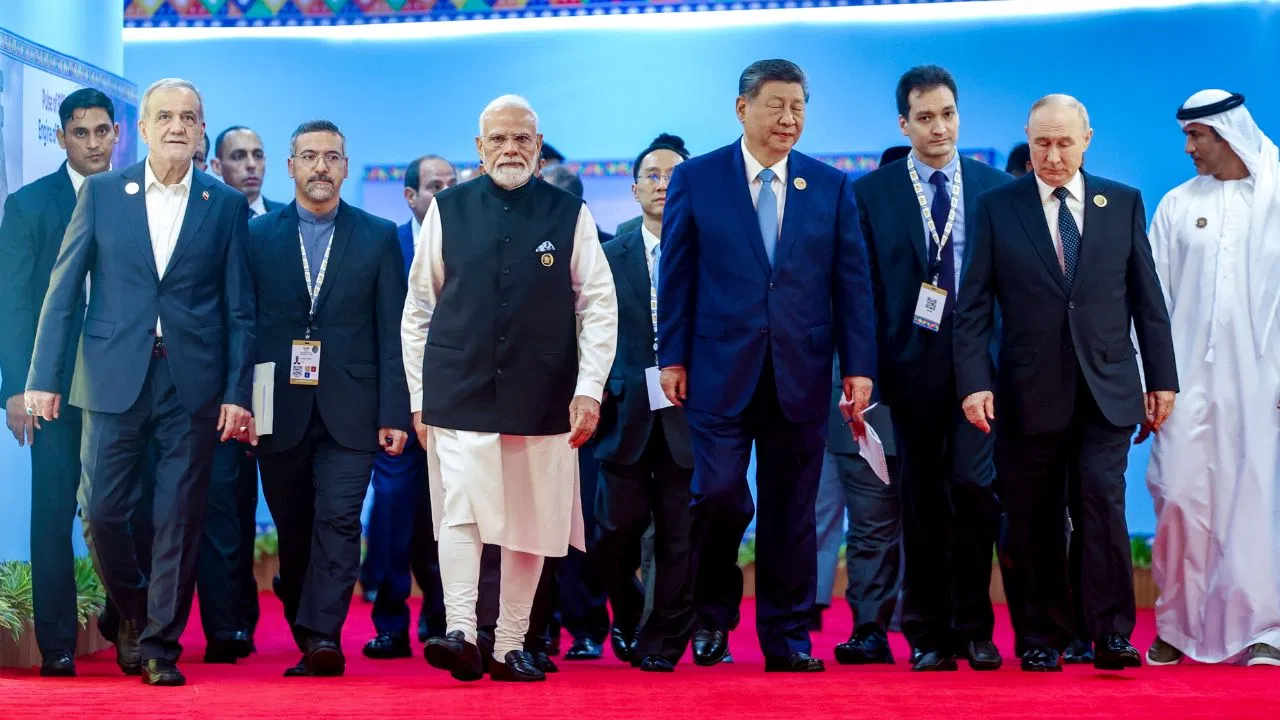
The BRICS Summit was held on 12-13 September under India’s chairmanship in 2026. The country has managed to build a consensus under the theme of “Building for Resilience, Innovation, Cooperation and Sustainability”. The BRICS nations as a result have issued a joint statement in the form of New Delhi Declaration, which mainly stresses on making global governance more inclusive or reform, strengthening existing multilateralism; underscores issues that matter to the region and international peace and security; and member states seek to build understanding over how to reinforce people to people cooperation.
In the joint statement, which reflects the voice of all members and whose wording is interesting for shaping new discourse in international politics, the leaders agreed to achieve cooperation in three different sectors: political and security, culture and reinforcing strategic partnership for the people’s benefits through making global governance more representative, fairer, sustainable and reformed multilateral organizations.
However, analysts believe that as the BRICS has become a strategic force over the past two decades, it also seeks to create a “counterweight” to the present alternative of a Western-dominated system. Also, intra-BRICS divisions as several of its members have disputed history over territory and other issues; critics say they are in the process of issuing their own currency. The currency issue became an important issue among a section of experts, but no discussion or proposal to issue a common currency was made in the meeting, and member states favour using local currencies in bilateral trade. Chinese leaders’ presence marks an important departure from its old policy and sets the stage for its next year BRICS chairmanship. During Xi’s Delhi address, five initiatives were announced for greater BRICS cooperation in the domains of trade and investment facilitation, AI, digital industry, smart manufacturing and talent development.
West is not Worried
Whatever developments are taking place in the BRICS organization, the West is cautious about making what it can to prevent the organization from becoming effective and to reduce its influence to the extent that new members could not join it and dare to replace the West-led global governance. The BRICS have some powerful economies and two UNSC permanent members, China and Russia. China’s control of BRICS could harm New Delhi’s interests and its big market. Analysts therefore stress that New Delhi’s interest remains in “sabotaging BRICS” to the greater extent China become “juggernaut” that floods India’s interests.
For the West, a divided BRICS is an opportunity to lose its relevance and remain a talking shop as almost all of its members have disputes and “divergent interests”, therefore, it poses no significant concern for the United States and its Western alliance partners.
India’s multi-hedging grand strategy takes an inclusive approach; it does not exclude anyone in the world and is not against the west, could be “non-Western”, it embraces all, shall not be interpreted by experts that building proximity to mainland China means challenging the West. BRICS has also grown into a voice of the margins, the Global South, and their concerns. As part of its multi-hedging strategy, India does not favour any special actor, but moves to achieve its practical interests dependent on geopolitical development.
Conclusion
The evolving geopolitical realities have pushed countries to rethink their behaviour and future approach to dealing with emerging challenges. India’s multi-hedging grand strategy is a monumental model for the margins of the Global South region in the last decade, or can be traced after economic opening up. What India is thinking today, the Global South must start thinking to converge interests, minimize risks, and maximise benefits for a shared future through practical cooperation and inclusive growth. The outcome and success of the BRICS Summit in New Delhi is a classic example, which needs to be preserved, not sabotage the already made investment in multilateralism and reformed global governance. Next year, China will chair the 2027 BRICS presidency. The BRICS summit shows an evolving gathering of mutual benefits and win-win cooperation, which acts in reciprocity.
Dr Chander Shekhar is an Assistant Professor at Akal University, Punjab, India.
