20 June 2026, NIICE Commentary 12573
Apoorva Prasad
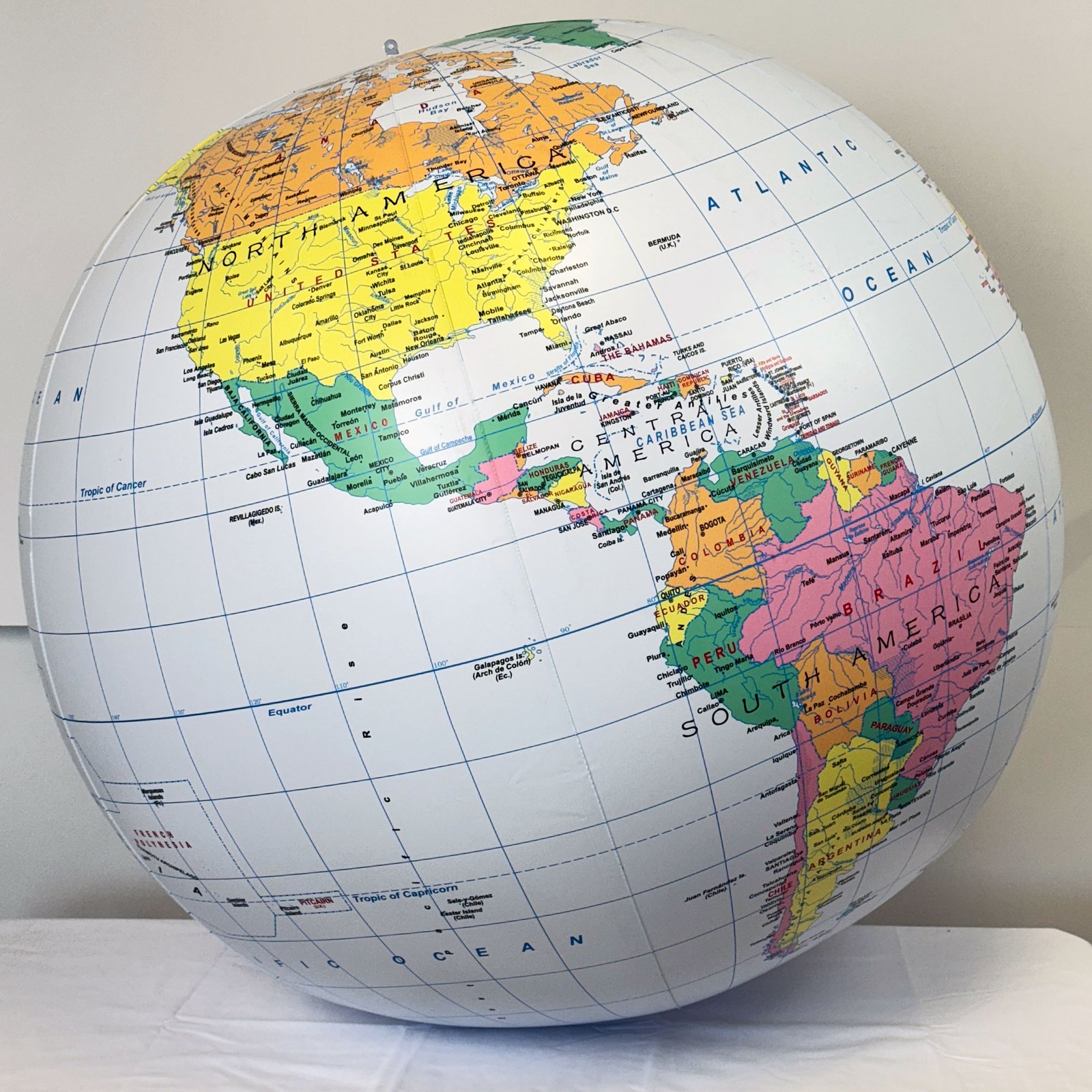
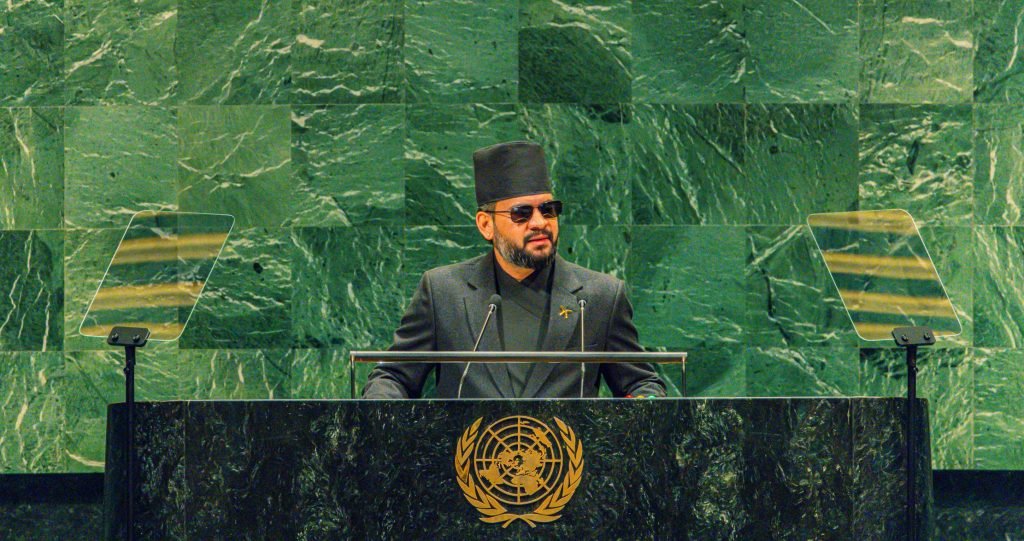
When Balendra “Balen” Shah walked into office as Nepal’s Prime Minister on March 27, 2026, he was not just Nepal’s youngest-ever head of government at 35. He was also inheriting one of the most complex geographic positions in contemporary world politics. Nepal is a landlocked country squeezed between two rising giants, India, which controls Nepal’s only land access routes to sea and accounts for the overwhelming majority of its trade, and China. A third power, the United States, has since entered this equation with strategic and financial commitments of its own. How Shah chooses to navigate these relationships over the coming years will not just determine Nepal’s future. It could become a case study for how small states everywhere manage a world where great-power competition has returned with renewed intensity.
The Old Playbook Was Not Working
For decades, Nepali foreign policy ran on a fairly predictable script: whichever party held power would lean a little harder toward either New Delhi or Beijing, depending on ideology and convenience. Communist-led governments, especially under former PM K.P. Sharma Oli, were known for playing what analysts called “the China card,” using closer Beijing ties as leverage against India and as a domestic nationalist talking point. The trouble was that this kind of political manoeuvring rarely led to real development gains on the ground. As documented analysis of Nepal’s economic engagement with China has shown, major Chinese infrastructure commitments under the Belt and Road Initiative, including cross-Himalayan railway projects, largely failed to materialise, while Nepal’s trade deficit with China widened steadily. Instead of forming real strategic partnerships, Nepal started to be seen less as an independent player and more like a stage where outside influences compete. This often meant that changes in the domestic political scene led to shifts in foreign policy that tended to benefit specific political groups rather than the country as a whole.
That script was completely torn up in September 2025, when youth-led “Gen Z” protests over corruption and economic stagnation forced Oli’s government to collapse. An interim administration under Sushila Karki, Nepal’s first woman Prime Minister, held the country together long enough to deliver a fresh election within six months. When Nepalis voted on March 5, 2026, they handed a landslide to Shah’s four-year-old Rashtriya Swantantra Party, which had campaigned on governance reform and economic accountability rather than geopolitical positioning, sweeping aside the traditional establishment parties that had dominated Nepali politics since the end of the monarchy and way before that.
A Different Kind of Balancing Act
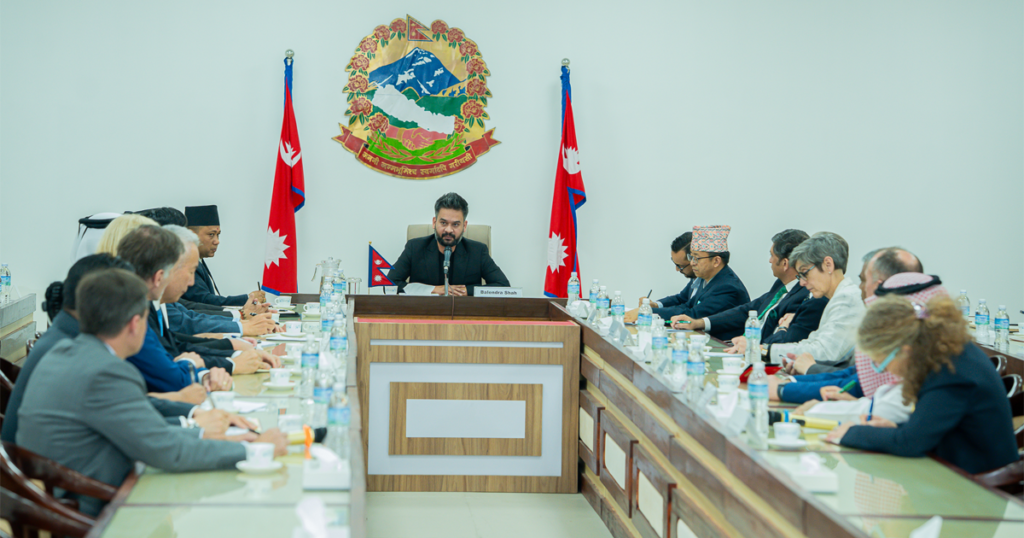
What’s striking about Shah’s early diplomacy is not any dramatic policy U-turn. It’s the style. Rather than meeting foreign ambassadors one-on-one behind closed doors, as is tradition, Shah called in seventeen heads of mission, including the envoys of India, China, and the United States, for a single joint briefing at his office in April. Analysts have read this as a deliberate signal: no single power gets a privileged channel.
The pattern has held since. When senior Nepali officials meet Indian counterparts, they are soon seen meeting Chinese counterparts as well, almost like clockwork. In mid-June, Foreign Minister Shishir Khanal made the highest-level Nepali visit to China since the new government took office, sitting down with China’s Wang Yi and Wang Huning in Beijing. That trip carries real economic weight: bilateral trade between Nepal and China stood at roughly $2.16 billion in 2024, but Nepal’s exports to China were a mere $27 million, leaving Kathmandu staring at a stubborn $2 billion deficit it badly wants to narrow.
Meanwhile, India remains in the picture too, not least because of a long-standing, symbolically loaded tradition: Nepal’s prime ministers usually make their first foreign trip to New Delhi. As of this spring, Shah had not yet received that invitation, leaving commentators to watch closely for when and how that visit finally happens. The United States has further complicated Nepal’s diplomatic equation through the Millennium Challenge Corporation(MCC), which committed a $500 million infrastructure development grant to Nepal, the largest single foreign aid package in the country’s history. This makes Kathmandu one of the few capitals in South Asia simultaneously engaged in substantive partnerships with Washington, New Delhi, and Beijing, each of which carries distinct strategic expectations and conditions.
Why does this Matter Beyond Nepal?
It would be easy to dismiss all this as small-country diplomacy of limited consequence. That would be a mistake. Nepal sits at a genuine fault line of Indo-Pacific competition, and how Shah’s government manages it offers a live test case for a question every smaller state in the region is quietly asking: Is it actually possible to deal with rival great powers as equals, rather than picking a patron?
There are real risks here. Critics note that Shah’s caution- no major bilateral summits in his first months, no bold new initiatives- could look less like principled neutrality and more like indecision, especially if it costs Nepal access to financing or technology that a clearer alignment might unlock. Geography also has a habit of reasserting itself: however symmetrical Shah’s diplomacy looks on paper, India’s proximity and economic weight give it leverage China cannot match, and vice versa on infrastructure financing.
But there’s an upside too. A government that treats both neighbours as genuine partners, rather than threats or patrons, has more room to extract better terms from each, precisely because neither power can take Kathmandu’s loyalty for granted. In practice, this leverage operates on several fronts. On infrastructure financing, Nepal can resist accepting Chinese loans on unfavourable terms by pointing to MCC grant funding as a credible alternative. This way, they can leverage the support from Washington to encourage Beijing to offer better terms. On trade access by signalling genuine openness to Chinese connectivity alternatives through the Rasuwagadhi-Kerung corridor. On energy, Nepal’s hydropower export potential gives it a commodity both neighbours want, allowing Kathmandu to negotiate power purchase agreements from a position of competitive rather than captive supply. The small state, in other words, cannot match its neighbours in power, but it can use their rivalry to ensure it is never entirely dependent on either.
Looking Ahead
Shah’s first major diplomatic test, his first state visit, will tell us a great deal about whether this calibrated balancing act can survive contact with reality. Agreements on trade corridors, hydropower export arrangements, and border infrastructure will each require Nepal to make choices that cannot always be symmetrical, and each choice will be watched carefully in both Beijing and Washington, as well as New Delhi.
For now, Nepal, under its youngest-ever Prime Minister, is attempting something genuinely new: refusing to be just a chessboard square in someone else’s game and instead trying to be a player in its own right. Whether that experiment succeeds will matter well beyond Kathmandu, offering lessons for every small state caught between today’s competing giants.
Apoorva Prasad is a Research Intern at NIICE and a student at the Central University of Gujarat, India.