
18 Jun 2026, NIICE Commentary 12564
Shruti Khadka
The echo of the term geopolitics is heard at every nook and corner of the country, from the tea talks to the intellectual mania; the discourse of geopolitics is omnipresent. To put it simply, geopolitics refers to the impact of a country’s geography on its foreign policy practice and conduct of international relations. Now, geopolitics has extended its remit and impacted global governance in a flux in an unprecedented manner.
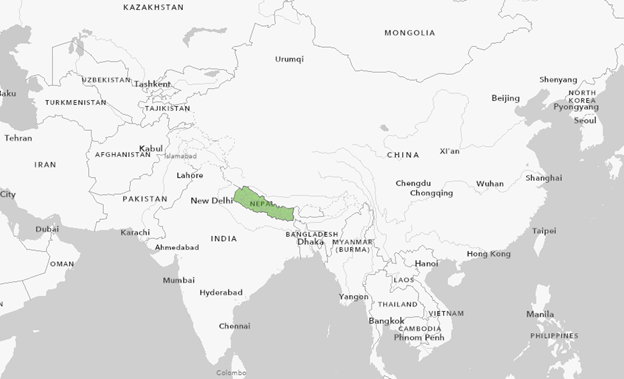
Geopolitical sensitivity has always been a reality shaping Nepal’s interaction in the international arena, although it might feel like a bitter pill to swallow. Ever since the notion of the “yam between two boulders” to “non-alignment” to the current day scenarios, geopolitics has played an active role in shaping Nepal as an international personality.
The Yam Theory
King Prithivi Narayan Shah, after the unification, had suggested his bhardars of Nepal’s positioning as a yam between two boulders and that caution be maintained with the Imperials beyond the seas and China to the North. Although the King’s ambitions inside the Nepali territory were aggressively expansionist, he maintained an isolationist policy vis-à-vis the rest of the world. It was suggested to fight back only if it’s a compulsion to secure national interests, depicting a defensive realist worldview.
Towards the South
As the British thirst for territorial expansion, power, and control had not been quenched, Nepal came into its radar. The newly unified Nepal had to face the ambitions of the British Raj in the Indo-Nepal War. In 1814-1815, the British imperial ambitions in South Asia led to them waging a war on Nepal, where Nepal lost one third of its territory, becoming the losing party to Sugauli Sandhi, retaining as much as to call itself a sovereign. After the institutionalization of the Rana Regime, Nepal’s foreign policy was based on appeasing the British. This move of the Regime not only served the Rana interests but also helped keep Nepal’s status as a sovereign nation, as the British didn’t find it necessary to colonize a nation that bent in its own direction. Though the sovereignty of Nepal was pretty much diluted as Nepal viewed everything through the British lens, it was the only reason why Nepal was able to uphold its territorial integrity and its most touted virtue of never being colonized.
Return of the Lost Territory
Nepal’s proactive role in suppressing the Sepoy Mutiny in British East India in 1857 led to the return of the four districts of Nepal (Banke, Bardiya, Kailali, and Kanchanpur) in 1860 by the British Empire as a gesture of gratitude. This historical milestone carries deep importance and an unusual practice in the international realm. Either way, it marked how taking a politically favorable stance helped Nepal to the extent that it got its lost territories back, showcasing how geopolitical sensitivities and calculative interests have always been there, molding Nepali interests and actions.
The Blockade of 1989
On the pretext of disputes arising on concluding two separate treaties of Trade and Transit, Nepal’s position on two treaties as a right permitted by International Law, and India’s refusal citing security concerns, a blockade was imposed upon Nepal from (1989 March to 1990 April 1990. This caused a colossal impact on the lives of Nepali people, creating a scarcity of food, medicine, fuel, and basic needs. The GDP growth contracted from 9.7 % to 1.5 %, wreaking havoc on Nepal’s economy. This shows how the geography of Nepal and inherent power asymmetry have confined it to being India-locked. With the Elephant on Nepal’s three sides, the wrath of a powerful neighbor brought forward unwanted complexities at home.
The Constitutional Aftermath
The promulgation of the constitution of Nepal on Ashoj 3, 2072, led to dissatisfaction among the Indian faction, leading them to impose an unofficial blockade in Nepal, leaving the fate of essential supplies in limbo. There were cries of fuel crisis, medicine supplies, and food prices blew up, and every Nepali household had to face the consequences. The lives of Nepalis were severely halted, showcasing how heavily we are dependent on India, so that upon their resistance, the entire economy of Nepal would spiral, impacting thousands of lives every day. This also led to the compounding of anti-India sentiments in Nepal. It points out the truth of how deeply geopolitics is entrenched in Nepal. The transit agreement with China, signed in 2016, served as a trump card to balance India during this period.
Dragon in the Neighborhood
Nepal’s relation with its Northern neighbor hasn’t been as intensive as it is with India, primarily due to the mighty Himalayas in the North. Differences in culture, tradition, religion, and values have also led to the distance between the neighboring countries. Although there has been the arrival of Buddhist monks from China to Nepal, and Araniko in the 13th century had cemented Beijing city with Nepali Architecture, there were very few interactions in comparison to India. However, China can’t be separated when it comes to brewing a geopolitical threat for Nepal as well. Nepal signed a Transit Transport Agreement with China in 2016, seeking to reduce excessive dependence on southern transit routes. However, geographical barriers, limited infrastructure, and logistical challenges have restricted the full implementation of these arrangements. Nepal follows the One-China Policy and clarifies it time and again to avoid any unforeseen consequences. The Tibetan refugees that Nepal hosts on a humanitarian basis irk the Chinese side. Nepal prevents any kind of violent and anti-China activities from taking place in its territory.
Nepal’s interactions with India invite a threat on the Chinese side, and interactions with China bring a threat on the Indian side. This has always been the case in Nepal's dealings with its neighbors. Trilateral cooperation has been highly ineffective due to bilateral contentions between India and China. Economic activities have also been impacted by the disruptions at the border due to challenges brought forward by natural disasters. China’s BRI has raised several eyebrows as the undertones of its debt trap diplomacy sway through the minds of people within and beyond Nepal. Indian security concerns regarding BRI have also constrained the relations with the southern neighbor. The fear from the South regarding the diversion of Nepal, which it has always treated as its sphere of influence, towards the North has raised economic, socio-cultural, and geopolitical concerns in the neighborhood.
Beyond the neighborhood
Sandwiched between two Asian giants, Nepal has to always act cautiously when it comes to its geopolitics. Nepal possesses a distinct image in the global order due to its mighty neighbors. The involvement of a major power like the US in Nepal through MCC is a case in point. However, MCC signing was also a huge issue in itself as it had connotations of alignment with the American ambitions in the Indo-Pacific. The misinformation regarding US troops arriving in Nepal and several protests carried on regarding MCC and SPP is nothing but an overstretch of imagination, which time and again arises, creating panic in the psyche of Nepali people. Nepal has to participate in international affairs without being entangled in the great power politics. The landlocked status of Nepal, coupled with its meager infrastructural developments and internal constraints, prevents Nepal from actively participating in economic and socio-cultural exchange in the international arena. Developing internally while expanding interactions globally is the need of the hour.
To conclude, despite the challenges exerted upon it, the positioning of Nepal between two rising powers of Asia can be a strategic leverage to enhance Nepal’s global interactions and its foreign policy aspirations in the international arena. As the Nepali aspirations scream of making Nepal a vibrant bridge between India and China, the sensitivities owing to the geo- positioning cannot be sidelined. In order to establish Nepal as a vibrant bridge, mutual understanding, solidarity, and trust between the three states should be enhanced. The sensitivities need to be navigated by practically implementing Nepal’s non-aligned foreign policy and equi-proximity with its neighbors. The border anomalies regarding the Lipulekh-Limpiyadhura pass have been a constant irritant in Indo-Nepal relations that needs to be resolved via diplomatic channels and pragmatic communication. Diversifying relations with neighbors as well as the rest of the world in economic and socio-cultural fronts needs to be done by developing internal capacity, connectivity, and infrastructural consolidation, as well as pragmatic diplomacy.
Shruti Khadka is currently pursuing her Master's in International Relations and Diplomacy at Tribhuvan University, Nepal.
