
03 June 2026, NIICE Commentary 12521
Sidhant Kumar
Europe's relationship with India is a result of the international political pressures faced by both regions. Europe has been under duress since the Russia-Ukraine war, and the US’s dressing down of Europe recently has made Europe more vulnerable than ever. The US has compelled the European NATO member countries to spend 5% of their GDP on their military defense and is threatening to withdraw troops as well, compounding Europe’s woes. For decades, Europe relied on cheap Russian oil, cheap trade with the US, and expensive exports to China, which have been cut-off. As part of its “turning point," due to the Russia-Ukraine War and the US's blowback on the EU's common security, Europe is looking elsewhere.
India needs partners at a time of significant geopolitical restructuring, including President Donald Trump’s unruly behaviour and tariffs. A US- China bonhomie is also emerging. The just-concluded US-China summit in Beijing portends to undercut India as a market for both the US and China, as China becomes crucial for trade, chips, computer software (AI), and critical minerals. For long, India benefited from a US-China rivalry by becoming the node of the US's pivot to Asia and kept buying China’s cheap machinery. This trend may be nearing its conclusion. In this regard, the foreign minister, S. Jaishankar, said India wants to “cultivate” Europe as it offers a market for Indian products such as textiles and agro-based products. Europe also offers cooperation on emerging technologies, particularly in the sector of green technology and AI, as China and the US seek to monopolise these sectors. European countries like Sweden and the Netherlands have been forthcoming in developing joint defense production units in India
India’s turn to Europe was also exacerbated by an assertive China, which disrupted the supplies of machinery for the development of India as a manufacturing hub. Europe provides advanced tech in the manufacturing and automobile sectors. Furthermore, in Europe, this moment is a giant upheaval in its political history. Its long-time ally, the US, is abandoning the region, which it forged as part of its post-Second World War reconstruction program.
US-Iran War and Domestic Crisis
The US-Iran war has compounded the geopolitical pressures as well as the war-linked domestic crisis facing India and Europe. Europe had been untouched by the US-Iran war so far. But early trends of its impacts have started to reveal themselves. Crude oil per barrel has crossed the $100 mark. The European refineries can only process crude into petrol rather than diesel and jet fuel limiting domestic supply chains. Europe had been importing from Russia, the Gulf countries and India. With the Hormuz blockade and the Russian aggressive offensive, imports have reduced. European countries have also ramped up diesel imports from the American Gulf and increased domestic production, which were able to cushion the impact.
Europe has started to feel the pinch as the food crisis is also threatening the economies of Europe. In the UK, the US-Iran war has disrupted shipments of agricultural fertiliser. As the UK sources half of its food from overseas mostly chicken and pork, its domestic productivity has come under strain. Britain’s economy has also hit a wall with growth rates stuck at 1.3 %.
Amidst this, European leaders are also facing unprecedented levels of public disapproval. The European leaders at the helm lack the charisma of Angela Merkel or François Mitterrand. According to a report, only one out of five voters trusts French President Emmanuel Macron, and among a third of the population has an unfavourable image of Macron. German Chancellor Friedrich Merz, has also seen his popularity vanish due to his sub-par tenure. Merz also wanted to slash down the EU. Macron recently clashed with the EU over a free-trade agreement with the MERCOSUR, as it will make French farmers’ prone to competition from cheap products from Latin America. The victory of far-right parties in the local elections of the United Kingdom have jolted UK’s Prime Minister’s Keir Starmers’s patchy position in office. Elections are also scheduled in France next year and will test Macron’s shaky tenure.
On the domestic security front, the US has come down heavily as it has announced to withdraw 5000 troops from Germany as Merz criticised Donald Trump’s Iran war. Fearing US’s undue tariffs and military retrenchment, France sent its aircraft carrier to the Strait of Hormuz. Macron realises that not aligning with US-led efforts would lead to consequences. The threat of military withdrawal from the EU is a looming factor.
At the same time, European leaders are facing the question of Ukraine's entry in the common security umbrella of the EU. Ukraine has been a thorny issue among the leaders. EU farmers are worried about Ukraines’ large- advanced farming industry. However, several EU leaders want to extend the Art 42.7 mutual-defence clause to Ukraine. Recently, the German Chancellor Merz proposed that Ukraine can become an associated member of the EU, a move that was not received well in Europe and Ukraine.
The unprecedented energy crisis in India arising out of the US-Iran war has also pressured India to look towards Europe. For the longest time, India enjoyed a favourable geopolitical situation. The Russia-Ukraine war allowed it to buy Russian oil in cheap. But it was short-lived as India had to reduce its imports of Russian oil due to US tariffs. For India, the US-Iran war had a debilitating impact on its economy. Unemployment has risen, inflation is at a record high, food prices have gone up, and labour-intensive industries are shutting down. The government has announced austerity measures to cut down on fuel expenses, discouraging buying gold to save up the fast-depleting foreign exchange.
Headways in EU-India Relationship
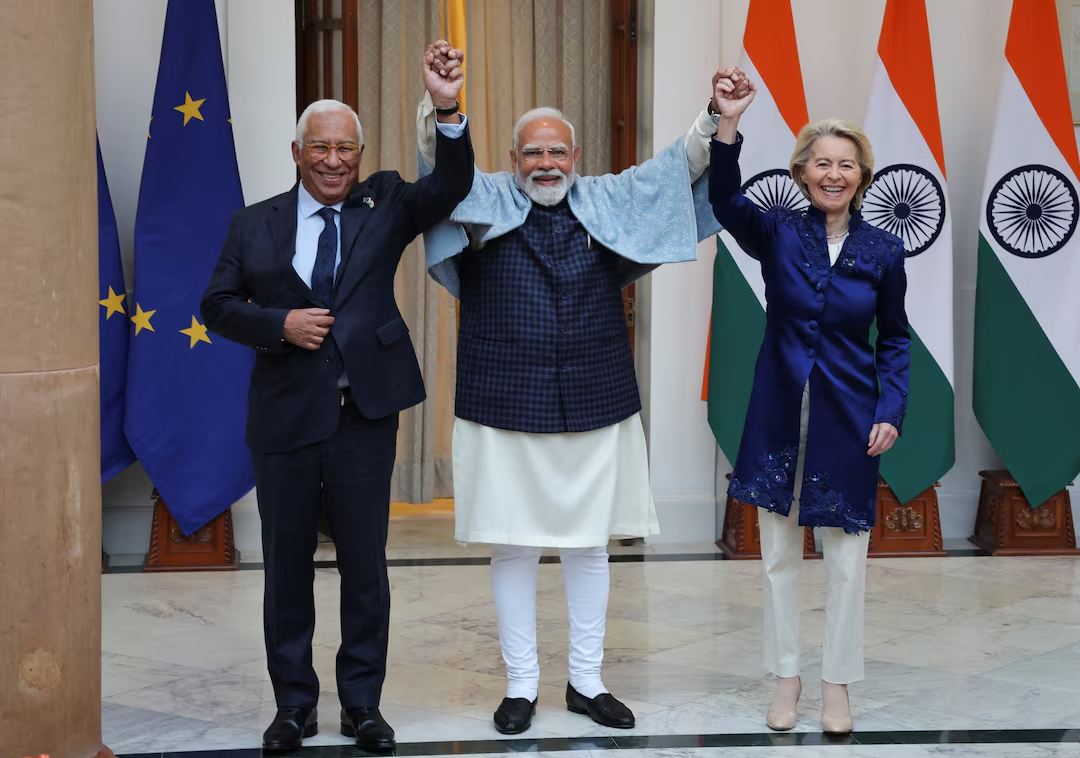
In this context, confronted by imperial ambitions and regional tensions, India and Europe have found each other. Europe calls the India-Europe cooperation a "consequential partnership," as the EU is the second largest trade partner of India, amounting to over 20% of India’s exports. Netherlands and Germany are the major hosts of India’s trade. Europe provides India a sophisticated mix of advanced technology, investment capital, high-value goods, and market access. Bilateral trade reached USD 193.18 billion in FY 2024–25, making Europe a vital partner for India's modernization.
European FDI into India stands at USD 162.51 billion, far outpacing Indian investment in Europe. Additionally, Europe is India's most relevant partner on the energy transition, offering expertise in offshore wind, green hydrogen, and smart grids. EU low-emissions electricity investment reached USD 128 billion in 2024, and Europe's SDG implementation experience provides policy templates India can adapt. The EU's Global Gateway strategy, mobilising EUR 300 billion for global infrastructure, has identified India as a key partner, anchoring the India-Middle East-Europe Economic Corridor (IMEC) as a flagship connectivity initiative.
What does India have to offer Europe?
India offers Europe a high-growth market, a deep talent pool, and strategic partnership across technology, manufacturing, and defence. India's exports to Europe reached USD 98.44 billion in FY 2024–25, spanning mineral fuels and refined oils, electrical machinery, machinery and boilers, gems and precious stones, and pharmaceuticals and organic chemicals, a basket that reflects India's growing industrial and knowledge-economy depth.
India hosts the world's third-largest tech startup ecosystem and leads on Digital Public Infrastructure such as Aadhaar and UPI being globally studied models. With over 6 million tech professionals and one of the highest concentrations of AI skills globally, India is a natural talent and innovation partner for European firms facing demographic constraints. India also ranks fourth globally in total installed renewable energy capacity and hit its 50% non-fossil fuel target five years ahead of schedule. European capital and technology in green hydrogen, offshore wind, and solar finds a ready, scaled market in India.
To deepen the economic partnership, EU, recently signed a Free Trade Agreement with India. Touted as the mother of all deals, the FTA marks a breakthrough in Europe’s trade expansion beyond its traditional partners. On market access, the EU will liberalise 99.5% of its tariff lines on Indian imports over seven years, with roughly 91% facing zero import duties from day one. The key beneficiaries are labour-intensive sectors including, textiles and apparel, leather and footwear, marine products, gems and jewellery, and engineering goods, where EU tariffs previously ranged from 4% to 26%, with nearly $33 billion worth of exports set to gain zero-duty access.
On the Indian side, tariffs on 96.6% of EU goods exports will be eliminated or reduced, with cars seeing a phased reduction from as high as 110% to 10% over five years. Non-tariff barriers, however, remain a friction point, particularly the EU's Carbon Border Adjustment Mechanism (CBAM), which continues to impose costs on Indian exports of iron, steel, and aluminium.
The recent visit by PM Narendra Modi to the Nordic countries, the Netherlands and Italy has reiterated India-Europe’s “consequential partnership” on critical minerals and emerging technologies. India has elevated its relationship with the Nordic bloc into a green strategic partnership, covering offshore wind, green hydrogen, smart grids, and sustainable manufacturing and aligned it with India- Europe's FTA. In sum, we are going to witness a remarkable coming decade for India- EU relationship, with increased levels of economic and diplomatic exchanges.
Sidhant Kumar is a Visiting Fellow at NIICE and a PhD Scholar at the Jawaharlal Nehru University, New Delhi, India.
