
06 June 2026, NIICE Commentary 12529
Pahi Bhuyan
The Himalayas are often described as the “Third Pole” because they contain the largest reserve of ice and snow outside the Arctic and Antarctic. Stretching across multiple countries and supporting the livelihoods of nearly two billion people, the Himalayan region serves as a vital source of freshwater, biodiversity, energy resources, and climate regulation. Yet while discussions surrounding the Himalayas frequently focus on glaciers, rivers, and geopolitics, far less attention is paid to the communities that inhabit these fragile landscapes and act as their long-standing custodians.
Today, climate change is transforming the Himalayan region at an unprecedented pace. Scientific assessments by the Intergovernmental Panel on Climate Change (IPCC) and the International Centre for Integrated Mountain Development (ICIMOD) indicate that the Hindu Kush Himalayan (HKH) region is warming faster than the global average. Glacier retreat, changing precipitation patterns, biodiversity loss, landslides, floods, and water insecurity are increasingly threatening mountain livelihoods across Nepal and India. These challenges are not confined within national borders. Environmental risks originating in one part of the Himalayas often affect communities, economies, and ecosystems across the region. Consequently, mountain communities such as the Thakali, Sherpa, Gurung, Tamang, Bhotiya, Lepcha, Monpa, and several other Himalayan groups are emerging not only as victims of climate change but also as crucial stakeholders in regional governance, climate adaptation, and environmental diplomacy.
This article argues that the future of Himalayan resilience depends on recognizing mountain communities as strategic actors rather than passive beneficiaries of development policies. Drawing upon examples from Nepal and India, it further contends that India–Nepal cooperation offers a valuable framework for protecting vulnerable mountain populations while advancing a broader agenda of Himalayan diplomacy.
Climate Change and the Changing Reality of Mountain Communities
Scientific evidence suggests that climate change is already reshaping the ecological foundations of mountain life across the Himalayas. According to the IPCC AR6 Synthesis Report and ICIMOD’s Hindu Kush Himalayan Assessment, glaciers across the region are retreating rapidly, while snowfall patterns are becoming increasingly erratic. These changes are directly affecting water availability, agriculture, biodiversity, and local livelihoods.
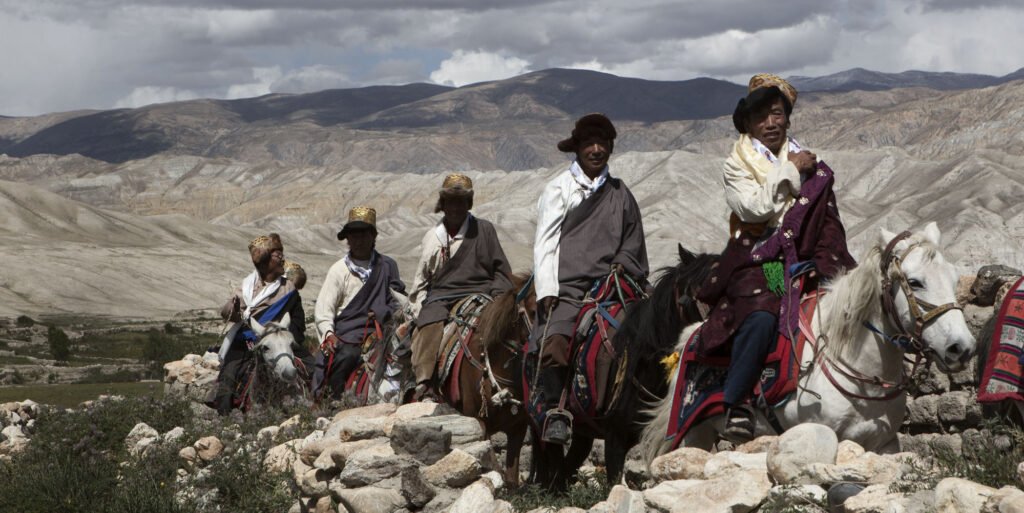
A frequently cited example is Upper Mustang in north-western Nepal, home largely to the Thakali and Loba communities, where changing snowfall patterns and prolonged water scarcity have altered traditional agricultural systems. Communities that once relied on predictable snowmelt for irrigation are increasingly facing water shortages. Local farmers report declining productivity in barley cultivation and changing grazing patterns for livestock. As a result, seasonal and permanent migration among younger populations has increased, with many seeking employment in urban centres such as Pokhara and Kathmandu or abroad. Recent climate adaptation studies conducted by ICIMOD indicate that declining snowfall and increasing water stress are significantly affecting agricultural livelihoods in Upper Mustang.
Similarly, Sherpa communities in the Khumbu region of Nepal have reported increasing concerns regarding glacial retreat, changing trekking seasons, and heightened risks from Glacial Lake Outburst Floods (GLOFs). Since tourism remains a major source of income, climate-related disruptions directly affect local livelihoods and economic security. Changes in snow cover and weather conditions have also affected mountaineering activities, creating uncertainty for households dependent on tourism revenues.
The consequences of climate change extend beyond gradual environmental change. The Melamchi flood of 2021 demonstrated how extreme weather events can rapidly devastate mountain communities. Triggered by intense rainfall and debris flow, the disaster destroyed roads, bridges, hydropower infrastructure, and water supply facilities that served hundreds of thousands of residents in Kathmandu Valley. The event highlighted the growing vulnerability of Himalayan communities to climate-induced disasters and the cascading effects such events can have on national development.
Similar trends are visible across India’s Himalayan states. In Uttarakhand, increasing landslide risks, changing rainfall patterns, and water scarcity have intensified existing socio-economic pressures. These environmental changes are making traditional livelihoods increasingly difficult and forcing communities to adapt to rapidly changing conditions.
Migration, Livelihoods, and the Human Dimension of Climate Change
Migration has emerged as one of the most visible manifestations of environmental stress in mountain regions. While migration has historically been influenced by economic and social factors, climate change is increasingly acting as a multiplier of existing vulnerabilities.
In Nepal, communities including the Thakali of Mustang, the Dolpo-pa of Dolpa, and Tibetan-origin communities in Humla and Mugu have witnessed significant youth outmigration over the past two decades. Declining agricultural productivity, changing climatic conditions, and limited livelihood opportunities have encouraged younger generations to seek employment in Kathmandu, Pokhara, and overseas labour markets. While remittances contribute significantly to local economies, the loss of working-age populations can weaken community resilience and reduce the transmission of traditional ecological knowledge.
India faces similar challenges among several Himalayan communities. In Uttarakhand, Bhotiya communities inhabiting border villages such as Mana, Niti, and Nelang have experienced increasing outmigration due to declining economic opportunities, changing environmental conditions, and recurring natural hazards. Many younger residents have relocated to Dehradun, Haldwani, and other urban centres in search of employment. The phenomenon of “ghost villages” has become a powerful symbol of mountain depopulation. According to reports from the Uttarakhand Rural Development and Migration Commission, more than 1,000 villages have experienced severe depopulation or complete abandonment due to a combination of livelihood insecurity, inadequate infrastructure, environmental degradation, and increasing disaster vulnerability.
The challenge is therefore not merely demographic. As younger generations leave, communities risk losing centuries of accumulated knowledge related to forest conservation, water management, biodiversity protection, and climate adaptation. This makes migration both a social and environmental issue that requires coordinated policy responses.
Why Mountain Communities Matter for Regional Security
The significance of mountain communities extends far beyond local development concerns. The Himalayas support major river systems such as the Ganges, Brahmaputra, and Indus, making them essential to food security, energy production, and water availability across South Asia. The importance of Himalayan ecosystems for regional water security has also been emphasized by the UN World Water Development Report 2024. Consequently, environmental instability in mountain regions can create far-reaching impacts for downstream populations.
In the Eastern Himalayas, indigenous communities such as the Lepchas of Sikkim, the Bhutias of Sikkim and Darjeeling, and the Monpas of Arunachal Pradesh maintain livelihoods closely linked to forests, water systems, and mountain ecosystems. Environmental degradation therefore affects not only local economies but also cultural heritage, traditional knowledge systems, and regional ecological resilience.
The 2023 Glacial Lake Outburst Flood (GLOF), documented by India’s National Disaster Management Authority, illustrates this reality. Originating from South Lhonak Lake in Sikkim, the disaster affected several Lepcha settlements and downstream communities along the Teesta basin. It caused widespread destruction, damaging roads, bridges, hydropower facilities, and settlements while displacing thousands of residents. Beyond infrastructure damage, the event disrupted local livelihoods dependent on agriculture, tourism, and river-based economic activities.
Similarly, the Chamoli disaster of February 2021 in Uttarakhand demonstrated how mountain hazards can rapidly evolve into national security and development challenges. A massive rock-and-ice avalanche triggered devastating floods in the Rishiganga and Dhauliganga river systems, destroying hydropower infrastructure and causing more than 200 fatalities. The disaster raised important questions regarding sustainable development, environmental governance, and infrastructure planning in ecologically fragile regions.
These examples underscore a crucial point: mountain communities are not simply local stakeholders. Their resilience directly influences broader regional resilience. Environmental risks originating in mountain regions increasingly affect multiple countries, making mountain governance a matter of regional security.
From Nepal’s Role to India–Nepal Mountain Diplomacy
Much of the recent discourse on Himalayan governance has focused on Nepal’s growing role in climate diplomacy. Through institutions such as ICIMOD and its active engagement in global climate forums, Nepal has emerged as an important advocate for mountain ecosystems and vulnerable communities.
However, the future of Himalayan governance cannot depend solely on Nepal’s efforts. Environmental systems do not recognize political boundaries. Rivers, glaciers, biodiversity corridors, and climate risks connect communities across Nepal and India. Consequently, effective responses require stronger bilateral cooperation grounded in shared environmental interests.
Such cooperation is particularly important because many Himalayan communities share historical, cultural, and economic connections across borders. Communities such as the Sherpas, Tamangs, Bhutias, Monpas, and several Tibetan-origin groups possess transboundary cultural networks that can support collaborative approaches to climate adaptation and sustainable development.
India and Nepal already possess several advantages that can facilitate such cooperation. The two countries share an open border, common river systems, deep cultural ties, and similar environmental challenges. These shared realities create opportunities for what may be described as “mountain diplomacy” – a form of regional cooperation centred on ecological interdependence, climate resilience, and human security.
An India–Nepal framework for mountain diplomacy could focus on several priorities. Joint glacier monitoring programmes could improve scientific understanding of environmental changes across the Himalayas. Cross-border early warning systems for floods, landslides, and Glacial Lake Outburst Floods could strengthen disaster preparedness. Collaborative livelihood programmes could help reduce distress migration while promoting sustainable economic opportunities. Furthermore, both countries could work together to document and integrate Indigenous and community-based knowledge into climate adaptation strategies. International organizations such as the Mountain Partnership have increasingly emphasized the value of Indigenous and community-based knowledge in climate adaptation strategies. Such initiatives would move beyond traditional diplomatic concerns and place mountain communities at the centre of regional cooperation.
Policy Recommendations
To strengthen the resilience of Himalayan communities, several policy measures deserve immediate attention. First, India and Nepal should establish a Himalayan Resilience Platform bringing together scientists, policymakers, local governments, and community representatives to facilitate knowledge sharing and coordinated responses to emerging environmental challenges.
Second, investments in climate-resilient livelihoods such as sustainable agriculture, eco-tourism, mountain entrepreneurship, and renewable energy should be expanded to reduce economic vulnerability and discourage distress migration. Such approaches are consistent with the World Bank’s Green, Resilient and Inclusive Development (GRID) framework.
Third, governments should strengthen community-based adaptation programmes that combine scientific research with traditional ecological knowledge. Special emphasis should be placed on involving Thakali, Sherpa, Gurung, Tamang, Bhotiya, Lepcha, Monpa, Bhutia, and Dolpo-pa communities in policy design because these groups possess generations of knowledge regarding water conservation, biodiversity management, sustainable agriculture, and disaster preparedness.
Fourth, both countries should expand transboundary disaster management cooperation through real-time data sharing, joint emergency response mechanisms, and integrated early warning systems, drawing lessons from initiatives such as the South Asia Water Initiative (SAWI). Finally, mountain communities should be provided greater representation within national and international climate governance processes to ensure that policies reflect local realities and priorities.
Conclusion
The Himalayas are undergoing profound environmental transformations that are reshaping livelihoods, migration patterns, and development trajectories across Nepal and India. Mountain communities are among the first to experience these changes, yet they also possess valuable knowledge and adaptive capacities that can contribute to sustainable solutions.
The experiences of the Thakali and Loba communities in Mustang, the Sherpas of Khumbu, the Dolpo-pa communities of Dolpa, the Bhotiya villages of Uttarakhand, the Lepcha settlements of Sikkim, and the Monpas of Arunachal Pradesh demonstrate that climate change is no longer a distant environmental concern. It is a present-day challenge affecting livelihoods, infrastructure, migration, and regional security. At the same time, these examples reveal the resilience and ingenuity of mountain populations that continue to adapt despite growing uncertainty.
Recognizing mountain communities as strategic stakeholders rather than passive victims is essential for the future of Himalayan governance. While Nepal has emerged as an important voice in climate diplomacy, meaningful progress will require stronger India–Nepal cooperation that places mountain communities at the centre of policy design and implementation.
Ultimately, the true guardians of the Himalayas are not governments or institutions alone. They are the Thakali farmers of Mustang, the Sherpa communities of Khumbu, the Dolpo-pa of western Nepal, the Bhotiya villages of Uttarakhand, the Lepcha settlements of Sikkim, the Monpas of Arunachal Pradesh, and countless other Himalayan communities whose knowledge, resilience, and stewardship have sustained these landscapes for generations. Protecting their future is not only a matter of social justice but also a prerequisite for ensuring the environmental stability, human security, and geopolitical resilience of the Himalayan region itself.
Pahi Bhuyan is a Research Intern at NIICE & a student at the School of International Studies, Central University of Gujarat, India.