10 June 2026, NIICE Commentary 12534
Kim Wilhelm Perez & Amadeus Quiaoit
Critical Standpoint of the Regional Status Quo
With Taiwan’s main opposition party, the Kuomintang (KMT) made a rare visit to the People’s Republic of China (PRC) on 10 April 2026, with a so-called party-to-party diplomacy between Beijing and Taipei, it reached new developments over talks that could bring peace negotiations in the cross-strait. With an aim of the One China principle became the center of the summit to de-escalate the tensions between Beijing and Taipei. Tensions in the cross-strait became a ticking time bomb due to possible military confrontation between the US and China, which applied coercive diplomacy to deter the US from increasing support of Taiwan to take steps toward independence through military assistance.
Taipei’s view of Beijing is an existential threat to its independence, and potentially, the year 2027 became a concern that could lead to the total invasion of Taiwan. This comes after US officials claimed that by 2027, Beijing will have successfully built up its military capability and doubled its inventory of ballistic and missile stockpiles in 2020. Meanwhile, in the recently published US National Defense Strategy (NDS), President Trump does not mention Taiwan as part of the US grand strategy but focusing more on the side of Western Hemisphere and on defending the US homeland. Even the Quadrilateral Security Dialogue (QUAD), which serves as a multilateral force between allied states, is not mentioned in the US National Defense Strategy (NDS). This US policy became unclear to its allies like Japan, South Korea, and India which forced them to provide for their own defense or reconsider their reliability with the US partnership.
On the other side of the world, the US conflict against Iran had a tremendous effect globally, which strategically challenges China’s expanding ambitions in the Indo-Pacific region. As a result, the US missile defense system from South Korea and thousands of marines stationed in Japan have relocated to the area of the Persian Gulf, which left both countries defenseless against possible conflict in the region. Some experts say that the military’s overstretched by military operations in Latin America and the Middle East could signal a willingness to step back from its support for Taiwan, which could limit arms sales for military support. With the exhausted military footprints of the US in the Indo-Pacific region, the possibilities of a changing power dynamics could result in new opportunities that could shape the region’s status quo.
Western Allies and Expanded Multilateral Defense Initiative
Revival of the Philippines’ external defense capabilities after decades of neglect due to post–Cold War demilitarization, internal security priorities, and limited defense spending has begun to rebalance what was once criticized as an “unequal arrangement” under the Mutual Defense Treaty (MDT) with the United States. The Philippines’ previous lack of military capacity not only fostered dependence on the US but also raised concerns in Washington that the Philippines might leverage the treaty to assert its South China Sea claims in ways that could trigger unwanted conflict with China.
The ongoing modernization of the Philippine forces, coupled with increased international recognition of its maritime claims and shifting U.S. strategic focus toward China, signals a stronger commitment to self-defense and reduces reliance on treaty ambiguity, thereby creating conditions to clarify obligations and restore the treaty’s credibility as a deterrent mechanism. The closing reiteration of Balikatan 2026 centered on the idea of a “dangerous security environment”. Referred to as the new focus that could cause an impact on cross-strait conflict near Taiwan, the Luzon Strait shall be an area of concern, which could activate the Multi-Domain Task Force employing precision capabilities for maritime key terrain seizure operations as part of sea denial and territorial defense.
Adding to the events of Balikatan 2026, the US was able to do a test fire of a Tomahawk missile as part of its Typhon Mid-Range Capability (MRC) missile system. This mobile system could launch Tomahawk cruise missiles and SM-6 interceptors from land-based platforms, which is categorically designed to extend long-range strike capabilities. This activity is part of the scenario under the Joint Pacific Multinational Readiness Center (JPMRC), which formed part with the involvement of maritime strike groups from the US, Philippines, Japan, and Canadian forces.
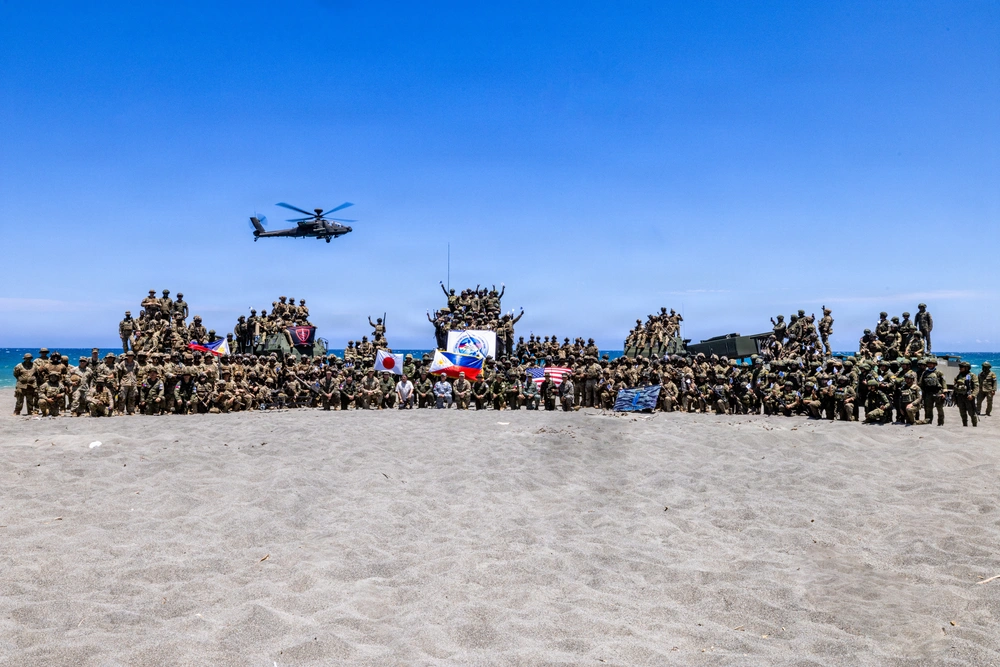
With the participation of Japan in Balikatan 2026, this evolves into a bilateral alliance to a broader strategic alignment of US partners aimed at counteracting China. This comes after Japan’s aim to secure the First Island Chain and counter Chinese maritime expansion in the South China Sea. Japan was able to deploy 1,400 personnel, the first time it sent combat troops to the Philippines soil since World War II. Tokyo’s strategy of growing alliances in Southeast Asia will focus more on relaxed arms exports, security pacts, and joint exercises. According to the Philippine Marine Corps (PMC), Japan’s inclusion in the Balikatan 2026 demonstrated improved territorial defense operations with the US forces and its allies in enabling seamless integration of air, land, and sea capabilities with an aim to have interoperability of participating forces through execution of complex amphibious operations.
The Philippines, Strategic Theater for Future Coercive Conflict
The Philippines is a fulcrum of the U.S.-Chinese strategic competition in Asia. Based on its geography alone, the Philippines is arguably Southeast Asia’s most important country. Its southernmost island sits in a tri-border region with Indonesia and Malaysia, while its northernmost island is a mere 90 miles from Taiwan. The northern islands of Luzon are part of the First Island Chain, with the Second Island Chain marking the maritime boundary of the Philippine Sea’s eastern reaches. For 200 nautical miles off its west coast stretches the West Philippine Sea and, beyond that, the broader South China Sea. As then President Trump has said of the Philippines: “It is a strategic location, the most strategic location. The most prime piece of real estate from a military standpoint.” Yet, the story of the Philippines is one of unmet potential. Historically, the country has been dogged by political instability, economic mismanagement, and internal security threats. For too long, the Philippines has been a nation swept up by the geostrategic currents of its neighborhood rather than a shaper of them. That has started to change.
The geographic advantage of the Philippines is set to be seen as a primary concern because of the geopolitical framework encompassing islands and archipelagos from Japan through Taiwan, including the Philippines, and down to Borneo. The Philippines shapes the dynamic of the East and South China Seas due to its strategic position between these two seas. Both the US and Japan, through the Enhanced Defense Cooperation Agreement (EDCA) and the Reciprocal Access Agreement, complement each other’s ability to have a framework in flexibility and coordination for the Philippines’ allies who have a vital interest in the First Island Chain. The Philippines’ archipelagic nature gives the US and its allies leverage in determining strategic chokepoints through the Luzon Strait, waters surrounding Palawan, and areas of proximity to key maritime routes and contested waters located in the South China Sea. Consequently, the Philippines can be transformed into a natural barrier against potential Chinese movements into the Pacific, making it a critical asset in any US-China military confrontation.
Strategic Assessment and Relevance
The Philippines’ shift from a traditionally bilateral defense posture through the Mutual Defense Treaty with the United States toward a more collective framework reflects a rational strategic approach to the evolving power asymmetries in the South China Sea. This transition enhances external balancing against China’s growing maritime capabilities while simultaneously strengthening deterrence credibility through multilateral signaling and shared strategic commitments. Embedding a new security approach within a broader network of like-minded states, the Philippines stands firm in adhering to a rules-based international order, consistent with the 2016 ruling of the Permanent Court of Arbitration, and aligns with Southeast Asia’s broader practice of strategic hedging by engaging multiple actors to constrain unilateral dominance without provoking outright confrontation.
Ultimately, collective defense provides Manila with greater strategic resilience, bargaining leverage, and operational capacity, positioning it more effectively within an increasingly contested maritime domain. Japan’s defense posture toward a collective security framework is significantly reinforced due to its strategic role in Southeast Asia. As a proactive contributor to peace, Japan enhances external balancing against China by adding advanced military capabilities and supporting coalition-building dynamics. Japan’s involvement also reflects Southeast Asia’s strategy of hedging and networked security, where middle powers diversify partnerships to avoid overdependence on a single ally while constraining coercive behavior. Japan functions as a critical “force multiplier” in the Philippines’ transition from bilateral defense to a layered, collective security architecture, enhancing both strategic resilience and regional stability in the South China Sea.
Meanwhile, the ASEAN–NATO–style collective defense pact in Southeast Asia remains strategically appealing but ultimately constrained by the region’s political realities. Amitav Acharya’s argument over ASEAN’s foundational principles, particularly non-interference, consensus-based decision-making, and strategic neutrality, poses structural barriers to a NATO-like alliance. Unlike Europe during the Cold War, Southeast Asia lacks a unified threat perception; member states maintain varying degrees of economic and political alignment with China, making binding mutual defense commitments difficult to institutionalize. As Amitav Acharya argues, ASEAN’s strength lies in its flexibility and inclusivity, not in rigid military alliances. Thus, the networked security architecture, which is composed of overlapping bilateral and minilateral arrangements involving actors such as the United States, Japan, Australia, and selected ASEAN states, forms a collective defense that is less formal but still strategically meaningful, enabling deterrence without provoking full-scale bloc confrontation, aligning with Southeast Asia’s long-standing hedging strategy.
Kim Wilhelm Perez is a Research Associate of IDSC and a graduate of AB International Studies at Far Eastern University – Manila, Philippines. Amadeus Quiaoit is a Resident Fellow of IDSC and a graduate of BA International Studies at the Polytechnic University of the Philippines (PUP), Philippines.