30 April 2026, NIICE Commentary 12469
Dr Chander Shekhar
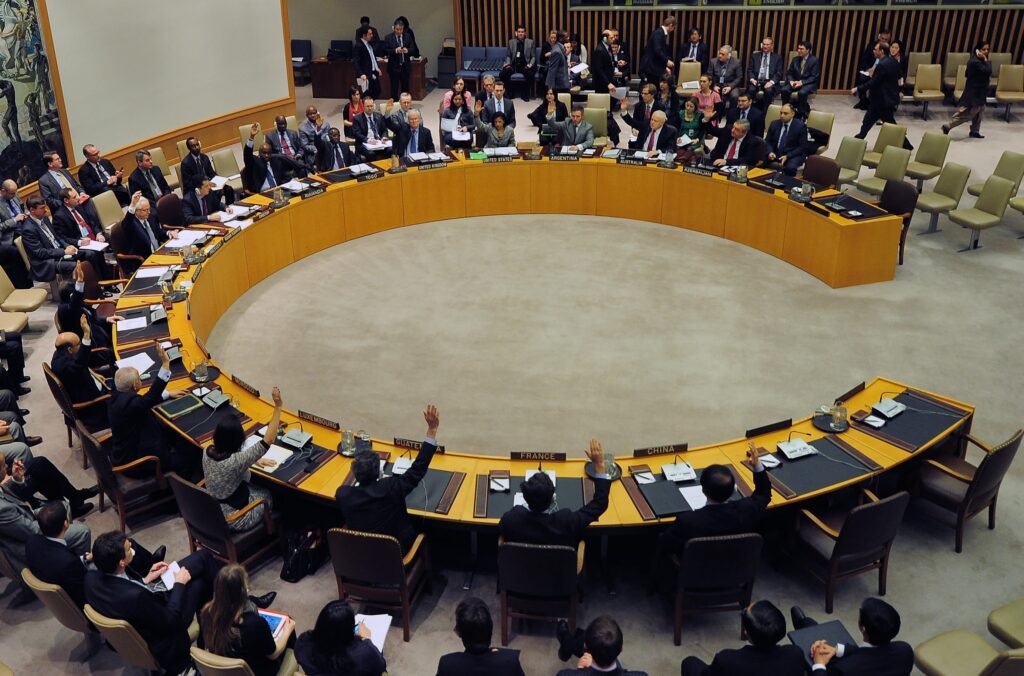
On 27 April 2026, the UN organized an open debate in the United Nations Security Council on “the safety and protection of waterways” under the broader agenda to maintain international peace and security. This meeting was held under the presidency of Bahrain in April 2026. Bahrain has played a crucial role in proposing defensive measures to protect international shipping, backed up by Western countries and GCC brotherhood nations, to prosecute and bring Iran on track to normalize the situation in the Middle East. Initially, it had welcomed IMO’s call to condemn Iran for closing Hormuz, now utilizing its UNSC chairmanship by addressing the shared issue. Before the UN Meeting, on 19th April, the Bahrain foreign ministry issued a statement to step up the call for the global community “to continue cooperation and coordination to safeguard the freedom of international navigation and prevent future violation”. As the two oldest, or perennial, geopolitical and traditional rivals, Bahrain and Iran, the former is accused of having ties with the United States-led alliance, and it has withdrawn the citizenship of more than 68 people for their support of Iran since late Feb. The maritime meeting has examined the case of the Strait of Hormuz (SOH), seeks measures to de-weaponize the strait, presents collective deterrence, and did not touch upon how to establish peace in the region by dialogue and diplomacy.
Concerns and Outcomes
Recent years have seen how countries have weaponized resource dependence and exploited the global energy market. Iran, whose ambition to make nuclear weapons and ensure state survival, is accused of weaponizing the geography as a tool for negotiation with the United States and Israel. It is the Strait of Hormuz through which oil, gas and other goods are shipped to different Asian, African, and other countries. It is the lifeboat for these economies.
During the latest UNSC Special Maritime Meeting, the IMO Secretary General underlined the ground challenges that emerged in the wake of the recent standoff in the Hormuz, where nearly 20,000 seafarers and about 2,000 ships were trapped in the region, given that the ‘principle of free navigation is not negotiable’. He says, “Shipping and seafarers shall never be used as leverage in geopolitical conflicts.”
Closing straits and setting payment tolls are major issues discussed and seen against the UNCLOS, as mentioned by the IMO SG. It was stated that issues a) straits being used for international navigation should not be closed by bordering states, and b) starting payment or setting up tolls for entry and exit of ships form no legal basis. They violate long-established rules and norms under international and customary laws.
The IMO SG’s 4 Points Action Plan underscored in the UNSC meeting marks a breakthrough event. These measures are linked to safely evacuation of innocent seafarers, removal of mines and other hazardous items which affect commercial shipping lines, providing operational and technical civilian assistance with respect to evacuation and taking pragmatic steps to normalize shipping, such as lowering insurance costs, etc. Among others, UK Representative Steven Doughty expressed concerns about this crisis, which has cascading effects, not just on shipping, but also on increasing costs across the energy market and supply chains. Iran should not hold the international economy hostage, which threatens international and regional security.
US Assertion under Trump
For the United States, the Middle East has been a chessboard, giving Israel an upper hand to be the regional hegemon to shape regional geopolitics by dividing and dominating regions, which stepped up under the Trump administration. The moment of unipolar world order seems to be over and fractured after Trump’s calibrated push for strategic autonomy in different continents from Europe, Sub-Asian regions, and more importantly, the re-emergence of the global south without assertion, and struggling for recognition in the power game. The Strait of Hormuz, unlike the Panama Canal, where US asserted its power to retake and sought to rename the Gulf of Mexico to America are mighty steps in his last term as president of the United States, is something different ground, here Mahanian Sea based power doctrine may lose its strategic relevance as Iranian employed multi-domain warfare strategies with less costly instruments shown a pragmatic and progressive Muslim country.
Hopefully, the United States, which has withdrawn from several UN agencies and agreements, is not thinking of leaving the United Nations Security Council sooner or later, which, under Trump, is possible, could be a strategic win for China and Russia. The decline of NATO organization is already visible in states’ policies.
In the UNSC Maritime meeting, US Ambassdor Mike Waltz noted down the maritime chokepoints relevance in global commerce in general, which accounts of more than 80 percent of global trade by volume, and that’s vital for all as an international community which is “to be choked off, to be mined, to be weaponized, to be attacked like two-bit pirates”, the price of losing it the entire world would pay price. It was further stated that the Strait of Hormuz “is not Iran’s wield like its own moat and drawbridge, not Iran’s hostage, not Iran’s bargaining chip, not even Iran’s toll road”, these points testified by over 100 countries as noted by Ambassador Mike.
Conclusion
The Strait of Hormuz, after the Red Sea crisis, has emerged as a strategic test for countries dependent on it. Countries have weaponized resources at the onset, but Hormuz shows something different. The threat to state survival opens doors for energy supply side challenges. Although Iran has allowed the passage of ships for some countries in Asia. The US’s policy toward Iran shows laws are for weak states, not powerful states. States can be invaded, giving never-proven allegations, prima facie, in the end, national interests are achieved to make states submissive without words, rule and silence them.
The UNSC Maritime Security meeting presented a pre -planned agenda backed by the US and its regional alliance partners to deliberate issues of common interests, establish collective deterrence, which already failed, and set no ground for a conducive environment to negotiate with the Iranian regime, which survived by diversifying options to win over enemies. More needs to be done to establish stability and peace in the SOH.
Dr Chander Shekhar is a Researcher at the Center for International Politics, Organizations and Disarmament, Jawaharlal Nehru University, New Delhi, India.