
1 April 2026, NIICE Commentary 12409
Shruti Khadka
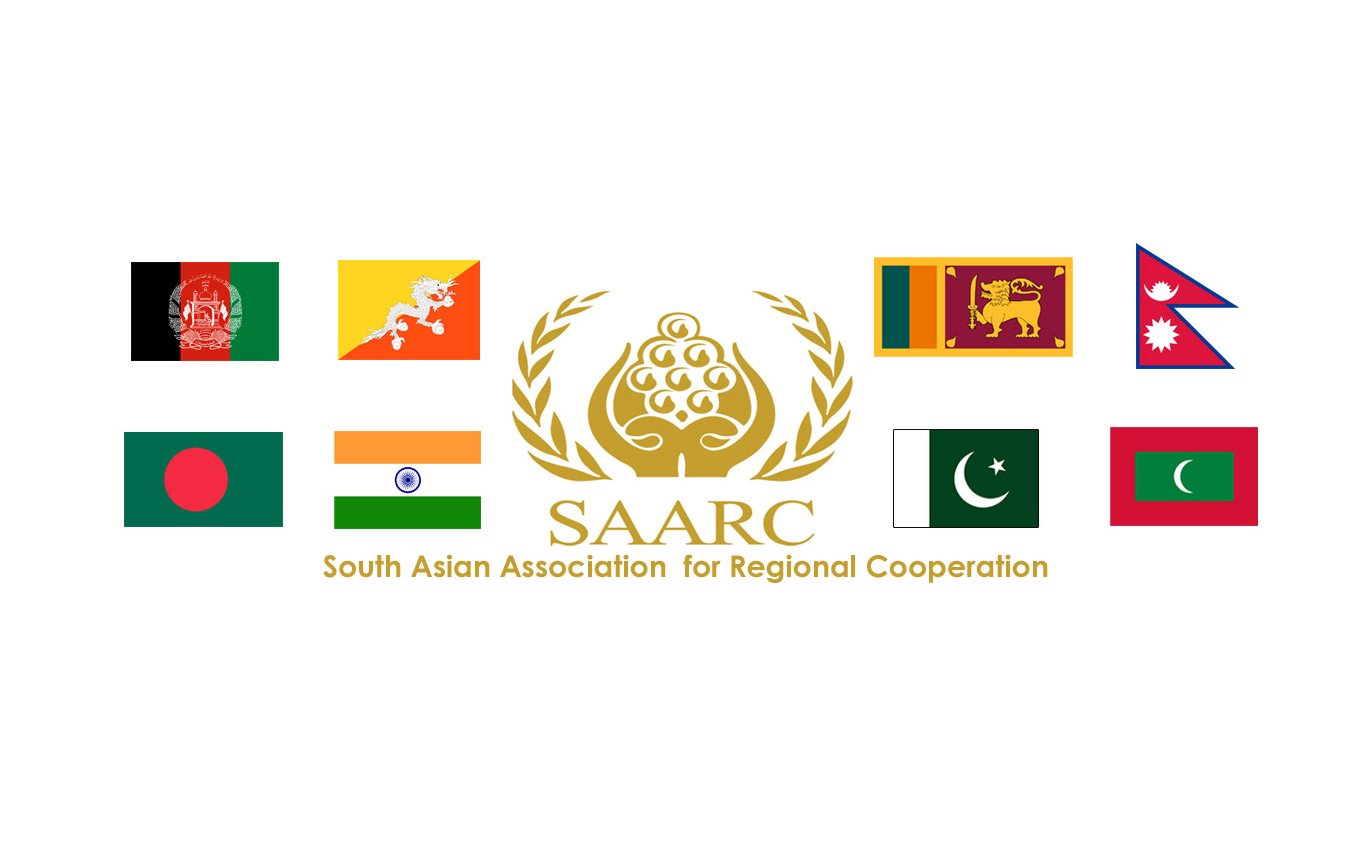
SAARC (South Asian Association for Regional Cooperation), a regional organization that lit up the beam of light in South Asian countries with a newfound hope for prosperity, development, peace and a shared future, hasn’t seen the light of day in a decade. What came across as a common solution to the regional problems and means of cooperation in South Asia has been brain-dead and non-functional due to the power struggles among its members especially India and Pakistan.
Nail in the Coffin
With its mandate to keep bilateral matters at bay, SAARC was gaining momentum with the adoption of a range of regional cooperation frameworks and mechanisms like the SAARC Development Fund, the SAARC Social Charter, SAARC Regional Centers, Agreements on Food Security, South Asian Free Trade Area as well as Regional Convention on Suppression of Terrorism to promote integration and collective action in South Asia. All hell broke loose ever since India refused to participate in the SAARC Summit that was due to be held in Pakistan in 2016 due to the bilateral contentions between the two. It remained stalled following the terror attack in Pulwama in Jammu and Kashmir that the former blamed on Pakistan. The SAARC summit, the supreme body of leaders, hasn’t been held since 2014, leaving the fate of SAARC in limbo.
Watching through the Lens of Theories of International Relations
Realist Perspective
Realist power struggles between India and Pakistan have plagued the effective functioning of SAARC. The two members have been in contention in order to secure their national interests and security. The Darwinian notion of “struggle for existence” has obliged the leaders of both states to place their foreign policy and practice in order to secure their own interests using power as a key to the survival of the states. Large power asymmetry of India to other member states has forced the rest of the members of SAARC to be limited to the role of silent spectators as no negotiation and talks of resuming the summit have been going on. As Kenneth Waltz puts it, regional cooperation is difficult in anarchic systems with unequal power. The gist of Morgenthau’s power politics is reflected in SAARC.
Liberalist Perspective
Inadequacy of liberal institutionalist values has also played a key role in undermining the purpose of SAARC. Liberalism focuses on economic, social and cultural power rather than the traditional hard power in the conduct of relations between states. The central argument lies in the point that cooperation rather than confrontation is in the interests of nations. The notion of liberalism focuses on free trade, democracy and global institutions in order to secure their interests vis-à-vis the rest of the world. The intra-regional trade of the SAARC countries amounts to less than 5% of global trade. This has further cemented the operationality of SAARC. Conflicts are automatically reduced when economic interactions take place. The whole purpose behind the establishment of SAARC was to accelerate the economic growth, social progress, and cultural development in the region as well as promote collective self-reliance. Lack of economic interaction has halted it in achieving its objectives. On the contrary, ASEAN, a regional organization of Southeast Asia, has been considerably successful in achieving its objective of regional peace, stability and prosperity. Its intra-regional trade exceeds over 25%. This has contributed largely to their regional peace, stability and prosperity.
Constructivist Perspective
From the constructivist lens, the lack of common regional norms and identity has also contributed to the inefficiency of SAARC as a regional organization. Norms, values, shared understandings, identities and culture that the states evolve within and among themselves guide state behavior. The core idea of constructivists is centered on states’ perception of each other as Wendt emphasizes anarchy as what states make of it. There is an absence of a strong “South Asian Identity” in the arena of South Asia. Lack of collective identity and mistrust among each other has eroded the consolidation of South Asia as a functional regional apparatus. Animosities and historical grievances have prevented them from engaging with each other as the mistrust becomes institutionalized. There prevails a negative intersubjective structure that emphasizes that other states are potential threats rather than partners. Thus, despite the geographical proximity and shared culture, cooperation seems like a distant dream lacking a common unified approach.
Revitalization of SAARC
With its geographical proximity, abundance of natural resources, similarity in socio-cultural aspects and practices, South Asia can spur its economic growth, peace and stability as well as prosperity as a regional organization. A collective solution to collective problems should be institutionalized to give direction to its development aspirations. To achieve this, first of all, the political willpower of the member states should be accelerated. There should be a political willingness to divert bilateral adversities in order to achieve a greater regional advantage. Enhancing connectivity via infrastructural development and intra-regional integration should be facilitated. The SAARC Growth Quadrangle should be reinvigorated as a sub-regional organization to fulfill the developmental needs of the nation. Bilateral matters should be kept aside and the SAARC Summit should be held as soon as possible to make the institution active. Cooperation should start with low political dimensions like economic exchanges, climate diplomacy, health coordination, educational cooperation and student exchange facilities, Information and Communication Technology, and so on, rather than politically sensitive issues. Promotion of tourism and public diplomacy would further help to reduce the suspicion and insecurities among people.
In a nutshell, SAARC has been a playground of states’ self-interests, geo-political rivalries, institutional inefficiencies as well as the internal constraints of the states. Reinvigorating SAARC needs to underscore mutual interests, economic interaction, and social cooperation coupled with revamping the institutional capacities. While it may seem like catching a tartar, it is possible with increasing political willpower and commitment, insulating bilateral contentions for broader regional interests and accentuating common South Asian identity on the international front, thriving in the global world order as a united regional body.
Shruti Khadka is currently a first-semester student pursuing a Master's in International Relations and Diplomacy as well as a Master's in Public Administration at Tribhuwan University, Kathmandu, Nepal.
