31 March 2026, NIICE Commentary 12406
Arman Sidhu
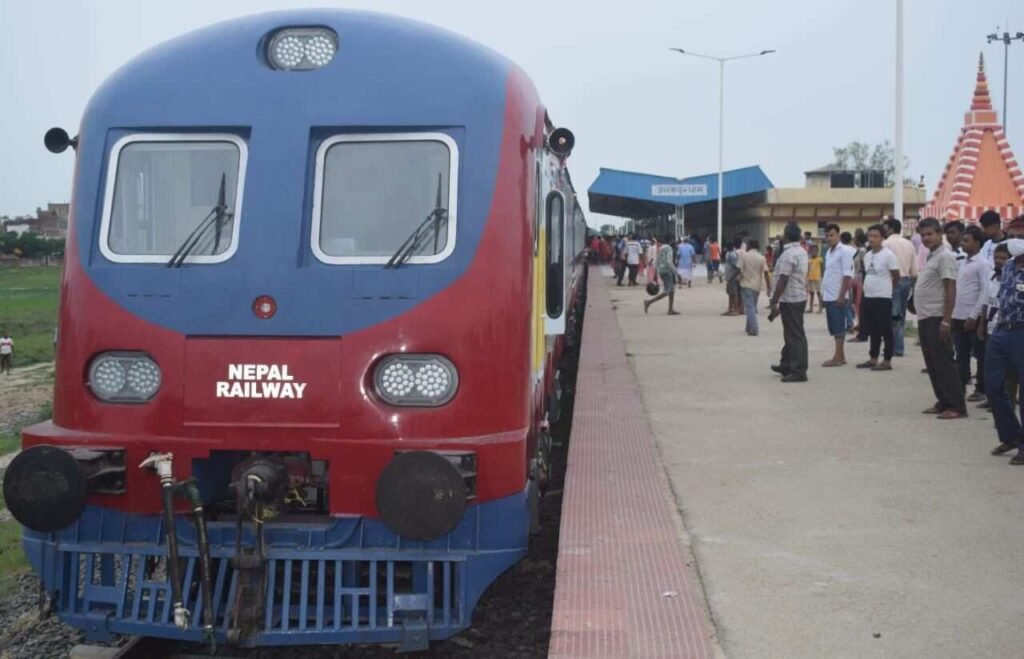
The two most consequential infrastructure proposals currently under consideration in Nepal are railway projects, and both carry implications that extend well beyond passenger transport. India’s proposed Raxaul-Kathmandu broad gauge railway (136kms, estimated cost exceeding USD3 billion) and China’s proposed Kerung-Kathmandu standard gauge railway (approximately 72kms on the Nepal side, estimated at USD5.5 billion for the full section) represent competing bids to become Nepal’s primary cross-border freight corridor.
The direction in which bulk commodities, including mineral resources, flow across Nepal’s borders for the next several decades will be substantially determined by which railway reaches operational status first. For a country with identified mineral deposits across 16 commodity categories and a mining sector contributing just 0.51 percent of Gross Domestic Product (GDP), this is a resource geopolitics question as much as it is a transport infrastructure question.
Two Railways, Two Gauges, Two Strategic Logics
India’s Raxaul-Kathmandu project would extend Indian Railways’ broad gauge (1,676 millimetre) network into the Kathmandu Valley through 42kms of tunnels and 13 stations. India’s Railway Minister Ashwini Vaishnaw confirmed in the Rajya Sabha on 20 March 2026 that the Final Location Survey and Detailed Project Report (DPR) have been completed. The choice of broad gauge is analytically significant. Broad gauge is incompatible with the standard gauge (1,435 millimetre) used by Chinese rail networks.
Nepali infrastructure analysts have noted that the gauge selection was deliberate: it prevents any future Chinese standard gauge extension from connecting through Nepal into the Indian rail network. The railway would integrate Nepal’s freight system into the Indian logistics architecture, routing bulk commodities south toward Indian ports and industrial centres.
China’s Kerung-Kathmandu railway carries a different engineering and strategic profile. The approximately 72km Nepal segment would require roughly 98.5 percent tunnel and bridge coverage, spiralling from an elevation of roughly 4,000 metres at the Tibet border to 1,400 metres at Kathmandu.
Ground surveying was jointly conducted through early 2025, and the project received institutional momentum when Nepal signed a Belt and Road Initiative (BRI) Framework Cooperation Agreement during Prime Minister Oli’s December 2024 visit to Beijing. The estimated USD5.5 billion construction cost makes it among the most expensive per-kilometre railway projects in the world. If completed, it would connect Nepal to the Qinghai-Tibet Railway and provide the country’s first direct freight link to Chinese markets, bypassing Indian territory entirely.
The Mineral Trade Dimension
Nepal’s mineral trade currently flows in a single direction. India accounts for approximately 64 percent of Nepal’s total trade, and all current mineral imports and exports transit Indian territory. Nepal imports over USD1 billion in iron and steel annually, overwhelmingly from or through India. The cement sector, Nepal’s only significant mineral processing industry (with installed capacity of 22 million tonnes across 124 registered factories), depends on Indian market access for its export ambitions. Indian authorities have withheld IS-mark certification for Nepali cement since January 2024, effectively blocking exports.
This blockage has been linked to restrictions on goods with Chinese components, with Chinese-invested cement operations (Hongshi Shivam and Huaxin Cement, approximately USD 500 million in combined Foreign Direct Investment (FDI)) as the apparent targets. The episode illustrates how south-facing trade dependence creates leverage that India can apply selectively.
A northern railway connection would alter this dynamic. China’s western provinces face supply constraints in construction materials, base metals, and industrial minerals. Nepal-Tibet bilateral trade reached 5.12 billion yuan (approximately USD700 million) in 2024, up approximately 85 percent year-on-year, indicating growing commercial gravity on Nepal’s northern border.
Nepal’s identified iron deposits (exceeding 300 million metric tonnes across Jhumlabang, Dhaubadi, Phulchoki, Labdi Khola, and Thoshe), copper occurrences in Ilam and Solukhumbu, and limestone reserves sufficient to sustain current cement production for decades represent potential bulk freight commodities. The railway that reaches operational status first will create the infrastructure pathway through which these resources enter international supply chains.
Critical Minerals and Supply Chain Positioning
The railway competition intersects with the broader global contest over critical mineral supply chains. Chinese geological research has documented substantial rare-metal potential in the Himalayan leucogranite belt that extends from Tibet into Nepal, including tantalum, niobium, lithium, tin, and beryllium occurrences.
India’s Union Budget 2026 announced Dedicated Rare Earth Corridors across four states, while the Mutual and Holistic Advancement for Security and Growth Across Regions (MAHASAGAR) regional cooperation framework provides a broader strategic architecture for engaging South Asian neighbours’ mineral resources. The Australian Institute of International Affairs identified Nepal’s tantalum and niobium deposits in March 2026 as relevant to a proposed South Asian Rare Earth Corridor. Nepal has no seat at any multilateral critical minerals table: it is absent from the Minerals Security Partnership (MSP), the successor Forum on Resource Geostrategic Engagement (FORGE), and the Extractive Industries Transparency Initiative (EITI).
The transport infrastructure question shapes which of these supply chain architectures Nepal’s mineral potential feeds into. A functional northern railway would enable raw mineral concentrate to flow to Chinese processing facilities in Tibet and Sichuan. A functional southern railway would route materials toward Indian refining capacity and, potentially, into India-aligned Western supply chain diversification frameworks.
Nepal’s last systematic mineral exploration programme ended in the mid-1980s, and no deposit has been quantified to international reporting standards (Joint Ore Reserves Committee (JORC) or National Instrument (NI) 43-101). The resource base itself remains speculative. The infrastructure that will determine its commercial orientation, by contrast, is under active development.
Nepal’s Positioning Under the Shah Government
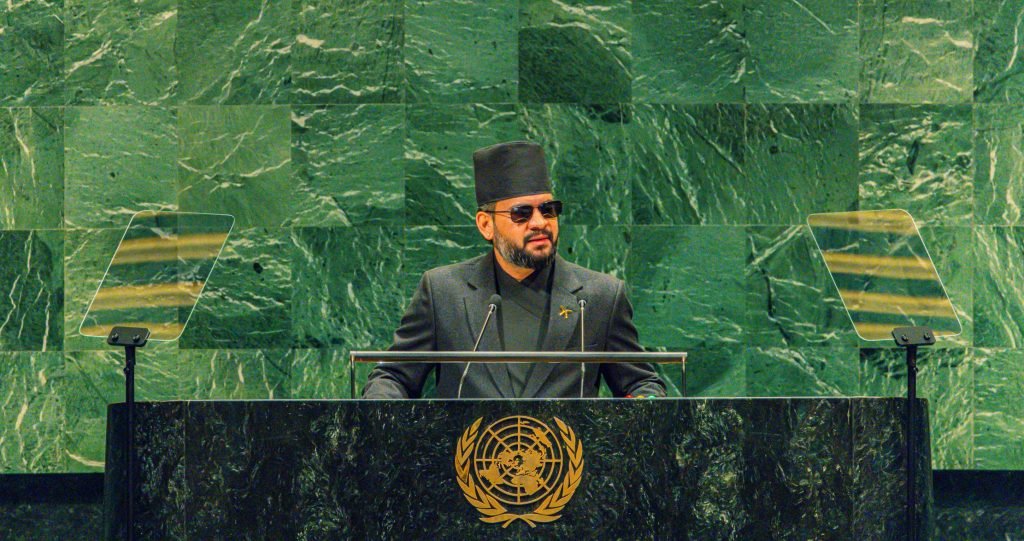
Prime Minister Balen Shah’s Rastriya Swatantra Party (RSP) government inherits both railway proposals and the underlying geopolitical competition they represent. Previous governments managed the India-China dynamic through strategic ambiguity, accepting feasibility studies from both sides without committing decisively to either.
The RSP’s policy manifesto lists infrastructure development and minerals as priority sectors. The party’s 182-seat majority provides legislative capacity to advance either or both railway agreements without coalition constraints. The strategic calculus for Kathmandu is not limited to choosing one railway over the other. Landlocked states with extractive resource potential benefit from multiple export corridors, as competition between transit routes strengthens the resource holder’s negotiating position. Mongolia’s experience with the Tavan Tolgoi coal deposit, where competition between Russian and Chinese railway proposals enhanced Ulaanbaatar’s terms, offers a relevant parallel.
Nepal’s challenge is that neither railway is close to operational, the mineral resource base is unquantified, and the governing legal framework (the Mines and Minerals Act of 1985) contains no provisions for the federal-provincial jurisdictional coordination that large-scale extraction would require.
Outlook
The sequencing of railway completion will create structural facts on the ground that persist for decades. Whichever corridor reaches operational status first will establish the logistics architecture, commercial relationships, and processing partnerships through which Nepal’s mineral resources enter international markets.
The gauge incompatibility between the two proposed systems means that freight infrastructure built for one corridor cannot serve the other without transshipment, compounding the lock-in effect. Nepal’s mineral sector is dormant (0.51 percent of GDP), its resource base is unquantified, and its governing legislation predates the federal system. The infrastructure that will determine the direction of Nepal’s mineral future is being designed before the resource governance framework exists to manage it. This sequencing mismatch represents the central policy challenge for the Shah government’s mineral development agenda.
Arman Sidhu is an American geopolitical analyst who is a Doctoral Candidate at Arizona State University, USA.