2 April 2026, NIICE Commentary 12413
Akshara J.A.
The path to victory in China’s strategic thinking increasingly runs through confrontation, particularly in the South China Sea. This region hosts multiple maritime disputes between China and littoral states. China’s claim, initially articulated through the eleven-dash line and later revised to the nine-dash line, has further intensified these conflicts. Under Xi Jinping, China’s policies in the region have included strategies such as salami slicing. Moreover, these policies exhibit continuity with those of Mao Zedong. Mao’s foreign policy treated sovereignty as non-negotiable, a principle embedded in the Five Principles of Peaceful Coexistence. Xi Jinping maintains this stance through assertive territorial claims in the South China Sea. These claims are framed as integral to China’s national interests. Official Chinese statements emphasise the importance of safeguarding territorial integrity; for instance, China has declared that it will “never yield one inch of its territory and maritime rights and interests”. China’s South China Sea strategy reflects a modern form of sovereignty absolutism: maintaining control over maritime space while simultaneously engaging in multilateral dialogue and infrastructure development on contested features. This demonstrates continuity with Mao’s structural emphasis on regime security and national autonomy.
The fusion of Xi Jinping’s South China Sea strategy with Mao Zedong’s foundational concepts of sovereignty shows an evolution of “Sovereignty Absolutism”. Under Xi, the People’s Republic of China has rendered Mao’s defensive, survival-minded attitude into an assertive, expansionist mindset defined by “National Rejuvenation”. The visible attitude change is seen in the shift from the historical eleven-dash line to the modern nine-dash line. China defends it as a “Core Interest” (héxīn lìyì) on par with the status of Taiwan. Validating this via the 2016 Ministry of Foreign Affairs statements following the Permanent Court of Arbitration verdict, China’s denial to “yield one inch” of maritime space is not merely a border dispute but a modern application of Maoist-regime security.
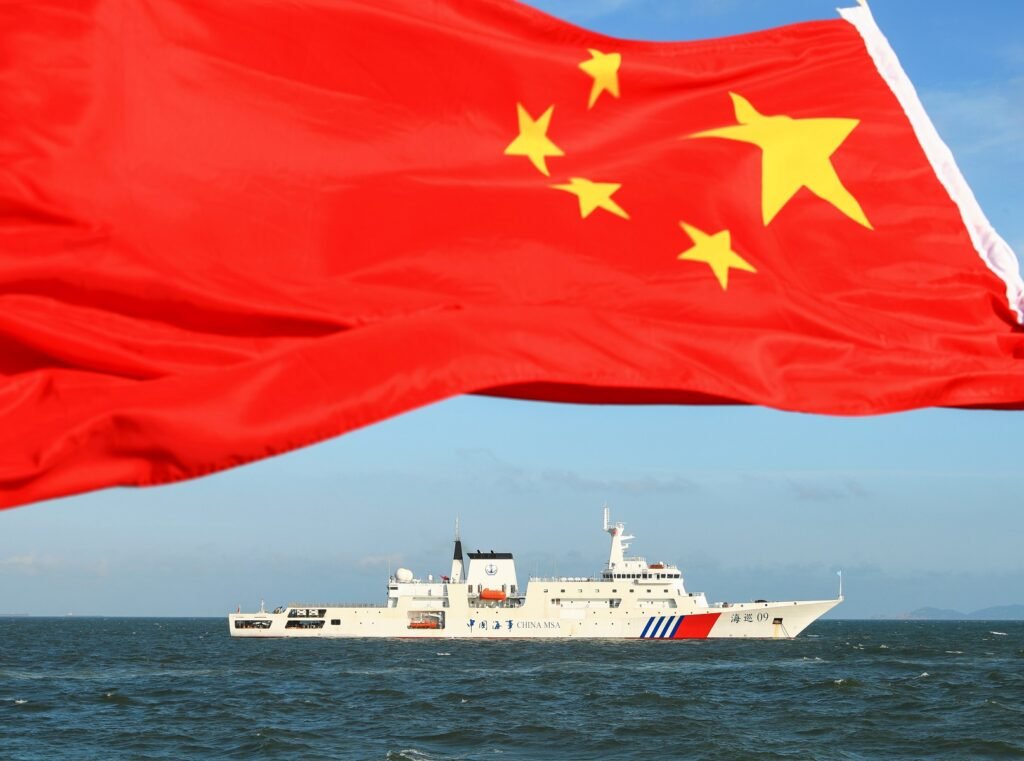
The enforcement of this is done through the “Salami Slicing”. It is an incremental and low-intensity provocation. The instance of this tactic occurred in April 2012 during a dispute with the Philippines over Scarborough Reef in the South China Sea. The Philippines stationed many coast guard soldiers on an island. The soldiers finally evacuated because the reef had been swamped and encircled by Chinese naval and paramilitary vessels. In October 2013, a similar sequence of events happened over Ayungin Island in the Spratlys, resulting in an unequal confrontation between a large number of Chinese warships and the Filipino coast guard. Another tactic called ‘Cabbage Tactics‘ is also employed in the strategy. It is wrapping disputed islands in layers of maritime law enforcement, fishing fleets, and the People’s Liberation Army Navy (PLAN). The recent case of a ‘military-grade’ laser used by China to temporarily blind the crew members of a Philippines Coast Guard (PCG) vessel on a resupply mission to the Ayungin Shoal, one of Manila’s claimed islands. It is not new in the history of Chinese fleets doing a roundabout in the South China Sea to harass foreign vessels and label them as a ‘threat’ so as to indirectly grant itself access to counteract them on its own will. It creates a new normal of control through the building of the “Great Wall of Sand”. By building runways, radar arrays, and missile shelters on artificial features like Subi and Mischief Reefs, Xi demonstrates a structural continuity with Mao’s emphasis on national autonomy, ensuring that maritime space is treated as “blue national territory” inseparable from the CCP’s domestic legitimacy and mandate to rule.
By wrapping a disputed feature, such as the Second Thomas Shoal or Scarborough Shoal in successive layers of civilian fishing vessels (the “Maritime Militia”), China Coast Guard (CCG) ships, and finally the PLAN. Beijing creates a transparent but impenetrable barrier. This layered approach, documented extensively by the Asia Maritime Transparency Initiative (AMTI), forces littoral states into a Catch-22, i.e., they must either concede their maritime rights or risk initiating a kinetic conflict against “civilian” targets. This would allow China to claim the role of the victimised party. This is a highly advanced development of Mao’s “People’s War” doctrine, adapted from the mountains of Yan’an to the deep waters of the tropics, using mass mobilisation to overwhelm a technically superior or legally justified opponent.
The physical transformation of the “Great Wall of Sand” provides the structural backbone for what Chinese scholars call “Harmonious Oceans”. It is a euphemism for a China-centric regional order. According to CSIS data, China has reclaimed over 3,200 acres of land in the Spratly Islands since 2013, installing high-frequency radar arrays, Point Defense Weapons Systems, and hardened shelters for YJ-12 anti-ship missiles. These installations do not merely serve as a military purpose; they function as “sovereignty markers” that provide a permanent, physical manifestation of the Nine-Dash Line. By establishing the “Sansha City” administrative district to govern these remote features, Xi has successfully institutionalised Mao’s obsession with national autonomy, transforming ephemeral maritime claims into a concrete bureaucratic reality that international law, including the UNCLOS framework, struggles to dismantle.
The South China Sea serves as the primary theatre where Xi Jinping’s “China Dream” meets the reality of geopolitical friction. While Mao’s foreign policy was often a struggle for the PRC’s very existence, Xi’s strategy is a struggle for dominance, framed as the inevitable return to a historical norm. The continuity between the two leaders lies in the belief that territorial integrity is the ultimate barometer of the Party’s strength. By combining Maoist ideological rigidity with modern industrial and naval power, China has created a “fait accompli” in the region. The path of confrontation is not seen by Beijing as a risk to be avoided but as a necessary rite of passage for a rising power. As China continues to refuse to “yield one inch”, the South China Sea remains the definitive testing ground for whether a 21st-century superpower can rewrite international norms through the sheer persistence of “Sovereignty Absolutism”.
Akshara J.A. is currently pursuing her M.A. in International Studies at Stella Maris College (Autonomous), Chennai, Tamil Nadu, India.