16 February 2026, NIICE Commentary 12314
E V A Dissanayake
India’s position in the multilateral system is undergoing an important transformation. As global governance becomes more contested, fragmented, and multipolar, traditional multilateral institutions, particularly those established in the post-1945 Western order, face unprecedented pressures. Rising geopolitical friction, slow reform processes, and the emergence of new coalitions across the Global South are reshaping the logic of global cooperation. India, positioned as both a major developing country and an increasingly influential geopolitical actor, is leveraging these systemic shifts to expand its diplomatic agency. This article examines how the challenges of competing great powers, pressures for institutional reform, and evolving coalitions shape India’s contemporary multilateral strategy.
Challenge of Competing Powers: Geopolitical Friction
The multilateral system is increasingly strained by intensifying rivalries, particularly between the United States and China. Their strategic competition spills into major global institutions—from the United Nations (UN) and World Trade Organization (WTO) to specialized bodies such as the WHO and ITU – creating polarization that complicates global decision-making. For India, this environment presents both constraints and opportunities.
India navigates these tensions by maintaining a careful balance. While India collaborates closely with the United States and Western partners in forums such as the Quad, it simultaneously maintains strategic autonomy by engaging China and Russia in platforms like BRICS, the Shanghai Cooperation Organization (SCO), and the G20. This duality reflects India’s long-standing non-alignment ethos, adapted to contemporary geopolitics.
China’s growing assertiveness is especially consequential. Beijing’s expanding influence in the UN system, Belt and Road Initiative (BRI), and leadership roles in multilateral development institutions present challenges for India’s strategic space. Bilateral tensions, such as border disputes and competition for regional influence, extend into multilateral arenas where China often blocks India’s initiatives, including India’s efforts to list Pakistan-based militants under UN sanctions regimes.
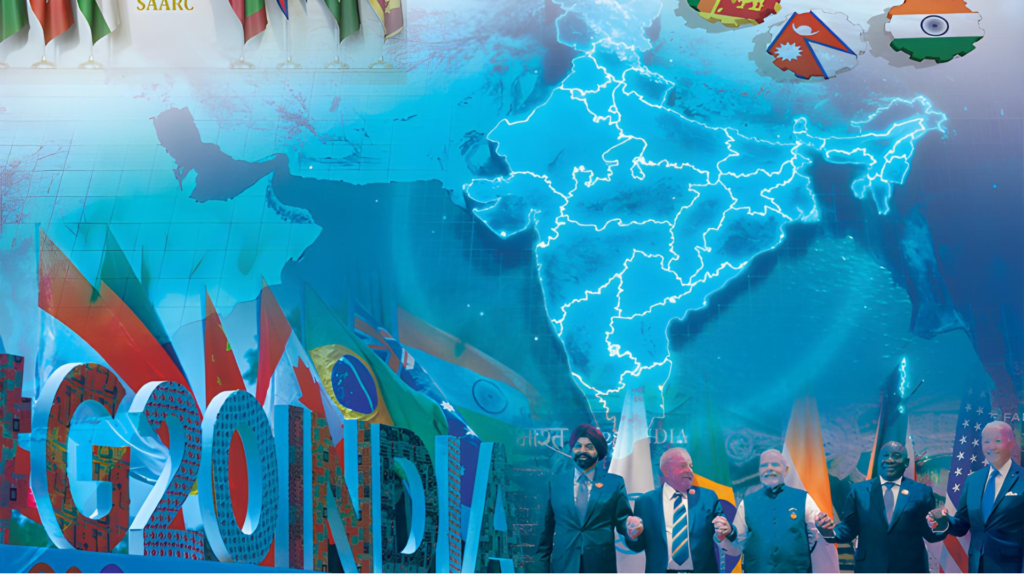
Conversely, India also leverages great-power competition to highlight the positive role it can play as a consensus-builder. Its 2023 G20 Presidency is often cited as evidence, where India secured a joint declaration despite severe US-China-Russia tensions by foregrounding development priorities, digital governance, and the voice of the Global South. The success demonstrated India’s capacity to mediate between competing camps and reinforce its identity as a constructive multilateral actor.
India’s geopolitical posture thus reflects a “multi-alignment” strategy, maintaining diversified partnerships, to enhance diplomatic maneuverability while avoiding overdependence on any bloc. This strategic flexibility remains central to India’s evolving multilateral identity in a fractured global order.
Reform Pressures: Shifting from Rule-Taker to Rule-Shaper
Another major dynamic shaping India’s multilateral trajectory is the growing recognition that existing global institutions inadequately represent contemporary power realities. As a country with the world’s largest population, the fourth largest economy, and a major regional power, India increasingly rejects its historical designation as merely a “rule-taker.”
India’s push for UN Security Council (UNSC) reform is the most visible example. New Delhi argues that the Council’s current composition, reflecting 1945 geopolitics, fails to accommodate rising powers from Asia, Africa, and Latin America. India has long sought permanent membership, supported by countries including the United States, France, Japan, and many in the Global South. Yet reforms remain stalled due to resistance from existing P5 members and competing regional rivalries.
India’s reform agenda extends beyond the UNSC. At the WTO, India advocates for special and differential treatment (SDT), technology transfer, and policy space to protect domestic agriculture and promote industrial growth. India has resisted plurilateral initiatives perceived as eroding multilateral norms, emphasizing the need for equity and special treatment for developing economies.
In global financial governance, India supports quota reforms in the IMF and World Bank to reflect the greater economic weight of emerging markets. These demands align with broader Global South calls for a fairer institutional order.
In new-generation governance domains such as digital regulation, climate change, and supply-chain resilience, India is progressively assuming a rule-shaping role on the global stage. It has actively proposed the Global Digital Public Infrastructure (DPI) framework at the G20, championed climate justice through the principle of “Common But Differentiated Responsibilities” (CBDR) in climate negotiations, and advocated for technology sovereignty alongside data localization frameworks. Beyond these, India has spearheaded the creation of alternative multilateral instruments, exemplified by initiatives like the International Solar Alliance (ISA) and the Coalition for Disaster Resilient Infrastructure (CDRI), reflecting its commitment to shaping international norms and governance mechanisms across emerging domains.
These initiatives highlight India’s shift from a defensive posture within multilateral institutions toward proactively building new rule-making coalitions and platforms that reflect its normative and developmental priorities. Thus, reform pressures, both in old institutions and new governance spaces, are pushing India to evolve into a more assertive, agenda-setting multilateral player.
Changing Coalitions: The Rise of the Global South
A key factor shaping India’s evolving multilateral role is the resurgence of the Global South as a collective diplomatic force. The COVID-19 pandemic, geopolitical fragmentation, and unequal global governance responses have intensified North-South divides, revitalizing demands for a more inclusive world order with India positioning itself at the forefront of this shift.
During its G20 Presidency, India amplified Global South priorities, focusing on food security, climate finance, debt sustainability, digital access, and inclusive development. Its activism is reinforced through leadership roles in Southern-led forums such as BRICS – which expanded in 2024, strengthening the bloc’s economic and geopolitical influence – the IBSA Dialogue Forum (India, Brazil, South Africa), G77+China, where it advocates for development financing and multilateral equity, and the Shanghai Cooperation Organization (SCO), which provides a Eurasian platform for connectivity and counter-terrorism cooperation.
Engagement in these coalitions allows India to build bargaining power, increase diplomatic influence, and shape plurilateral outcomes aligned with developmental priorities, showcasing its effectiveness across Southern and Northern platforms.
However, India’s Global South leadership is not without complexity. Rising African and Latin American aspirations mean India must navigate intra-Southern competition while maintaining credibility as a champion of equitable development. Moreover, its deepening strategic partnerships with the United States and Europe require delicate balancing to avoid perceptions of alignment that could undermine its claims to represent developing-world interests.
India’s Global South diplomacy ultimately reflects a dual strategic objective: elevating its status as a voice for developing countries while consolidating its influence in shaping new global norms. This balancing act strengthens India’s identity as a connective power in an increasingly fragmented world.
Conclusion
India’s evolving multilateral role is shaped by the interplay of systemic rivalry, institutional reform demands, and shifting coalitions. Amid intensifying geopolitical friction between major powers, India leverages multi-alignment to protect strategic autonomy and expand diplomatic maneuverability. In response to slow reform in legacy institutions, India seeks to transition from being a rule-taker to a rule-shaper, pushing for representation, equity, and new governance frameworks. Simultaneously, the rise of the Global South enables India to build new coalitions that reinforce its status as a bridge-builder between developed and developing worlds.
Together, these dynamics position India as a pivotal actor in the emerging multipolar order. India is not merely adapting to changes in global governance – it is actively shaping them. If sustained, the country’s strategic balancing act may allow it to become one of the principal architects of 21st-century multilateralism.
E. V. A. Dissanayake is an Independent Researcher from Sri Lanka. She is a Robert Bosche Stiftung Fellow and a Visiting Scholar of Columbia University, USA.