
8 January 2025, NIICE Commentary 12231
E. V. A. Dissanayake
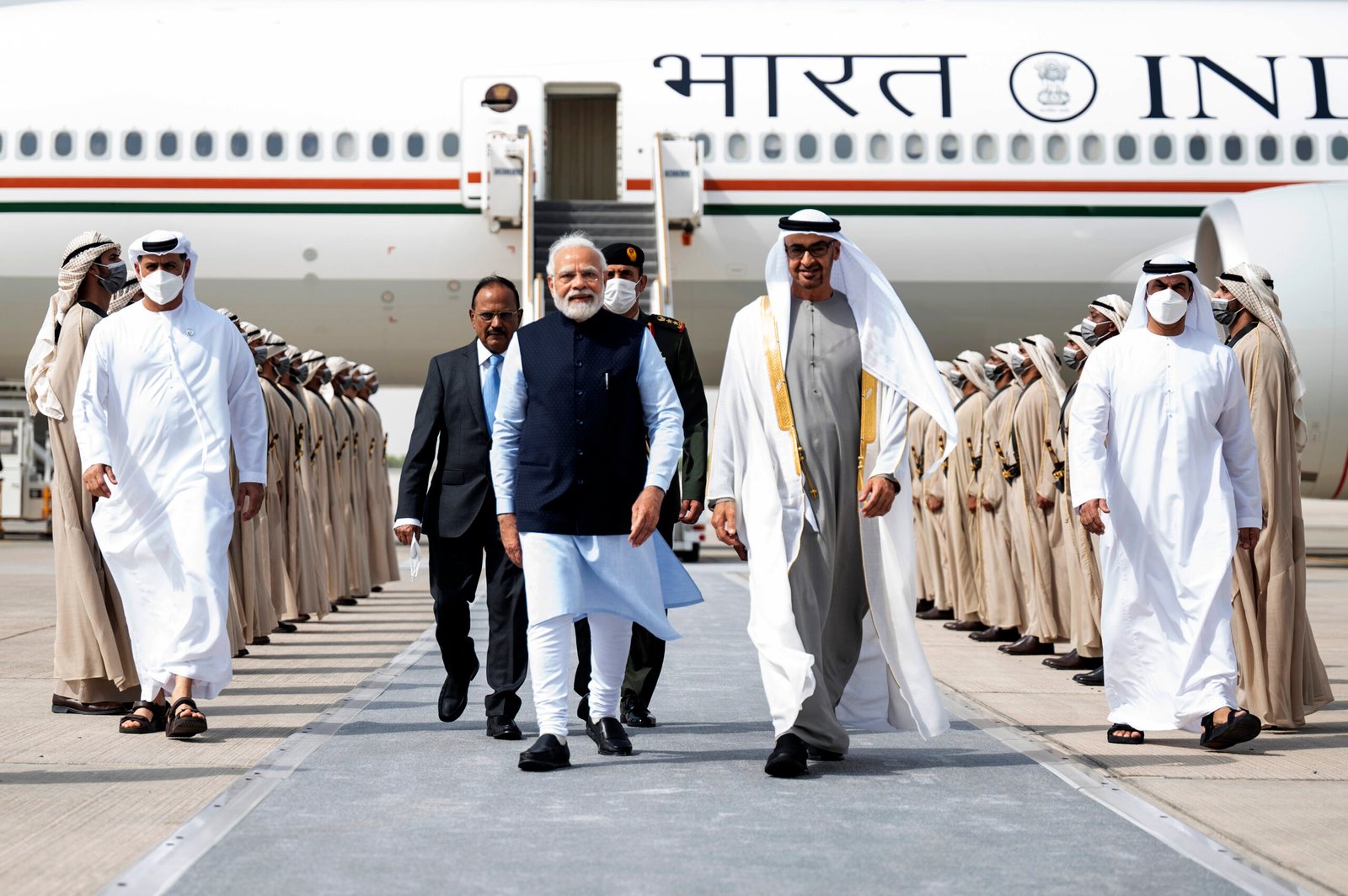
India’s foreign policy in West Asia has transitioned from ideological non-alignment to pragmatic realism. While energy security and diaspora welfare remain vital, New Delhi now pursues a multidimensional strategy that integrates trade, maritime security, and connectivity driven by global ambitions, India has adopted a proactive, multidimensional strategy in West Asia. By balancing partnerships with the Gulf, Israel, and Iran, New Delhi prioritizes energy, trade, and maritime security to enhance its regional influence while maintaining strict strategic autonomy. This article explains India’s renewed focus on West Asia not as a departure from past principles, but a strategic recalibration driven by realism, multipolar diplomacy, and the pursuit of middle-power influence in an increasingly fragmented international order.
Historical Context: India–West Asia Relations before the Pivot
For much of the post-independence period, India’s engagement with West Asia was shaped by ideological considerations and structural constraints. Rooted in the principles of non-alignment, India adopted a cautious approach that emphasized political solidarity with Arab states, strong support for the Palestinian cause, and avoidance of deep security entanglements in the region. During the Cold War, New Delhi’s limited economic and military capacity, coupled with regional rivalries and superpower politics, restricted the scope of its involvement beyond energy imports and diaspora welfare.
Energy security and labor migration emerged as the primary pillars of India’s West Asia policy. The Gulf region became a vital supplier of crude oil and natural gas, while millions of Indian workers migrated to Gulf Cooperation Council (GCC) states, contributing significantly to India’s foreign exchange earnings through remittances. However, strategic and defence cooperation remained minimal, and India largely avoided taking positions that could disrupt its balanced relations with competing regional actors such as Iran, Israel, and the Arab states. This cautious and compartmentalized engagement, while stable, limited India’s influence in West Asia and underscored the need for a more adaptive foreign policy as regional and global conditions evolved.
Drivers of India’s Westward Turn
India’s renewed focus on West Asia is driven by a convergence of economic, strategic, and geopolitical imperatives. Foremost among these is energy security. Despite diversification efforts, West Asia continues to supply a substantial share of India’s oil and gas imports, making regional stability a core national interest. Long-term energy partnerships with Gulf States have thus become central to India’s external economic strategy.
Significant role of the Indian diaspora in the region
As of early 2025, approximately 9.9 million Indians reside and work in West Asia, in the Gulf Cooperation Council (GCC) countries, contributing billions of dollars annually in remittances, and acting as a bridge for trade, investment, and cultural ties. Protecting diaspora interests has encouraged India to deepen political trust and institutional cooperation with regional governments. Strategically, India’s westward turn reflects its pursuit of strategic autonomy in a multipolar world. As global power competition intensifies, New Delhi seeks diversified partnerships that allow it to engage multiple actors without entering formal alliances. Additionally, regional instability, maritime insecurity in the Red Sea and Gulf, and transnational terrorism have underscored the importance of closer security cooperation with West Asian partners. Collectively, these drivers have pushed India toward a more assertive, pragmatic, and multidimensional engagement with West Asia.
Key Pillars of Engagement: India’s New West Asia Strategy
India’s recalibrated approach towards West Asia rests on a set of interlinked strategic pillars that reflect pragmatism, diversification, and selective deepening of partnerships. A central component of this strategy is India’s expanding engagement with the Gulf Cooperation Council (GCC) states, particularly the United Arab Emirates, Saudi Arabia, and Qatar. Over the past decade, relations with these countries have evolved from transactional energy ties to comprehensive strategic partnerships encompassing defence cooperation, counterterrorism, trade, and investment. The signing of the Comprehensive Economic Partnership Agreement (CEPA) with the UAE in 2022 marked a significant milestone, signaling India’s intent to institutionalize long-term economic integration with the Gulf.
Another crucial pillar is India’s deepening strategic partnership with Israel. Since the formal “de-hyphenation” of India’s Israel–Palestine policy, cooperation with Israel has expanded rapidly in defence technology, intelligence sharing, agriculture, and innovation. This engagement reflects India’s willingness to pursue issue-based partnerships while maintaining diplomatic support for the Palestinian cause, underscoring its emphasis on strategic autonomy rather than ideological alignment.
At the same time, India has sought to preserve its historically important relationship with Iran. Despite the constraints imposed by U.S. sanctions, New Delhi has continued to engage Tehran through selective cooperation, particularly in the development of the Chabahar Port, which provides India with strategic access to Afghanistan and Central Asia. Together, these differentiated partnerships illustrate India’s flexible and interest-driven strategy in West Asia.
Connectivity and Emerging Frameworks: IMEC and Beyond
Connectivity has emerged as a defining feature of India’s renewed engagement with West Asia, reflecting its broader ambition to shape regional economic architecture. The announcement of the India–Middle East–Europe Economic Corridor (IMEC) at the G20 Summit in 2023 marked a significant strategic initiative linking India with West Asia and Europe through multimodal transport, digital connectivity, and energy networks. By partnering with key regional actors such as the UAE, Saudi Arabia, and Israel, India aims to enhance trade efficiency while positioning itself as a central node in global supply chains.
IMEC also carries important geopolitical implications. It is widely viewed as a potential alternative to China’s Belt and Road Initiative, offering a rules-based and transparent connectivity framework aligned with India’s vision of multipolar cooperation. However, the initiative faces challenges, including regional instability, financing constraints, and coordination among diverse stakeholders. Despite these uncertainties, India’s emphasis on connectivity underscores a shift from passive engagement to agenda-setting diplomacy in West Asia. By integrating infrastructure, trade, and strategic partnerships, connectivity initiatives such as IMEC reinforce India’s long-term commitment to the region and enhance its profile as a pragmatic middle power.
Institutionalizing India’s Westward Turn: Recent Partnership Agreements
In 2024 and 2025, India strategically expanded its economic and connectivity footprint in West Asia through several landmark partnership agreements that reflect a shift from traditional energy-centric engagement to broader economic integration and regional connectivity. A focal point of this strategy was the Comprehensive Economic Partnership Agreement (CEPA) with Oman, signed in December 2025, which granted near zero-duty access for most Indian exports, enhanced market access for services, and signaled a deepening of bilateral trade relations beyond hydrocarbons (e.g., textiles, pharmaceuticals, automobiles) while reinforcing defense and maritime cooperation through initiatives such as joint military exercises and access to Duqm port. Concurrently, India strengthened its investment relationship with the United Arab Emirates by concluding a new Bilateral Investment Treaty (BIT) in October 2024, designed to provide investment safeguards and promote a more investor-friendly legal framework for mutual capital flows. Additionally, in May 2024, India secured a ten-year operational contract for the Shahid Beheshti Terminal at Iran’s Chabahar Port, a strategically significant milestone that enhances India’s connectivity to Central Asia and circumvents traditional transit constraints. Taken together, these agreements illustrate India’s multifaceted West Asian policy, which combines trade liberalization, investment protection, and infrastructure partnerships to foster deeper economic ties, diversify its engagement beyond energy imports, and strengthen its role in regional connectivity and security architectures. This approach underscores India’s broader aim of integrating economic statecraft with strategic cooperation in a region of critical geopolitical importance.
Conclusion
India’s renewed engagement with West Asia reflects a deliberate, pragmatic, and multidimensional strategy in West Asia, emphasizing economic, strategic, and diplomatic interests while preserving its long-standing principle of strategic autonomy. Through deepening ties with Gulf States, expanding cooperation with Israel, and maintaining selective engagement with Iran, India has successfully navigated complex regional rivalries and global power shifts. Connectivity initiatives, particularly the IMEC, demonstrate India’s ambition to shape regional economic architecture and assert influence in global supply chains.
While challenges such as regional instability, competing interests, and energy dependence persist, India’s approach highlights a measured, interest-driven foreign policy that balances realism with long-term ambition. By combining diplomacy, trade, and strategic cooperation, India positions itself as a pragmatic middle power capable of influencing outcomes in West Asia without compromising its autonomy. Looking forward, India’s continued engagement will likely remain central to its broader geopolitical strategy, reflecting both its rising global profile and its commitment to shaping a stable, multipolar international order.
E. V. A. Dissanayake is an Independent Researcher from Sri Lanka. She is a Robert Bosche Stiftung Fellow and a Visiting Scholar of Columbia University, USA.
