
30 December 2025, NIICE Commentary 12221
Ritika Suneja
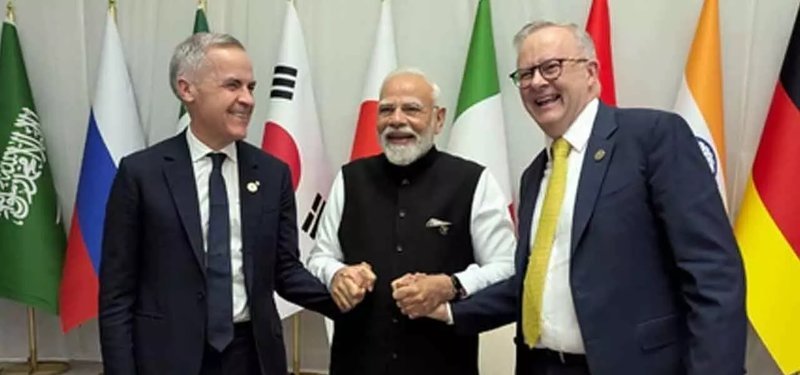
In a cross-continental initiative, three democracies across Oceania, North America, and Asia came together to announce a trilateral framework, namely, the Australia-Canada-India Technology and Innovation (ACITI) Partnership. In a joint statement, released on the sidelines of the G20 Summit in Johannesburg, South Africa, in November 2205, the parties pledged to strengthen collaboration in the domains of critical and emerging technologies, green energy, resilient supply chains, and critical minerals.
This transcontinental partnership in a minilateral format is not a new development in international politics, considering the complexities surrounding multilateral institutions in terms of funding, lack of consensus-building, and inconsistent political will, which could potentially render many meaningful initiatives deadlocked. While multilateral institutions have been the bedrock of institutional structure in international politics, minilateral or plurilateral settings provide a more flexible space for nations to fulfil their core national interests at home and strategic diplomatic objectives abroad. The minilateral framework, as opposed to a multilateral one, leads to swift collaboration in broad areas such as climate change, security, technology, etc., and issue-specific areas such as logistics, defence, maritime, etc.; thereby targeting key ideas and issues affecting the regional and global space.
In that regard, technology partnerships have come to gain considerable salience as countries spend heavily on research and development, and in the existing scenario, the idea of sharing innovative ideas and techniques across borders only brings countries to cooperate and exert influence in a constantly evolving geopolitical scenario, particularly the Indo-Pacific region, which is as strategic as it is ambiguous. To that end, the three countries bring to fore complementary strengths to this technology partnership- making it constructive and mutually beneficial; so much so that the combined synergies are capable of shaping future standards in accelerating innovation across emerging technologies and mass adoption in artificial intelligence.
However, in this particular partnership, the bonhomie between New Delhi and Ottawa stands out, as the countries have come a long way in leaving the past behind. In 2023, India-Canada relations suffered a diplomatic setback when the then Canadian Prime Minister Justin Trudeau publicly alleged that the Indian government agents were involved in the killing of a Canada-based Sikh separatist leader, Hardeep Singh Nijjar, in British Columbia. While New Delhi strongly rejected these allegations as unfounded, the accusations triggered a diplomatic crisis in which both countries expelled senior diplomats, suspended high-level engagements, and froze negotiations on key issues such as trade talks. Formal diplomatic ties had reached one of their lowest points in decades until Mark Carney’s election opened a window for a reset and renewed engagement, marking a decisive shift in the trajectory of India–Canada relations. Within weeks of taking office, the Carney-led administration moved to de-escalate tensions by reopening diplomatic channels that had remained strained since 2023, emphasising the need for restored dialogue, consular cooperation, and economic engagement. This recalibration gradually set the tone for a broader diplomatic reset, resulting in diplomatic gestures that included PM Carney’s invitation to Prime Minister Modi for the G7 summit, and Canadian Foreign Minister Anita Anand’s visit to India. This visit marked PM Modi’s first trip to Canada in about ten years, making it noteworthy in itself, given the invite was publicised on dates closer to the summit. Nonetheless, the visit was both symbolic and substantial, signalling improved relations between two integral democracies.
On the other hand, FM Anand’s visit to India in October 2025 played yet another pivotal role in resetting the tone of India–Canada relations by translating the political goodwill expressed by both prime ministers into concrete diplomatic progress. Her trip reinforced that Ottawa was committed to rebuilding trust, so much so that during the course of her visit, her meetings with External Affairs Minister S. Jaishankar and other senior officials resulted in the issuance of a joint statement highlighting renewed momentum for cooperation, rooted in mutual respect and sensitivity to each other’s concerns. The visit revitalised economic diplomacy by paving the way for renewed trade and investment discussions and plans to reconvene the Canada–India CEO Forum, while also expanding collaboration in clean energy, critical minerals, science and technology, and innovation. Hence, the visit to the foreign minister had changed the path of India-Canada relations from confrontation to cooperation, based on shared commitment and like-mindedness.
In line with that, the trilateral pact, including both India and Canada, only adds to the recalibrated relationship that countries have begun to have with each other; in a way that serves their national interests on one hand, and diplomatic and strategic interests on the other. Formed at the junction of the interconnected space of the Indo-Pacific region, the AICTI partnership gives Canada the necessary window to exert its influence and presence in the region. Additionally, Australia, being a dynamic and substantial power in the Indo-Pacific region, and its solid friendships with India and Canada, only add to the vigour of this partnership that promises to thrive in the times ahead.
However, while the friendship and partnership seem promising and timely in nature, it’s significant that the countries maintain consistency and continuity in terms of shared priorities and outlook- factors that defined the formation of this very grouping. In that sense, stable bilateral relations and adequate communication will enable the framework to become a reality for the people across borders.
Ritika Suneja is a Research Intern at NIICE and has completed her Master's in Politics and International Relations from Pondicherry University.
