
28 December 2025, NIICE Commentary 12214
Krishn Kumar
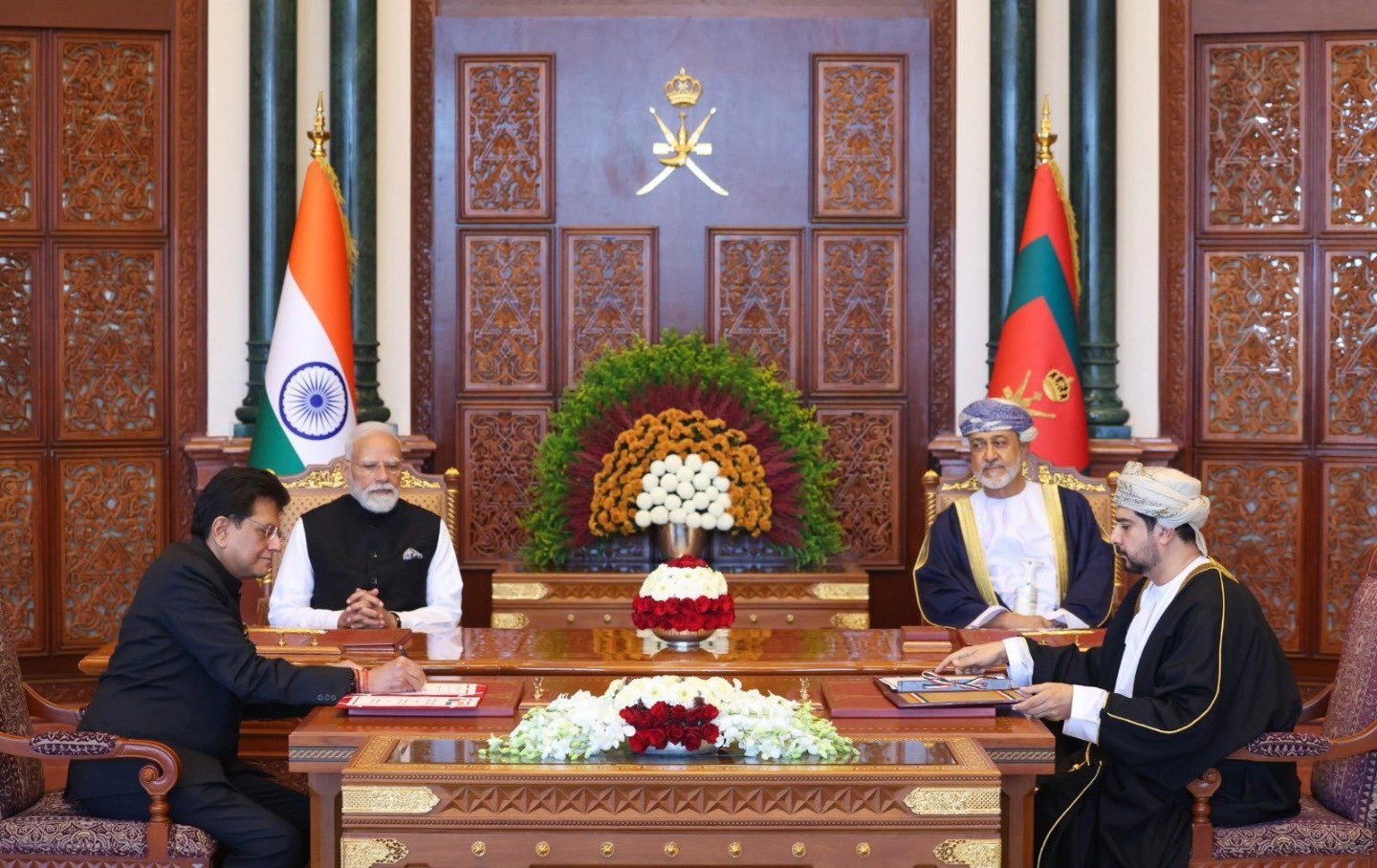
In response to the United States’ imposition of a 50 per cent tariff on certain imported goods, India has intensified efforts to diversify its trade partnerships and reduce overdependence on any single market. Within this context, the signing of the India–Oman Comprehensive Economic Partnership Agreement (CEPA) on December 18, 2025, marks an important milestone in India’s expanding engagement with the Gulf. Although formally a trade agreement, its significance extends well beyond tariff reductions and market access. Viewed through the lenses of West Asian geopolitics, supply-chain restructuring, and India’s “Extended Neighbourhood” policy, the CEPA emerges as a carefully calibrated instrument of strategic economic diplomacy.
Oman as a Strategic Gateway
Oman occupies a uniquely advantageous geostrategic position overlooking the Strait of Hormuz and the Arabian Sea, two of the world’s most critical maritime corridors. Unlike several regional actors embedded in intense geopolitical rivalries, Oman has consistently pursued a policy of neutrality and mediation, maintaining balanced relations with competing powers.
For India, deeper economic integration with Oman is therefore not primarily about accessing a relatively small domestic market. Instead, it opens pathways to leverage Omani ports such as Duqm and Salalah as logistical nodes connecting South Asia with East Africa, the Red Sea region, and beyond. In an era of global supply-chain disruptions and maritime insecurity, such diversification carries clear strategic value. The CEPA strengthens this gateway logic by improving regulatory predictability, reducing transaction costs, and encouraging long-term investment—key conditions for transforming geography into economic advantage.
Beyond an Oil-Centric Relationship
India–Oman relations have traditionally been anchored in energy security and labour mobility. This pattern remains visible in trade data. In FY 2024–25, bilateral trade stood at approximately USD 10.61 billion, with India exporting around USD 4 billion and importing USD 6.54 billion. Petroleum products and urea alone accounted for over 70 per cent of India’s imports, underscoring the hydrocarbon-heavy structure of trade.
The CEPA, however, signals a deliberate effort to rebalance this relationship. Oman is now India’s 28th largest trading partner and one of its most important export destinations in the GCC. The agreement is expected to expand Indian exports in engineering goods, pharmaceuticals, textiles, food products, chemicals, tourism, and services, gradually reducing dependence on energy-driven trade.
Industry reactions reflect this shift. The Confederation of Indian Industry (CII) has described the CEPA as a major milestone in India’s trade strategy, deepening economic engagement and supporting export growth, investment-led development, and long-term cooperation with a key Gulf partner.
Tariff Liberalisation and Industrial Competitiveness
From a trade policy perspective, the CEPA addresses long-standing tariff asymmetries. According to the Global Trade Research Initiative (GTRI), while over 80 per cent of Indian goods currently enter Oman at an average tariff of around 5 per cent, duties on select products range as high as 100 per cent. Under the CEPA, Oman offers zero-duty access on about 98 per cent of its tariff lines, covering nearly 99 per cent of India’s exports by value.
This reduction or elimination of tariffs is expected to improve the competitiveness of Indian industrial exports, particularly in manufacturing and value-added sectors. At the same time, analysts caution that sustained export growth will depend on quality upgrades and product differentiation, given the relatively small size of the Omani market. In this sense, the CEPA creates enabling conditions rather than automatic outcomes.
Investment Linkages and Economic Interdependence
India–Oman economic ties are already underpinned by significant investment flows. There are over 6,000 India–Oman joint ventures operating in Oman, with an estimated investment of over USD 7.5 billion. Meanwhile, cumulative FDI equity inflows from Oman into India between April 2000 and March 2025 amount to USD 605.57 million. The CEPA is expected to further institutionalise these linkages by providing a stable framework for services, investment facilitation, technology collaboration, and professional mobility. Indian industry leaders have emphasised that the agreement extends beyond goods trade to sectors such as technology, tourism, agriculture, and innovation-driven enterprises.
Green Energy and Technology Cooperation
One of the most strategically promising dimensions of the CEPA lies in renewable energy and green technology collaboration. Oman’s vast land availability, high solar irradiance, and access to global shipping lanes position it as a credible site for renewable energy and green hydrogen projects. India, in turn, is emerging as a major market and technology partner in the global energy transition.
While the CEPA does not by itself guarantee such projects, it lowers investment barriers and enhances regulatory certainty—critical prerequisites for long-gestation initiatives in green hydrogen, renewable manufacturing, and Agri-innovation start-ups. This aligns with industry expectations that the agreement will catalyse collaboration in emerging, knowledge-intensive sectors.
The Geopolitical Value of a Neutral Partner
Oman’s reputation as a neutral and mediatory actor has earned it the status of a stabilising force in West Asia. It has maintained constructive relations with Iran, Saudi Arabia, the United States, and India simultaneously—an increasingly rare position in a polarised regional environment. For India, deepening economic ties with such a partner enhances strategic trust and reduces political risk. The CEPA thus consolidates a long-standing relationship built on continuity and confidence rather than opportunistic alignment. It also reflects India’s preference for rules-based, private-sector-driven economic engagement, contrasting with more state-centric external models in the region.
Implications for Gulf Cooperation Council (GCC) Integration and Connectivity
The India–Oman CEPA follows the India–UAE CEPA (2022), collectively strengthening India’s economic footprint in the Gulf. Together, these agreements add momentum to the long-pending India–GCC Free Trade Agreement, even as negotiations remain complex. At a broader level, the CEPA complements emerging connectivity initiatives such as the India–Middle East–Europe Economic Corridor (IMEC). While IMEC remains aspirational, trade agreements provide the legal and economic scaffolding necessary for such corridors to materialise over time.
Conclusion
The India–Oman CEPA is more than a trade facilitation exercise. It represents a strategic investment in long-term regional engagement, combining economic pragmatism with geopolitical foresight. By anchoring its presence in a neutral, strategically located Gulf state, India enhances its capacity to navigate a West Asian order shaped by energy transition, supply-chain reconfiguration, and great-power competition. Ultimately, the agreement underscores India’s evolving approach to the Gulf—one that integrates trade, investment, technology, and strategic thrust into a coherent framework of economic diplomacy.
Krishn Kumar is a PhD Research Scholar at the Department of Political Science, University of Lucknow, India.
