18 November 2025, NIICE Commentary 11937
Kaveri Jain
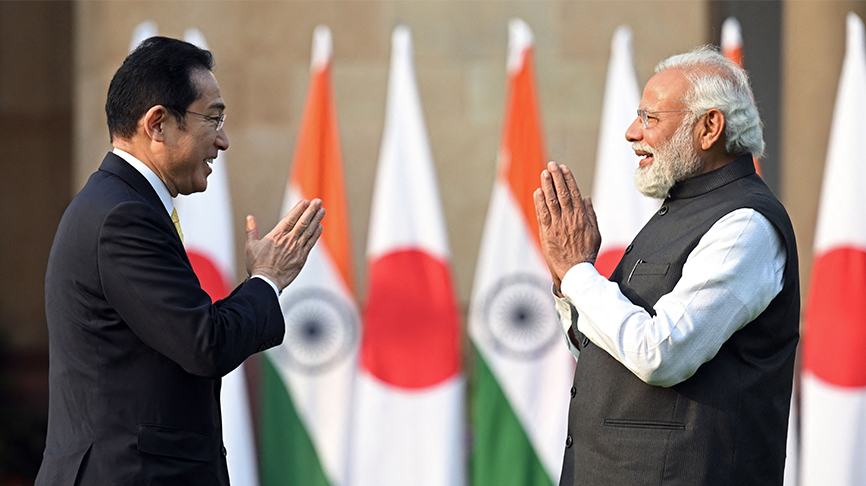
Poised as natural partners, India and Japan share deep-rooted historical and civilisational ties. From the early Buddhist connections formed in the 6th century A.D. to the elevation of their diplomatic relations to a Special Strategic and Global Partnership in the 21st century, both countries have travelled a long path in bolstering the strategic weight of their relationship. Reaffirming this trajectory, India’s external affairs minister S. Jaishankar, at the recent 8th India-Japan Indo-Pacific forum organised by the Japan Institute of International Affairs and Delhi Policy Group, underscored the larger responsibility of both nations in upholding democratic values and maritime security across the Indo-Pacific region. With the historic election of Sanae Takaichi as Japan’s first female Prime Minister, strained India-US relations, and increasing turbulence in Asian geopolitics, it becomes imperative to assess whether the India-Japan partnership can serve as a viable stabilizer in the Indo-Pacific. The central question, therefore, is whether this partnership is credible, capable and coherent enough to effectively act as a regional strategic anchor.
Convergences in the Relationship
In the case of India and Japan, the strength lies in their strategic convergence, economic synergy and positive regional perception. The overlap in foreign policy visions of the two nations, such as India’s Indo-Pacific Oceans Initiative along with the Act East Policy and Japan’s Free and Open Indo-Pacific (FOIP) vision, highlights shared alignment. Both nations share common concerns over issues such as maintaining maritime freedom, promoting a rule-based order and balancing China’s assertiveness. Complementing this is their coordination within multilateral frameworks such as the Quadrilateral Security Dialogue (QUAD), ASEAN, G20, United Nations and G4.
Clearly, this partnership is not mere diplomatic rhetoric but one rooted in institutional depth. It is reinforced through regular high-level interactions, including annual summits and 2+2 (Defence and foreign ministers) meetings. The 15th India-Japan annual summit held in Tokyo in August 2025 rekindled the intent to advance bilateral cooperation through the Joint Vision for the Next Decade, the Joint Declaration on Security Cooperation and an Action Plan for India-Japan Human Resource Exchange and Cooperation among others. These were complemented by the shared concerns over the East and South China Seas, North Korea’s nuclear programme, rising cross-border terrorism and their continued support for the “ASEAN Outlook on the Indo-Pacific” (AOIP). Moreover, the creation of joint task forces, working groups and think-tank collaborations across multiple fields demonstrates that the partnership is not just ad-hoc in nature but supported by concrete policy frameworks.
The next important pillar of this partnership is its economic complementarity. Japan’s long-standing Official Development Assistance (ODA) loans to India and increasing investments in infrastructure projects such as the Delhi-Mumbai Industrial Corridor (DMIC) and Mumbai-Ahmedabad High Speed Rail Project (MAHSR) reflect mutual interdependence. Also, emerging collaborations in domains such as semiconductors, green technology and supply chain resilience extend beyond bilateral benefits, resulting in the promotion of inclusive and sustainable growth across the region.
Defence cooperation is another critical pillar of the India-Japan partnership and one of the most important instruments of the bilateral involvement in the Indo-Pacific. Both countries have strengthened maritime interoperability through joint exercises such as JIMEX and the Malabar Naval Exercise, thus improving coordination in the Indian Ocean and Western Pacific. The signing of the Acquisition and Cross-Servicing Agreement (ACSA) allows the two countries to have easy and reciprocal access to each other’s facilities and logistics, bolstering operational synergies. Japan’s decision to increase its defence budget and India’s focus on maritime domain awareness are very much in line with the common objectives of securitizing sea lanes and ensuring regional stability. Defence technology collaborations, such as the agreement on the Unified Complex Radio Antenna (UNICORN) masts for Indian Navy Ships in November 2024, are one of the main examples of Japan’s willingness to move beyond its traditional role of an economic partner. They, thereby, become the most reliable instruments to support the security framework of a free, open, transparent, inclusive and rules-based Indo-Pacific.
India and Japan enjoy broad public trust which enables the partnership to withstand leadership shifts as well as external shocks. This political resilience was reiterated by Prime Minister Takaichi, who described the two nations as entering a “Golden Chapter” in ties, during her first interaction with Prime Minister Narendra Modi. A protégé of former Prime Minister Shinzo Abe, she carries forward his strategic vision of a free and open Indo-Pacific. Her statement embodies a sense of continuity and commitment to the evolving Indo-Pacific, reflecting confidence in Japan’s approach towards India and the wider region.
Constraints and Regional Challenges
Despite many convergences, several challenges continue to hamper the full bloom of this relationship. Stagnant trade figures, negative public sentiment in Japan regarding immigration (which stalled the exchange of 500,000 personnel in both directions, according to an agreement signed between India and Japan during the tenure of the former Prime Minister Shigeru Ishiba) and India’s continued close ties with Russia remain a source of friction influencing Japan’s strategic calculus in the Indo-Pacific. Regulatory complexities in India, including protracted land acquisition and bureaucratic approvals, have delayed projects like the MAHSR, which was originally targeted for 2022. These delays have inflated costs to nearly 2 lakh crores. Such delays in implementation may affect the pace of delivery in regional infrastructure connectivity which is a key pillar of their Indo-Pacific cooperation. Japan’s FDI to India dipped to $2.48 billion in 2024 from $3.17 billion in 2023 which highlights a deficit in infrastructure, gaps in skill development, non-tariff barriers, regulatory and operational issues and differences in certification standards. It is also important to foster deeper societal understanding between the two nations through increased people-to-people exchanges.
The regional environment adds its own complexities to the partnership. There is a difference in the intensity and manner of response to Beijing’s assertiveness, where Japan is a front-line stakeholder while India strives to balance engagement and competition. At the same time, the role of the United States is evolving in the region, presenting both opportunities and uncertainties in terms of complementing security interests but risking overdependence on its strategic guarantees. Another key player in the region, ASEAN, prefers neutral responses to avoid antagonising China, further limiting the scope for deeper trilateral and multilateral engagements. In this context, it becomes pertinent for both India and Japan to maintain strategic autonomy while ensuring regional inclusivity to uphold their credibility as balanced actors in the Indo-Pacific.
Conclusion
The India-Japan relationship is one of the most resilient and capable frameworks in the Indo-Pacific. The core strength of the bilateral relations lies in its ability to adapt to domestic and external pressures while maintaining shared purpose. A partnership based upon common values and shared commitments to a rule-based order, it continues to evolve into a credible pillar of stability in the region. There is growing convergence in security, technology and connectivity, demonstrating that the relations between the two nations have moved beyond symbolism to one with proactive strategic substance.
Looking ahead, both nations can expand cooperation in critical and emerging technologies, space situational awareness, cybersecurity while simultaneously deepening collaboration in defense innovation, maritime domain awareness, blue economy and climate resilient infrastructure. The Japanese government under PM Takaichi has a timely opportunity to give greater momentum to its relations with one of its closest allies in Asia, ensuring that the partnership between the two continues to anchor a stable and resilient Indo-Pacific for the decade ahead.
Kaveri Jain is a PhD scholar at the Amity Institute of International Studies, Amity University, Noida, India.