
1 October 2025, NIICE Commentary 12758
Shradha Arjyal Joshi
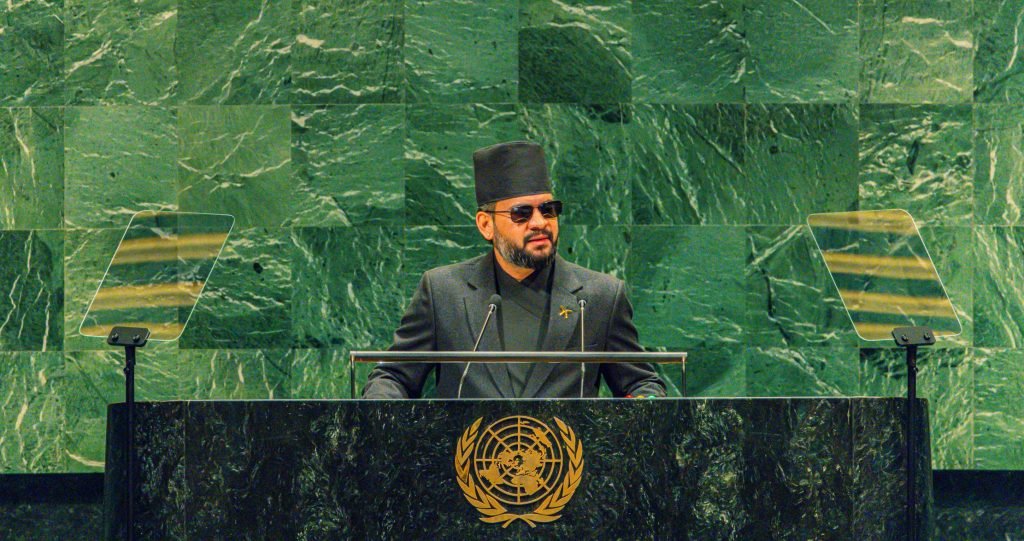
“We did not create this crisis, yet we are paying a colossal price for it.” With that line standing before the United Nations General Assembly on Thursday, Prime Minister Balendra Shah steered the new era of Nepal’s climate diplomacy. His message was unambiguous: the issue is real and the crisis is felt. “Climate justice cannot remain a beautiful phrase in United Nations documents,” he told the Assembly. “Climate change does not recognize borders. Glaciers and floods do not travel with stamps and passports.”
This address came five weeks after a catastrophic flood swept through Bhotekoshi river caused by an ice avalanche and debris surge which travelled downstream towards Trishuli corridor, devastating lives and infrastructures, killing more than 1400 people and leaving over 6000 missing. Nepal is one of the poorest countries in the world and it contributes less than 0.1% of global greenhouse emissions, now paying the loss for a crisis induced away from its land. This is certainly not symmetrical, and just not sentimental, on Shah’s case; it demands seriousness on its own merits, not consider only on the ground of sympathy.
Foreign ministry of the country, Shishir Khanal, had been making a similar case in the international community even before the Assembly convened. “What happens in the mountains does not remain in the mountain, the crisis is beyond borders. We are shifting our diplomatic framework from ‘aid’ to ‘justice liability.” Emphasizing the scale of what is at stake, he went ahead still: with Himalayan glaciers feeding rivers on which more than two billion people in South Asia rely, he called the crisis “a matter of civilizational survival.” When put together this case gains momentum in the international community, as reflected in three factors: geography, Generation Z, and geopolitics.
Geography
Nepal’s geography resides in a narrow belt between the Tibetan Plateau and the Indo-Gangetic plains, and its glaciers is an essence for the population far beyond its own high-altitude settlements. The Bhotekoshi flash flood established new brutal truth: a rupture in the mountains became a catastrophe that stretched hundreds of kilometers downstream through Rasuwa, Nuwakot and Dhading with the consequences felt far till China’s Tibetan region. The Himalayas belongs not just to Nepal- it’s shared infrastructure, and their collapse becomes a regional liability.
In an unusual candor for a foreign minister, Mr. Khanal said, “The glaciers are melting, the permafrost is thawing, and there is a risk of glacier flood,” before asking directly: “How fair is it for Nepali people and people of the Himalayas to bear the consequences of climate change, where we have had very little contribution to it?” Fair enough, and one PM Shah’s own proposals at the United Nations General Assembly tried to answer institutionally rather than rhetorically: a dedicated Himalayan climate cooperation mechanism, built around shared early-warning systems and disaster coordination across borders. This is the correct diplomatic instinct. Vulnerability alone is weaker in international forums; an institutional proposal is not.
The country’s Nationally Determined Contribution (NDC) 3.0 estimated that meeting its climate targets through 2035 would cost USD 73.74 billion, with a larger share from international climate finance. Mr. Shah accentuated this reality while speaking, demanding grant-based financing rather than loans and cautioning against a system that leaves vulnerable nations accumulating debt just to recover from disasters they did little to cause.”
Generation Z
Prime Minister Balendra Shah—who is rarely seen at public events and seldom speaks in Parliament surprised everyone when he announced he would attend the 81st UNGA. Since the Bhotekoshi floods, most of his communications have been restricted to social media. Yet, his declaration that he would use the UNGA platform to highlight climate justice for his country, while drawing global attention to the devastating losses suffered by the Nepali people, has been widely praised as a responsible and commendable move by the government and is a product of upheaval. The Gen-Z-led protest of 2025 forced the resignation of Prime minister K.P. Sharma Oli amid charges of corruption and failed governance. Shah, then Kathmandu’s mayor, was declared a winner of an election on 5th March 2026 in which his party won the highest share of votes. That backdrop explains the lines on his UNGA address: “When the house is burning, we do not ask the family to complete 50 forms. We act. That is what climate justice mean.” Satirical yet strong for a UN podium, indicating the shift in leadership style by a newer generation.
However, presence doesn’t determine policy, and Nepal shouldn’t mistake international attention as commitment. The generation that carried Balendra Shah to national politics is quite unaware of slow pace of global policymaking and delivery. Nepal’s credibility now vests on whether Gen Z’s demand for accountable institutions and good governance will be met by the government’s own strategies and actions post-disaster. After the gripping speech in New York, no excuses for slow response in the mountains will be accepted.
Geopolitics
While Nepal waited for Mr. Shah to speak at the UN General Assembly and voice the devastating effects of climate change country had witnessed, Foreign Minister Khanal worked slightly different to his dealings. He was seen involved in various ministerial meetings and bilateral engagements with neighboring and allied states. The message was clear, rich nations should foot climate bill for poorer countries.
But the path is harder than speeches and meetings. Nepal’s appeal and claim target the failing global governance and extend responsibility to its two neighbors, India and China which are no longer the minor emitters in absolute terms. Easier said than done, a trilateral Himalayan mechanism would require India and China to share satellite and hydrological data. The border tension between the two countries hasn’t yet concluded.
Nepal has proposed the framework and holds enough evidence of disaster exposure and vulnerability ranking, but the real question is whether it has the capacity to bring both these powerhouses to one table on monitoring and data sharing. Nepal’s own institutional performance plays a greater role in turning this ambitious plan into reality.
Reasons to Responsibility
Despite a fierce UNGA address and many diplomatic visits, this doesn’t guarantee a delivery mechanism. Nepal has raised the issue of climate justice in international forums but hasn’t been able to build the strong domestic mechanism to back the claim; the speech to its credit comes with stronger evidences and leverages to emphasize its case- but the leverage abroad is not exact as capacity at home.
At the parliamentary committee hearing, the foreign minister had conceded that Nepal’s climate diplomacy could not remain improvised: “We will not achieve the long-term results we desire simply by representing and addressing the UN General Assembly or COP. For that, it is necessary to work on developing institutional capacity and structure from now on.” It was an honest acceptance that the government’s own mechanism is shaky for the claim it is making abroad. Further, the Himalayan mechanism prime minister proposed will need a strong, serious domestic counterpart from the outset.
Strong speeches, compelling cases and wide appreciation are common in the General Assembly; strong outcomes are not. The real test for Nepal lies beyond the headlines- if the proposed Himalayan mechanism can actually bring together India, Nepal and China together for shared climate goals. Equally important for Nepal is to prioritize building strong institutions for delivering resilient infrastructure capable enough to withstand climate hazards, not merely rebuild what was lost but achieve sustained recovery. Nepal’s case has been heard. It’s now up to the global powers to decide whether climate justice remains a phrase in UN documents or becomes something real-something acted upon for the sake of humanity and the planet.
Shradha Arjyal Joshi is a Researcher and Development Professional focusing on Political Economy and Diplomacy.
