10 May 2026, NIICE Commentary 12485
Sidhant Kumar
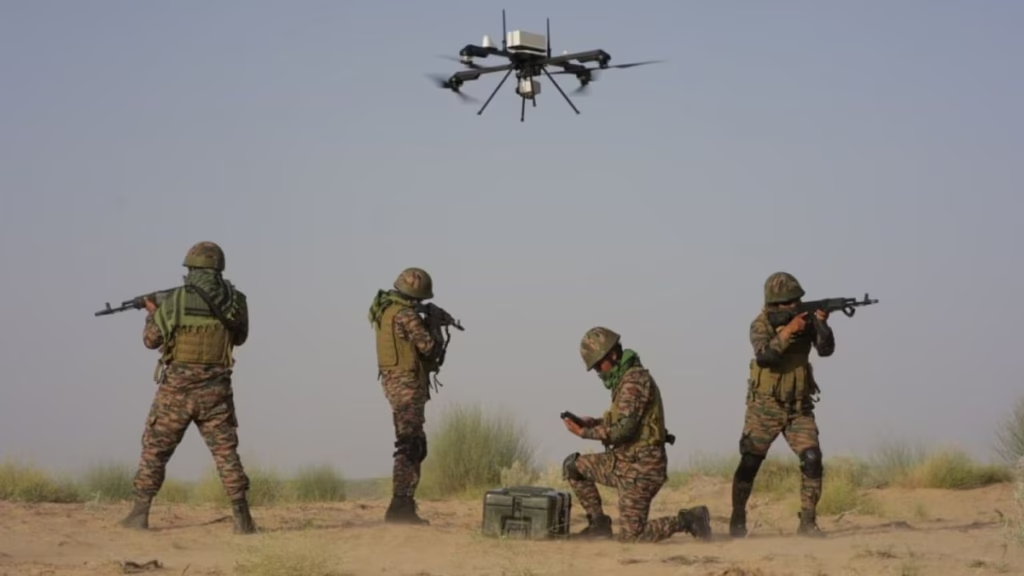
India is marking the anniversary of Operation Sindoor, a series of Indian military strikes against Pakistan’s military and terrorist sites in retaliation for the terrorist attacks in Pulwama in Jammu & Kashmir in May, 2025. The episode saw extensive use of drones, including loitering munitions, kamikaze drones and intelligence, surveillance and reconnaissance (ISR) drones, magnifying India’s defense priorities for drones. Pakistan launched nearly 300-400 drones targeting Indian military bases. The Indian armed forces deployed Sky-Striker Kamikaze drones, HAROP and Nagastra-1 in retaliation. The recent US-Iran war has also accentuated the critical importance of drones in modern warfare. The war exposed the vulnerabilities of the oil and air bases of the US in the Gulf countries to Iranian drones. Iranian drones destroyed oil fields and refineries of the Gulf partners of the US. High-value military targets like radars, were also found to be vulnerable to drone attacks. The military bases of the US in the Gulf countries have also been decimated to the point of irretrievability.
In retaliation, the US deployed drones through Task Force Scorpion, including the LUCAS loitering drones (influenced by the Iranian Shahed design) and MQ-9B turboprop Medium Altitude Long Endurance (MALE) Unmanned Aerial Vehicles (UAVs), against Iran. Israel deployed ISR drones and one-way loitering drones, including Hermes-900 turboprop MALE UAVs. Counter-drone systems in the US and Israel were expensive and had gaps in their capabilities. Whereas Iranian drones were cheap and efficient.
Specifically, the US-Iran war has established the importance of cheap swarm drones and loitering munitions, as well as winning local tactical warfare. Indian defence stakeholders realise the importance of loitering munitions and want to develop and import tactical drones, including swarm drones and anti-drone capabilities. On the eve of the anniversary of the Operation Sindoor, the Defence Secretary of India, R.K. Singh, emphasised the requirements of drones for the Indian armed forces and drove home the point about “stand-off weaponry” in modern conflicts such as the US-Iran war. After the conclusion of the Operation Sindoor, the Indian defence forces also earmarked Rs 30,000 crore emergency procurement contracts, especially for drones, counter-drone systems, loitering munitions, and electronic warfare equipment.
So far, Indian defence forces have largely relied on imported drones from the US and Israel, such as the MQ-9B Reapers and Israel’s Herons and Hermes. An approval of a 3.5 billion USD deal for 31 MQ-9B armed UAVs for combat operations has already been signed. Furthermore, the prospective acquisition of turboprop drones, including MQ-9B Predator drones, particularly the Sea Guardian variant, is in the pipeline. India already possesses over 30 Israeli-origin Harop and Sky Striker drones and wants to buy more of these. Loitering munitions, including HAROP and Harpy, are being operated by India’s air force. HAROP is also being co-developed in India under the Adani Group and is locally known as Agnikaa. India used these Israeli-origin drones for precise and rapid strikes over Pakistan in May 2025.
Long Endurance ISR drones are considered of less significance than loitering munitions because intense air-defence warfare undercuts the requirement of long-haul drones, including the US’s MQ-9B and Israel’s Hermes-900, which have already been procured by defence forces.
The need for development of indigenous drones has also heightened as Iran’s low-cost Shahed drones costing between $20,000 and $30,000 apiece were far more effective against the Patriot missiles and the THAAD battery were which cost close to $4 million and $13-15, respectively.
Furthermore, the Ukraine-Russia war also provided lessons for India’s drone thinking. Ukraine’s establishment of the Unmanned Systems Force in 2024, centralised drone operations, and a land force-led control of low-altitude airspace have become vital for operational success. The Gulf countries had also sought Ukrainian help in countering Iranian drone attacks. China is weaving drones into joint-force operations. It is one of the world’s largest exporters of armed drones. Drones have played a huge part in China’s move towards intelligentization in future conflicts. The recent Atlas drones of China are capable of winning local wars under informatized conditions.
India’s Drone Policies
Amidst the resurgence of drones in modern warfare, India has liberalised drone development policies to create an ecosystem for the development of drones and integrating it with the defence forces. The Government of India in 2020 came out with a vision document that seeks to make India a global hub for drones in 2030, which included liberal drone rules, setting up of defense corridors in UP and Tamil Nadu states to encourage the drone industry, and support for the drone startup ecosystem with initiatives like Innovation for Defence Excellence (iDEX), Acing Development of Innovative Technologies with iDEX (ADITI), and TDF.
Along with this, the government published the Drone Airspace Map in September 2021 and promulgated the policy framework for the UAS Traffic Management System in India in October 2021 and the National Unmanned Aircraft System Traffic Management (UTM) Policy Framework on October 24, 2021.
In 2026, India saw a record increase in defence budget to over Rs 7.19 lakh crore. About 81% of defence contracts, valued at INR 2.09 lakh crore, are to boost the modernization push and UAV manufacturing. The Production Linked Incentive scheme for drones and drone components was launched with a total outlay of INR 120 crore (approximately USD 13.93 million), distributed over three financial years from FY 2021–22 to FY 2023–24. Private actors such as Adani Defence have been brought in to co-develop and co-produce with foreign partners instead of relying solely on direct imports. Elbit Systems and Adani Defence & Aerospace are producing MALE UAVs, particularly the Hermes 900 drones.
However, very little innovation has been made in indigenous drone technology, and it has largely been sluggish. The indigenous drones are not yet fully functional and are under trials phase. For instance, High Altitude Long-Endurance (HALE) drones, including the Rustom-II with ISR capabilities and the loitering munition drones developed by DRDO, are yet to be integrated into military operations.
Challenges facing the Indian Drone Ecosystem
India is also a learner in the development of UAV systems and their integration in the defence forces. It faces several challenges. Foremost among them is the non-availability of timely funding for development and the absence of timelines for the induction of Rustom-I and TAPAS UAS, indicating incoherence and inconsistency in indigenous military UAS technology development programs. Post-Operation Sindoor increase in defence budget is welcome, but analysts fear that the future warfare will lay bare vulnerabilities if India does not cogitate. Secondly, in terms of acquisition, too, India has been a laggard. India signed a $3.5–$4 billion deal in October 2024 with the U.S. and General Atomics for 31 MQ-9B Sky/Sea Guardian HALE drones. The deal supplies 15 Sea Guardians for the Navy and 16 Sky Guardians for the Army/Air Force to enhance ISR capabilities. Deliveries only begin in 2029. The government’s FDI rule, further, bans imports of defence products from any nation sharing land borders with India. Due to this, cheap Chinese parts of drones have become unavailable. As a result, venture capitalists and angel investors have avoided investing in the drone sector.
The bureaucratic nature of PSUs/DPSUs has led to a slow and lethargic adoption of drone technologies. Added to this is the lack of domain expertise among these PSUs. The Atal Incubation Hub, launched in 2016, has also not reaped benefits as graduates leave their startups midway for lucrative jobs. The Indian armed forces, too, receive no drone training and are usually transferred across different military locations to perform drone operations. Defence analysts call for a tri-service school of drone that would include drone pilot training, GIS, technical training, and software know-how. At the same time, drone tech has undergone tectonic changes, with the tech changing every 3-6 months. India is not even catching up on the recent drone tech. The commanders of the Indian armed forces are not agile and lack the technological know-how emerging in the drone sector. Experts in India are anxious that the deficient drone capabilities of India are not enough for future warfare, for instance, the new developments that are happening in Pakistan and China. The next war could bring several innovations in drone warfare that will catch India off guard.
Sidhant Kumar is a Visiting Fellow at NIICE and a PhD Candidate at Jawaharlal Nehru University, New Delhi, India.