
20 March 2026, NIICE Commentary 12363
Suvrat Aditya Verma
"What lies between regions can often matter more than the region itself.”
Geography is the slowest of the slow variables of history. Fernand Braudel, the French historian best known for his work on the longue durée, built his understanding of the past around a deceptively simple idea- while time moves forward and politics constantly rearranges itself, geography remains, quietly dictating what becomes possible and what does not.
The Making of Siliguri: A Colonial Hinge
The late nineteenth century saw a small, sleepy settlement in the eastern-Himalayas, gradually grow into one of the most important corridors, commercially and strategically. Earlier, part of the kingdom of Kamtapur, it passed many hands, from Cooch Behar, to Sikkim, Nepal and finally the British. Under the British, this once unremarkable settlement was soon stitched into the colonial economy through railways, acting as a logistical hinge between hills and plains. Although an imminent threat of a possible military expedition on the eastern frontiers did not show up until the First World War, its importance arose from the geopolitical character of the Himalayas itself.
By the early twentieth century, the British Raj was grappling with a frontier that resisted easy control. Nepal, Tibet, Bhutan, and other princely states of the Northeast were not entirely absorbed by the Raj and enjoyed considerable autonomy. It was under such circumstances that Siliguri’s location made it an ideal base for administering a complex frontier. Its distance from the frontier further added to the strategic value, close enough to the Himalayas, yet far enough from the volatile edges of the empire. In 1947, the partition of India brought the region to the strategic nerve of the country, and created the Siliguri Corridor or famously the “Chicken’s Neck”. Overnight, a seemingly narrow strip of land, not more than 22km at its narrowest, became the umbilical cord connecting the rest of India to its eight North-Eastern states.
The Northward Expansion and A New Economic Spine
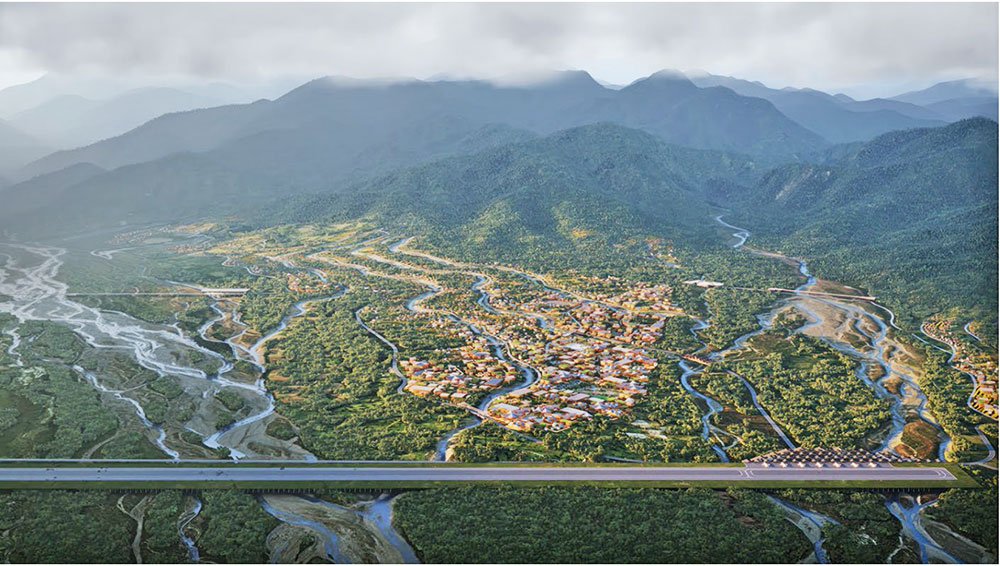
Almost seven decades later, Bhutan looks at its own geography with an urgency not very different from a post-partition India. Gelephu, located in the South Eastern district of Sarpang, bordering Assam, sits at the base of the sub-Himalayan range, much like Siliguri. As a crucial transit hub, Siliguri connected the Indian heartland to the Northeast. Gelephu is positioned to open the landlocked Himalayan kingdom to the global markets.
If one looks at the BBIN (Bangladesh, Bhutan, India, Nepal), Siliguri and Gelephu can be viewed as two points of a single economic spine, with the former acting as a logistical engine feeding the Northeast while the latter being imagined and designed to be the financial hub that bypasses traditional, mostly congested routes. The parallels are nowhere more striking than in the infrastructure being laid down. The proposed 70km Kokrajhar-Gelephu railway link project will mark the first-ever rail connection for the Himalayan kingdom. Such connectivity projects hint at a Bhutan which is no longer the hermit of yesteryears, but in fact a more integrated and ambitious player in the global economic scene. The rail link project is reminiscent of the historical expansion of the Frontier Railway, which turned the sleepy town of Siliguri from a quiet outpost into a regional pivot. By integrating Gelephu with the Indian rail network, Bhutan has expanded the ‘Siliguri effect’ towards the north, effectively creating a new multimodal hub for high-value tech as well as mindfulness.
The Great Antithesis: Mindfulness vs Extraction
Nonetheless, the geography of Gelephu mimics Siliguri during its formative years, the lens of philosophy views it as an antithesis. Siliguri’s growth in many ways was reactive, springing from the volatility and dynamism of an early 20th-century world. Its development was mainly in response to the logic of extractivism and ambitions of an expansionist power. Gelephu, by contrast, is planned to be a Special Administrative Region (SAR), covering an approximate area of 2,500square kilometres, almost three times the size of Singapore. Moreover, in times when the world is amidst the debate of shared but differing responsibility towards climate change, Bhutan’s focus on a “clean” industrialization can show the way towards a growth model which need not be stranded between climate consciousness and development objectives. Though in different time contexts, both act as reflections of changing priorities of a larger development model.
Geopolitically, the comparison becomes most poignant. The most significant strategic vulnerability of Siliguri has been the threat of a probable advancement by an adversary, cutting off more than 50 million people. For Bhutan, Gelephu carries a similar strategic weight. By building a global city close to the Indian border, it could be tethering its economic future to India’s security. For India, a stable and prosperous Gelephu might act as a buffer while adding weight to its “Act East” policy. For India, Gelephu can be promising in ensuring an economic overhaul of the vastly underdeveloped and volatile borderlands of Assam. For Bhutan, it is an attempt to break free from its isolationism and establish itself as the space between the Indian heartland and Southeast Asia. This serves as a stark reminder that sometimes what lies between regions can matter more than the region itself.
Beyond the Corridor
Just a century ago, the world was building railways for a sustained colonial extraction. A century later, smaller states like Bhutan are setting examples of development in line with a climate-conscious and more equitable world. As this Himalayan Kingdom faces the crisis of outmigration, Gelephu might be the answer it needed. It is in heightened need of a centre of increased economic integration, which can compete with global cities while serving the growing ambitions of its youth.
As far as the question of it being the second Siliguri is concerned, though dauntingly similar at many levels, unlike Siliguri, Gelephu aims to be a city of destination and not just a transit. However, what Siliguri was to the region a century ago, Gelephu is well positioned to be today. This story of the two settlements, in ways, is reflective of the evolution of the concept of a corridor itself. A place you could pass off easily to a place you would stay and reinvent. Nonetheless, the “return” of the soul of Siliguri in the form of Gelephu is a telltale of the geography of the Eastern Himalayas as one of the most critical real estate in Asia. If one was a 20th-century answer to connecting a colonial estate, the other is the 21st-century answer to integrating an isolated kingdom into the global economy. The question, therefore, is not whether Gelephu will become another Siliguri. It cannot, and need not. The century is different, the political context is different and Bhutan’s vision is different too.
Suvrat Aditya Verma is a postgraduate student of International Relations at South Asian University, New Delhi, India.
