
07 March 2026, NIICE Commentary 12338
J. S. Jeremiah
Relations between Canada and China have entered a complex phase characterized by simultaneous engagement and distrust. Once sustained by expanding trade, educational exchanges, and diplomatic dialogues, over the past decade, the relationship has declined due to geopolitical competition, security concerns, and normative differences. Yet neither country can afford disengagement. China remains one of Canada’s largest trading partners and a central actor in global governance, while Canada continues to be a significant supplier of resources, agricultural products, and advanced services to the Chinese market. This coexistence of cooperation and suspicion defines the contemporary bilateral dynamic.
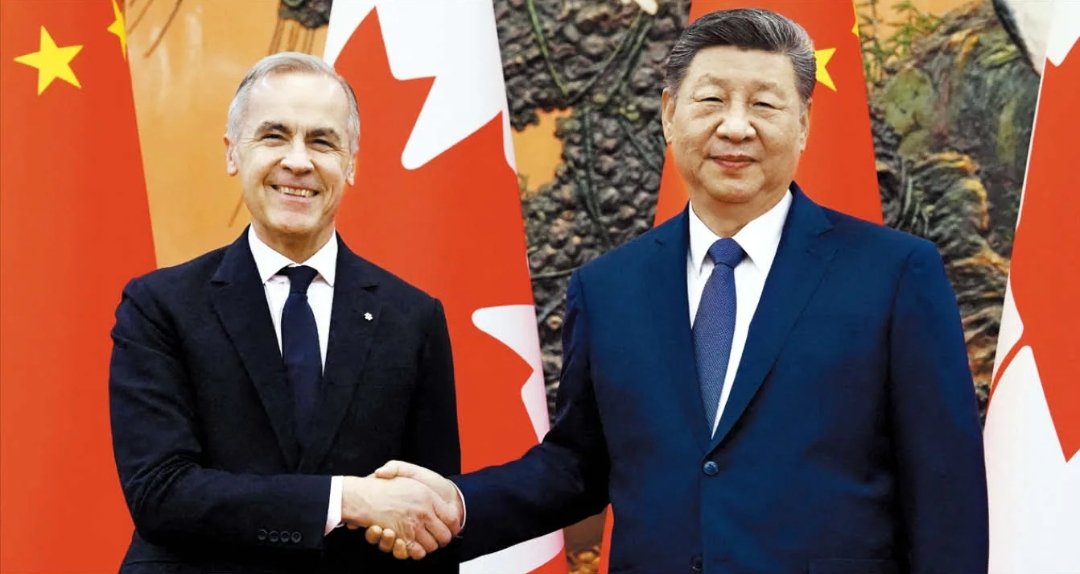
Recent diplomatic outreach by Mark Carney signals an effort to stabilize ties without fundamentally transforming underlying tensions. His visit followed nearly a decade after Justin Trudeau’s 2017 trip to Beijing, which had emphasized economic partnership and exploratory talks on a possible free trade agreement. Since then, shifting global power structures, domestic political recalibrations, and Canada’s closer alignment with Indo-Pacific security frameworks have complicated relations. The result is not a simple deterioration but a paradoxical condition: sustained economic interdependence alongside deep strategic mistrust.
This article argues that contemporary Canada - China relations are best understood as a form of guarded engagement driven by structural necessity rather than confidence. Economic imperatives, global governance challenges, and middle-power diplomacy compel cooperation, even as security concerns, ideological differences, and alliance politics generate suspicion. Understanding this paradox is essential not only for bilateral policy but also for assessing how middle powers navigate relations with major powers in an increasingly multipolar world.
Economic Interdependence as a Driver of Cooperation
Trade and investment ties remain the strongest stabilizing force in Canada - China relations. China has consistently ranked among Canada’s top export destinations, particularly for natural resources, energy products, agricultural commodities, and education services. Canadian exports such as canola, wheat, lumber, and seafood supply critical inputs for China’s domestic consumption and industrial production. Conversely, Canada relies heavily on Chinese-manufactured goods, electronics, machinery, and consumer products, reflecting global supply chain integration
Economic complementarities reinforce this interdependence. Canada’s resource-rich economy aligns with China’s demand for food security and industrial inputs, while China’s manufacturing capacity provides cost-efficient goods for Canadian consumers and businesses. Bilateral investment flows, although politically sensitive, have also played a role in infrastructure development, mining, and technology sectors.
Educational ties further deepen cooperation. Chinese students have long constituted one of the largest groups of international students in Canadian universities, contributing significantly to institutional revenues and fostering people-to-people connections. Tourism and migration links similarly support economic activity and multicultural exchange.
Despite periodic trade disruptions and regulatory tensions, neither side has pursued comprehensive decoupling. Scholars argue that such interdependence creates a form of “complex mutual dependence” that raises the costs of confrontation and incentivizes continued engagement. Diversifying export markets is a strategic goal for Canada, yet replacing China’s scale and purchasing power remains difficult in the short term. Canada offers a politically stable supplier of high-quality agricultural and natural resources for China. Thus, economic cooperation persists not because political relations are warm but because structural incentives favor continuity. This pragmatic engagement forms the cooperative half of the paradox.
Strategic Mistrust and Security Concerns
Parallel to economic cooperation is a growing layer of strategic suspicion. Canadian policymakers increasingly view China through a security lens shaped by concerns about cyber activities, foreign interference, technological competition, and regional stability in the Indo-Pacific. Canada’s participation in alliances and partnerships with Western democracies reinforces this perception.
The 2022 Indo-Pacific Strategy released by the Canadian government explicitly described China as a disruptive global power whose policies challenge international norms and regional stability. This strategy emphasizes strengthening security partnerships, enhancing military presence in the region, and protecting critical technologies and infrastructure. Such positioning signals a departure from earlier engagement-focused policies.
Public opinion trends mirror these concerns. Surveys conducted by research institutions indicate declining Canadian trust in China’s global intentions, influenced by geopolitical tensions and domestic debates over national security. Political parties across the spectrum have adopted more cautious or critical stances, reducing the space for expansive diplomatic initiatives.
Technology competition represents another sensitive domain. Restrictions on telecommunications infrastructure, research collaboration, and data governance reflect broader anxieties about technological dependence and intellectual property security. These measures align Canada with similar policies adopted by the United States and other allies, reinforcing the perception in Beijing that Ottawa is part of a coordinated containment effort.
Military and geopolitical factors also contribute to suspicion. Canada’s naval deployments in the Indo-Pacific, participation in freedom-of-navigation activities, and defense cooperation with regional partners are viewed by China as challenges to its strategic interests. While Canada frames these actions as support for a rules-based international order, China interprets them through the lens of great-power competition. This security dimension does not eliminate cooperation but constrains its scope. Engagement becomes selective, compartmentalized, and often transactional, reflecting a risk-management approach rather than a genuine partnership.
Normative Differences and Political Friction
Beyond material interests, normative differences further complicate relations. Canada traditionally emphasizes liberal democratic values, human rights, and multilateral governance, while China prioritizes state sovereignty, political stability, and non-interference. These contrasting worldviews generate friction in international forums and bilateral dialogue.
Canada frequently raises concerns about human rights and governance issues in global institutions, positioning itself as a defender of liberal norms. China, in turn, criticizes what it perceives as ideological bias and interference in domestic affairs. Such exchanges contribute to mutual mistrust and limit the potential for deep political alignment.
Domestic politics also play a role. Canadian leaders face pressure from civil society groups, diaspora communities, and opposition parties to adopt a principled stance toward China. Meanwhile, Chinese authorities respond strongly to perceived criticism, framing it as hostility. The result is a cycle in which domestic considerations on both sides reinforce diplomatic caution.
Nevertheless, both countries continue to cooperate in multilateral settings on issues such as climate change, public health, and global economic governance. China’s participation in international institutions and Canada’s commitment to multilateralism create overlapping interests that encourage dialogue despite disagreements.
Middle-Power Pragmatism in a Multipolar World
Canada’s approach to China reflects broader middle-power diplomacy in an era of shifting global power balances. As a country closely allied with the United States yet economically linked to Asia, Canada must navigate competing pressures. Complete alignment with Washington risks economic costs, while excessive accommodation of Beijing could undermine security partnerships and domestic political support.
Middle powers often pursue strategies of hedging, maintaining cooperation with major powers while avoiding overdependence on any single partner. This involves diversifying trade, strengthening regional partnerships, and engaging in multilateral institutions to amplify influence. Canada’s Indo-Pacific Strategy, expansion of trade agreements with Asian economies, and continued engagement with China illustrate this balancing act.
China’s own foreign policy toward middle powers also shapes the relationship. Beijing seeks stable access to resources and markets while resisting policies perceived as containment. Consequently, it often favors pragmatic economic cooperation even amid political tensions.
In a multipolar context, neither side views the bilateral relationship in isolation. It is embedded within global supply chains, alliance systems, and institutional frameworks. Cooperation becomes issue-specific rather than comprehensive, reflecting what analysts describe as “competitive coexistence”.
Path Forward
Contemporary Canada–China relations cannot be characterized simply as friendly or adversarial. Instead, they embody a paradox of cooperation amid suspicion. Economic interdependence, global governance needs, and middle-power pragmatism sustain engagement, while security concerns, normative differences, and geopolitical rivalry generate distrust. Diplomatic initiatives, including recent high-level visits, aim to manage this tension rather than resolve it. For both countries, disengagement is neither feasible nor desirable; managed coexistence appears to be the most realistic path forward.
As global power dynamics continue to evolve, Canada and China will likely remain partners in some domains and competitors in others. Recognizing and navigating this duality, rather than seeking a definitive transformation, may be the key to sustaining a stable, if uneasy, relationship in the years ahead.
J. S. Jeremiah is a Doctoral Researcher in Interdisciplinary Studies (Environment and Governance) at the University of New Brunswick, Canada.
