24 February 2026, NIICE Commentary 12325
Rebecca Speldewinde
The June 15, 2020, clash in the Galwan Valley serves as a watershed moment in the history of Sino-Indian relations, dismantling decades of border management protocols. Since then, New Delhi has transitioned from a policy of “cold peace” to one of “armed coexistence,” characterised by massive infrastructure expansion, military mirroring, and economic de-risking. This article examines India’s multi-layered strategy to manage a rising China, analysing how these shifts influence regional dynamics and the strategic autonomy of neighbouring states like Nepal.
The End of the “Wuhan Spirit”
For decades, the India-China relationship was governed by the 1993 and 1996 agreements, which emphasized the maintenance of “peace and tranquillity” despite a non-demarcated Line of Actual Control. However, the 2020 Galwan Valley skirmish – the deadliest in over 45 years -shattered the foundational assumption that economic engagement could be decoupled from territorial disputes. In the aftermath, India has made it clear: the state of the border is the state of the relationship.
Military Deterrence and “Mirroring”
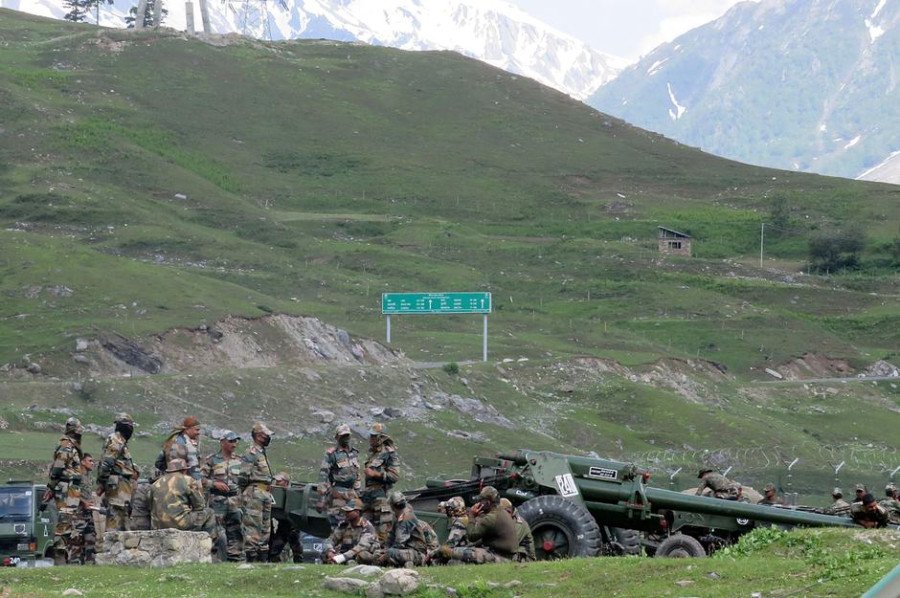
India’s immediate response to China’s “salami-slicing” tactics was a shift from reactive patrolling to “mirror deployment.” The Indian Army has permanently stationed over 50,000-60,000 troops in eastern Ladakh, supported by T-90 tanks and advanced artillery.
A critical breakthrough occurred in late 2024 when both nations reached an agreement to resume patrolling in Depsang and Demchok, effectively reversing the tactical blockades established by the PLA during the 2020 standoff. Unlike China’s “offensive realist” approach – which seeks to pre-emptively alter the status quo, India has adopted a “defensive realist” posture, prioritising the hardening of its positions to ensure that any further Chinese transgression incurs a prohibitively high cost.
In the years following the 2020 skirmish, the Indian military has undergone a profound doctrinal evolution. Historically, the Indian Army maintained a “defensive neglect” posture, believing that limited infrastructure would prevent Chinese incursions. This has been replaced by a “mirror deployment” strategy, where any move by the People’s Liberation Army is met with an equal and opposite force presence.
The October 2024 Patrolling Agreement marks a tactical victory in this regard. By securing a return to pre-2020 patrolling rights in the Depsang and Demchok sectors, India demonstrated that its refusal to “normalize” ties until the border returned to the status quo was an effective diplomatic lever. This agreement, which involves a coordinated schedule of 14 -15 personnel patrolling twice a month, serves as a significant confidence-building measure (CBM) in an otherwise trust-deficient environment.
The Infrastructure “Blitzkrieg”
Perhaps the most visible pillar of India’s strategy is the rapid development of border infrastructure. Historically, India hesitated to build roads near the LAC for fear of providing the PLA with easy access. Post-Galwan, this “defensive neglect” has been replaced by a “connectivity blitz”.
Considering the key strategic projects, the Sela and Zojila Tunnels are projects that provide all-weather access to Tawang (Arunachal Pradesh) and Ladakh, ensuring that troop movement is no longer seasonal. The Frontier Highway is a 1,800-km highway in Arunachal Pradesh designed to link various valleys, allowing for lateral movement across the eastern sector. Through the Vibrant Villages Programme, India is mirroring China’s “Xiaokang” villages, developing civilian settlements along the border to serve as a first line of “human surveillance” and assert sovereign presence.
While the PLA has long held a logistical advantage due to the flat Tibetan plateau, India’s Border Roads Organisation (BRO) has spent 2024 and 2025 narrowing this gap. The Shyok Tunnel, inaugurated in late 2025, is a centrepiece of this effort. Located on the Darbuk-Shyok-Daulat Beg Oldie road, it ensures that the northernmost outposts near the Karakoram Pass are accessible year-round, even in extreme sub-zero temperatures.
The expansion of the Arunachal Frontier Highway (a nearly 1,800 km project) further complicates China’s strategic calculus by enabling lateral movement across the eastern sector. This “all-weather connectivity” is not merely logistical; it is a psychological signal to Beijing that the Indian presence is permanent and unshakable.
Economic Statecraft and “De-risking”
India has pioneered a model of “selective economic decoupling” that has since been echoed by Western powers. Following the clash, India banned over 200 Chinese applications, including TikTok and WeChat, citing national security concerns. Furthermore, Press Note 3 (restricting FDI from neighbours) was introduced to mandate government scrutiny of Foreign Direct Investment (FDI) from countries sharing a land border, effectively stalling major Chinese investments in the automotive and tech sectors. While trade volume remains high due to India’s dependence on Chinese APIs and electronics, India is utilizing Production Linked Incentive (PLI) schemes to build domestic manufacturing resilience.
India’s “de-risking” strategy is perhaps most evident in its industrial policy. The Production Linked Incentive (PLI) schemes, particularly in electronics and IT hardware, have been specifically targeted at reducing dependency on Chinese supply chains. In 2025, a $2.7 billion package was introduced to promote the manufacturing of critical components like display panels and camera modules – sectors where China holds a near-monopoly.
While trade between the two giants remains at an all-time high-exceeding $135 billion with a massive deficit in China’s favour, India’s approach is “surgical.” New Delhi is not seeking total decoupling, which is economically unfeasible, but rather strategic insulation. By keeping Press Note 3 active, India has effectively forced Chinese firms like BYD and Great Wall Motor to look elsewhere, prioritising national security over short-term capital influx.
Strategic Autonomy and Minilateralism
India has significantly increased its participation in “minilateral” groupings to counterbalance China’s regional dominance. The Quadrilateral Security Dialogue (Quad) and the I2U2 (India, Israel, UAE, USA) are central to India’s “multi-alignment” strategy. By engaging in these forums, India signals that while it maintains “strategic autonomy” (avoiding formal alliances), it is willing to partner with any power that shares its vision of a “free and open Indo-Pacific”.
Implications for Nepal and the Region
For Nepal, India’s hardened stance creates both challenges and opportunities. Nepal has traditionally served as a buffer, balancing its relationships with its two giant neighbours. However, as the Sino-Indian rivalry intensifies, the room for “neutrality” shrinks, due to continued infrastructure competition, security dilemmas, transit dilemma and sovereignty issue at the Tri-junction.
Both India and China are competing to build transit corridors through Nepal (e.g., the Kathmandu-Kodari road vs. India-supported rail links), which can benefit Nepal’s economy if managed carefully. As India builds its border infrastructure, it increasingly views Chinese-led projects in Nepal, such as those under the Belt and Road Initiative (BRI), with high suspicion; and the increased Chinese investment in Nepal is also viewed through New Delhi’s security lens, leading to friction in India-Nepal relations.
This has led to “veto diplomacy,” where India occasionally restricts energy exports or transit facilities from projects built with Chinese involvement. The unilateral 2024 decision by India and China to reopen trade via the Lipulekh Pass without consulting Nepal highlights the “collateral damage” of great power alignment. Nepal claims this territory, yet its neighbours occasionally treat it as a bilateral bargaining chip, underscoring the fragility of Nepal’s strategic autonomy.
Conclusion
India’s post-Galwan strategy is one of “calibrated persistence.” It recognizes that the era of cooperation is being replaced by an era of contested regionalism. For think tanks like NIICE, the focus must remain on how mid-sized powers like Nepal can navigate this “tripolar” century (USA, China, India) without becoming a theatre for proxy competition.
Rebecca Speldewinde is currently pursuing her MPhil in Politics and International Affairs at Massey University, New Zealand.