
11 December 2025, NIICE Commentary 12141
Jayjeet Bajra Lama
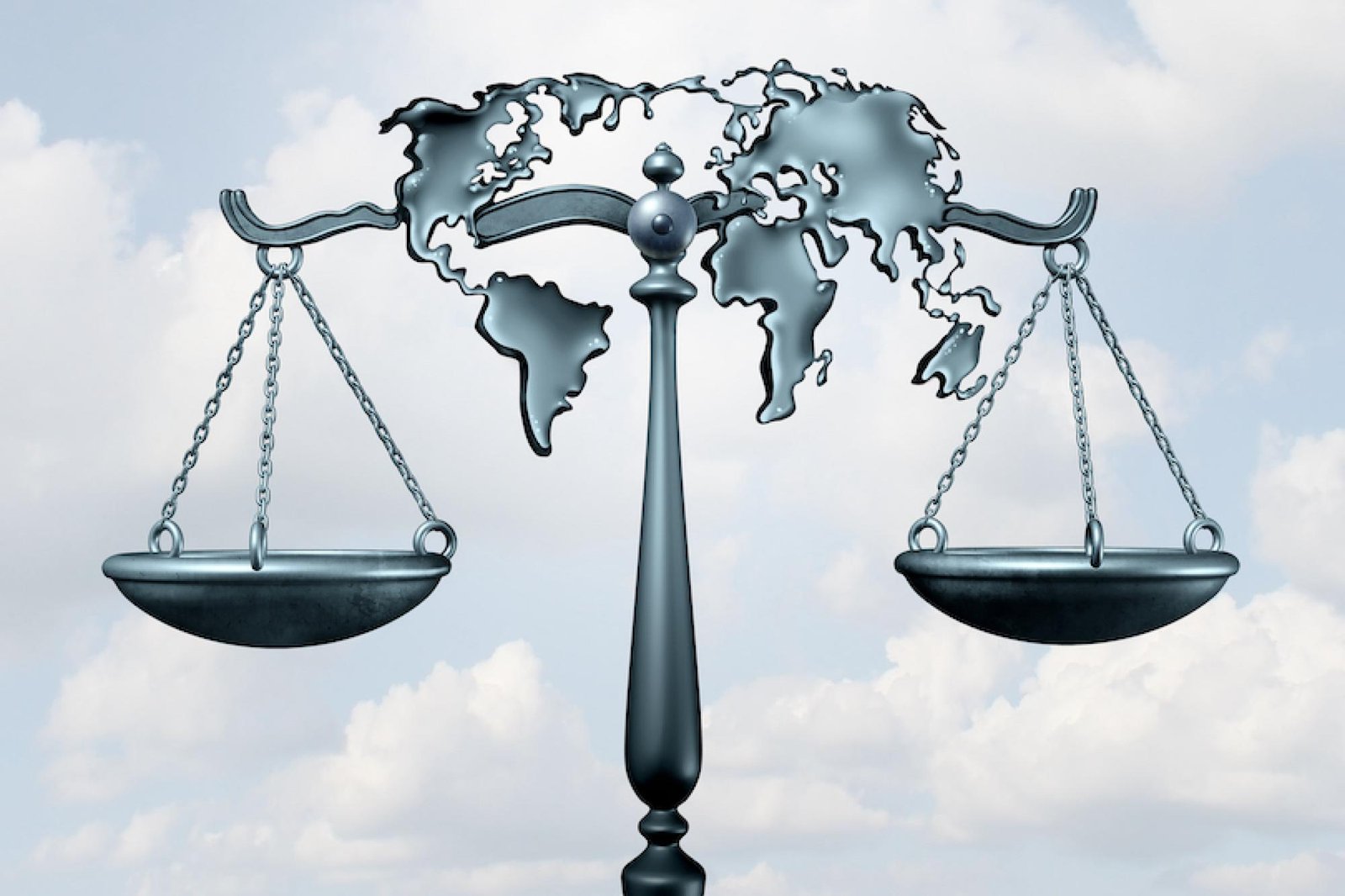
International law refers to principles, guidelines, and rules for maintaining social order and a sustainable relationship between states that all states accept. It serves as the foundation for maintaining relations between countries through treaties, accords and international organisations, especially emphasising human rights, peace, security, and international cooperation. However, its action in ensuring fairness and equality has been questioned among states, as stronger nations often dominate weaker ones, leading to interference and chaos rather than peace.
As stated in the report "Survival of the Richest" put forth by Oxfam International, the wealthiest 1% of the world's population accounts for almost two-thirds of total new wealth accumulated since 2020, new wealth compared to about double that of the rest of 99% of the world's population. Wealth inequality must be understood through its different forms, which are shaped by economic systems and practices that tend to benefit those in positions of power far more than others. The geopolitical priorities of the powerful states have determined international law development and enforcement, often colliding with strategic interests. The permanent members of the United Nations Security Council (UNSC), i.e. the U.S., the U.K., France, Russia, and China, have greatly influenced the shape of international legal regimes that suit according to their political and economic interests.
Similarly, opinion leaders and scholars claim that organisations such as the ICC are a neocolonial tool that ignores the activities of the strong Nations and keeps small governments in check by using accountability. This supports the argument that international law frequently functions as an instrument of ideological control, perpetuating global power imbalances rather than ensuring justice. ICC has charged only African defendants, which seems to have a much slower hand than the powerful countries. For example, while Putin was charged hurriedly in 2023, no officials from the United States had been held accountable for torture in Iraq. Additionally, evidence has been there since 2021 against Israel's Netanyahu, although nothing happened in that case much slower than with the other African suspects. This disparity in treatment starkly illustrates how powerful countries have the leverage to protect themselves from ICC indictment.
The US-led invasion of Iraq in 2003 illustrates how powerful states manipulate international law through selective enforcement. The United States and the United Kingdom deliberately claimed that Iraq had weapons of mass destruction without obtaining explicit UN Security Council approval, clearly constituting a violation of the UN Charter, which went unpunished. This speaks of a system where the influential would violate international laws at will while applying the same rules to lesser states at a high price. Yehuda Z. Blum is an Israeli scholar-diplomat who warns that holding power above principles like sovereignty and legal equality will ultimately legitimise occupation or aggression while upholding the interests of powerful states and eroding protections for vulnerable nations, jeopardising the foundations of international law.
Additionally, international law’s failure to enforce its own rules has turned justice into a tool of oppression, enabling a culture of impunity. Israeli settlements continue to expand despite multiple UN resolutions, with more than 700,000 settlers now living in the West Bank. Meanwhile, Gaza’s human toll has reached 46,707 deaths, including 18,000 children, alongside massive economic losses such as $25.5 million in daily labour income losses and $18 billion in damages, revealing the stark human price of this legal hypocrisy. Having considered the failures of international law in Palestine and the 2011 NATO intervention in Libya, both show two opposite but related problems. In Libya, intervention weakened state sovereignty without bringing stability, while in Palestine, the lack of enforcement has allowed occupation to deepen. Together, these cases reveal a core dilemma of international law: acting can cause harm, but doing nothing can do the same, leaving it criticised either way.
Similarly, international law has been practical and valuable in the overall advancement of environmental protection at the global level through multilateral agreements such as the Montreal Protocol in 1987 and the Paris Agreement in 2015. By 2030, the Montreal Protocol, the world's most successful environmental accord, may avert two million skin cancer cases by phasing out 88% of ozone-depleting compounds. Meanwhile, since the Paris Agreement, it has dramatically accelerated the low-carbon innovations and zero-carbon alternatives that have now become competitive across sectors, comprising 25% of global emissions. These solutions are projected to extend to industries accounting for over 70% of emissions by 2030. Frameworks like the Paris and Montreal Agreements, which are supported by international organisations, show international law’s strength in addressing environmental crises.
Additionally, International health laws, such as those under the World Health Organisation (WHO), have significantly prevented global disease and enhanced its prevention and responses. A notable success is COVAX, which by 2023 had delivered over 2 billion vaccine doses to 146 countries, saving 2.7 million lives. The WHO has also led major initiatives like the Global Polio Eradication Initiative, Ebola response, HIV/AIDS management, and coordination during the COVID-19 pandemic. These efforts demonstrate how, under international law, the WHO promotes health equity and proves that international cooperation can effectively serve collective global welfare.
However, International law often aligns with the interests of powerful countries. Wealthier countries supported the Montreal Protocol due to affordable alternatives, while poorer nations bear burdens under the Paris Agreement. This shows international law often reflects the priorities of powerful nations. UN peacekeeping succeeds in stable regions like Sierra Leone but fails in power-driven conflicts like Syria. Additionally, under the Trump administration, the U.S., a major donor to the WHO, withdrew from the organisation and the Paris Climate Agreement, signalling a preference for nationalism over multilateral cooperation and a rejection of international law and global governance.
International law has a strong influence over the protection and assistance of forcibly displaced populations around the world through institutions like the United Nations High Commissioner for Refugees (UNHCR) and its instruments such as the 1951 Refugee Convention. However, the Rohingya crisis weakens the institutions of International law, such as UNHCR. Despite evidence of genocide, China’s UN veto shielded Myanmar, prioritising strategic interests over human rights. Additionally, China and India’s promotion of nationalism and Islamophobia suggests a lack of genuine interest in resolving the Rohingya crisis. Meanwhile, Bangladesh bears the disproportionate burden of hosting over 1.1 million refugees as of March 2025, at an annual cost of $1.2 billion per year, with little international support.
In conclusion, International law is meant to serve as an impartial structure for global governance; however, it is often manipulated as a tool of power that privileges the strategic interests of dominant states against equitable justice. More particularly, the selective prosecutions of the ICC, the unpunished invasion of Iraq, the case of Libya, and the unchecked violations in Palestine. However, despite these perversions, success stories prove their potential mainly when collective interests resonate with legal norms: Environmental agreements and refugee protections. International law has real potential, but it requires urgent reforms, especially a more democratic UN Security Council and stronger protection from political influence. Without such changes, it risks becoming a mechanism for powerful states to dominate others rather than uphold justice. Ultimately, international law is too often used by influential nations to advance their own agendas instead of ensuring fairness.
Jayjeet Bajra Lama is a first-year BBM-LLB student at Kathmandu University School of Law with interests in international law, Corporate law, litigation, and public policy.
