25 September 202, NIICE Commentary 12787
Iffat Jahan Sharmin
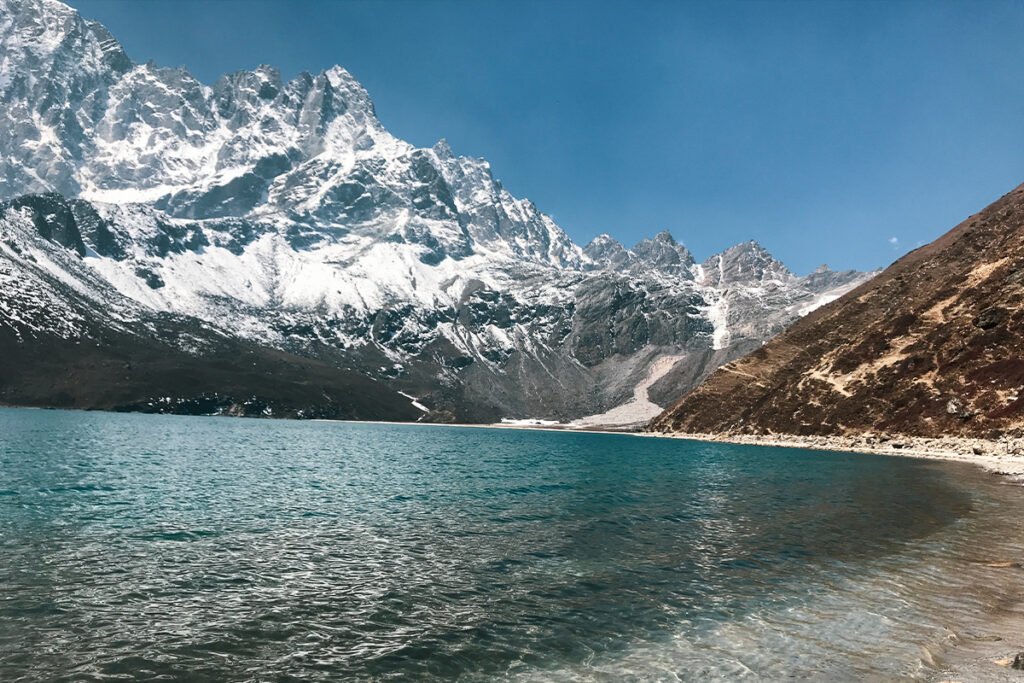
Despite being called a land of plenty with regard to its water resources, this country has been experiencing the opposite. The Himalayan ranges serve as the sources for some of the major rivers in Asia, thousands of rivers and streams crisscross the country, and the mountains abound in snow and ice. Nonetheless, millions of people have quite a different feeling about their country: there is plenty of water when people do not need it, and there is little when people really need it. This is the paradox of Nepal’s water situation.
One can say that this problem does not concern the deficiency of water in the country. In general, this is a problem of storing, managing, distributing and conserving water. Besides, climate change is complicating this imbalance even further. Over 80 percent of annual rainfall happens in monsoons in Nepal. And the outcomes are obvious – there are floods and landslides in the rainy months and increasingly problematic dry seasons after that. According to the World Bank, the country has some 225 billion cubic meters of annually available surface water resources but only 15 billion cubic meters are currently utilized. Meanwhile, less than 0.5 percent of the needed storage capacity has been developed.
Too Much Water, Too Little Water
This contradiction is witnessed throughout the nation. Monsoon rains can lead to flooding in rivers, destruction of road and bridge infrastructure, farmland flooding, and landslides. But within only a few months, farmers will not be able to get sufficient water for irrigation.
Tarai and Madhesh have faced this problem very seriously. There was an acute water shortage in Madhesh in 2025 due to insufficient winter rains and poor monsoons. ICIMOD had indicated a rainfall shortage of 30-50% in some parts of the province. Over 30% of boreholes were found to be dry, and there was a sharp decline in rice transplantation compared to the previous year. Around 400,000-450,000 tons of rice production had been under threat. The same area can suffer huge losses due to floods during the rainy season. The Lal Bakaiya watershed in Madhesh has been identified by ICIMOD as a “dual water crisis” area because of excess water during monsoons and insufficient water during dry periods.
Rivers alone do not create water security
The rivers of Nepal constitute an immense natural resource; however, water resources need to be harnessed for the purposes of human beings. In this regard, water security relies on infrastructural and institutional means like reservoirs, irrigation facilities, water supply networks, management of groundwater, conservation of watersheds and information about precipitation and flow of water in rivers.
Water resources have always received a lot more consideration in Nepal as a problem rather than in anticipation of its use as a resource. The results of this trend can be seen in agriculture, where the World Bank reports that year-round irrigation covers only 39 percent of irrigated land in Nepal, leaving agriculture highly exposed to seasonal rainfall variability. Thus, farmers are highly dependent on rain in this part of the world.
The disappearing spring problem
The water paradox is not restricted only to the plain areas. Communities in the hills and mountainous areas of Nepal depend on the springs rather than the big rivers for their water needs. But it has been found that springs are drying up in many parts. As per the World Bank report, 15 to 30 percent of springs in the mid-hills of Nepal have dried out, impacting the communities depending on the springs for their drinking water and agricultural needs.
It is quite a tricky situation because the village will be situated above the river carrying huge amounts of water flowing down below, but there will be no reliable source of water available for its use. As mentioned by UNICEF, communities in the western parts of Nepal have had to face such a situation where damaged or non-working water systems have left them with no other option but to walk for miles to fetch water.
Climate change is changing the equation
Climate change creates yet another source of variability. Alterations in the distribution of rainfall may lead to heavier rain in a short time or prolonged dry spells. Variations in snow and glacier melt could also alter river flows. A new regional study by ICIMOD reports that the Himalayan cryosphere is undergoing rapid change, while climate extremes and demand are rising, putting increased stress on the water systems of the Hindu Kush Himalaya. Almost two billion people are dependent on the region’s major river basins.
What does this mean for Nepal? For Nepal, planning based on historical rainfall data is rapidly getting more uncertain. An infrastructure built to last under the idea that the future will be the same as the past may not be resilient to the climate that is currently developing.
Nepal needs to Store Water, not just Celebrate it
A Nepalese response should therefore look to get beyond the well-worn rhetoric of Nepal being a “water-rich” nation. It must focus on water security. That requires investments in water storage – from community ponds and tanks to large-scale multi-purpose infrastructure within appropriate contexts – that is location-specific, environmentally sound and socially equitable. It involves restoring watersheds and springs, reducing irrigation inefficiencies, managing groundwater resources sustainably and making weather and hydrological forecasting robust.
There are already some examples of workable responses. In Kavre, community water-storage ponds are designed to collect rain during the wet season to be used during the dry season; while measures like this might lack the glamour of a large dam, thousands of small-scale interventions can contribute to a resilient buffer for communities that cannot afford to wait for large-scale infrastructure projects. Nepal also needs to better integrate its different uses of water. Drinking water, farming, hydropower, ecosystems and disaster management are often talked about separately, even though they are all dependent on the same water streams.
From Water Abundance to Water Resilience
Nepal’s biggest water problem may therefore not be in the quantity sense. It’s in seasonality, storage, and accessibility. We get vast quantities of water – way too much in the monsoon season, and way too little in the dry season. But the timing is becoming less and less reliable due to climate change, and the demand for water is rising due to expanding cities, agriculture and industry. Nepal has little control over the monsoon, and – as the impacts of climate change become more pronounced – little control over it either. But it does have control over whether it lets monsoon water run away as floodwater or whether it takes as much of it in as possible and stores it for later. Nepal doesn’t need to get richer in water, it needs to get smarter about the water it already has.
In Nepal, water security in the future will not be measured by the number of rivers that are flowing through the country. Instead, it will be whether they are able to sustain people, farms, towns, and ecosystems through the dry season.
Iffat Jahan Sharmin is currently pursuing her Master of Arts in International Relations and Peace Studies at Nalanda University, India.