
Eric Storm (2024), Nationalism: A World History, Princeton University Press, USA.
Sabeen Azam
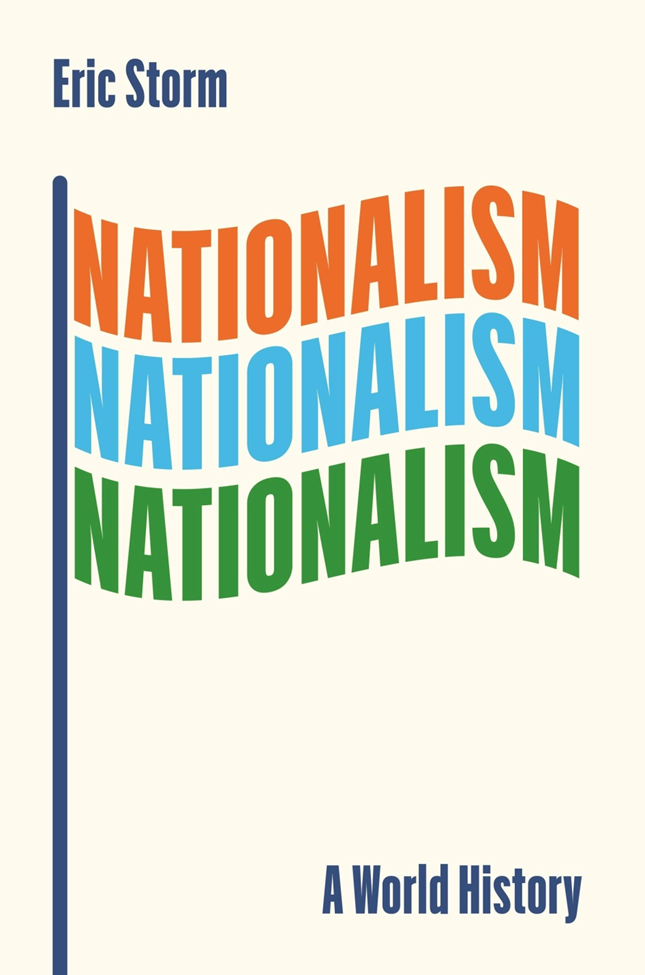 In his book Nationalism: A World History, Eric Storm offers a broad, historical, and global view of nationalism as a moving and changing ideology. The book further questions Eurocentric accounts that interpret nationalism emergence or changes as carrying a universal force since the early modern time to continue shaping the world political conditions, giving the reader a wide comparative aspect that had once used before. Storm denies the concept of nationalism as an export product of the west into the rest of the world. Rather, he holds a view that it is the result of different historical contexts, through successive cross-cultural interactions, colonial and encounters, and sociopolitical changes within. This provides an insight into the fact that readers are forced to learn how nationalism is not predetermined or monolithic, but rather contingent, pluralistic, and responsive.
Storm is chronological in organizing the book, as well as thematic, starting off with the intellectual and cultural convulsion of the early modern period, tracking through the enlightenment and the era of revolutions, and ending in the post-colonial and globalized world. The theme of the flexibility of nationalism forms a central theme. The author highlights how nationalism has been used in contradictory directions as it has been used by both liberators and oppressors, democrats as well as autocrats, revolutionaries and imperialists. He claims that it has existed cohabitating with other ideologies like socialism, religious revivalism and authoritarianism. Another area that Storm: covers is how nationalism adapted to other forms of non-Western contexts where local traditions, native movements and colonial resistance created but also defined forms of national identity that are extremely hybrid.
The author uses the approach that is transnational and comparative, using the broad number of regional case studies. Instead of providing the history focused on the European state formation, Storm develops the discussion of nationalist movements in Asia, Africa, Latin America, and the Middle East with an aim of demonstrating how actors on the ground reinterpreted and transformed nationalist ideas. Indicatively, the Indian and Egyptian struggles of anti-colonial nationalism are elucidated not as dependent on European models, but thriving and centered in the traditionalist intellectual traditions, religious, and political desires. This method is appropriate in stripping the sphere of action of Europe out of the nationalist historiographical paradigm, making the book fit into the current of postcolonial studies that demands the choice of numerous post-colonized people.
Nonetheless, although the universal perspective presented by Storm is refreshing and necessary, in some cases, his universality can prove contrapuntal to deeper analysis. Certain local case studies, especially those of sub-Saharan Africa and South East Asia are dealt with quite succinctly, which leaves the reader wondering whether the expansiveness of scope has come at the cost of textural depth of detail. Also, although Storm does a laudable job at illuminating the appropriative character of nationalism in colonized territories, it might have been prudent to direct increased emphasis on contradictions and tensions that exist within nationalist movements themselves including how nationalist projects have been divided or hampered by contradictions in terms of classes, genders and ethnicities. The book could also have used relating more to the critique of nationalism by subaltern studies and feminism, which also examines how nationalism in many ways has served to silence the marginalized regardless of its intentions of representing the whole.
The writing is dense, but clear, meticulously avoiding the pitfalls of getting too scholarly on the one hand and too expository on the other. The fact that he does not use theoretical jargon makes the book appealing to laymen, whereas his knowledge of global history serves as a source to scholars. However, a reader who would seek a more theoretically informed interrogation of nationalism might think that the conceptual framework in the book remains underdeveloped. One way in which Storm differs not only with current scholarly trends in nationalism studies, but also with many of the foundational works under discussion is the degree to which it addresses itself to the historical and political rather than the more philosophical or psychological processes that drive most of what has been written about nationalism in the past couple of decades.
Particularly, Storm does not limit his analysis to the past but he provides some interesting parallels to the present. Storms work in a time of renewed populism and illiberal nationalism in a world of Trump and Brexit or the aggressive ethno-nationalism of Modi India or of Erdogan Turkey. He reminds the readers that nationalism has survived into the present era as a protean phenomenon that continues to be attractive. However, he does not go along with such reductive judgments: nationalism can be inclusive and exclusionary, or libratory as well as repression-based, depending on the way it is built and on how it is used. Such an equilibrated evaluation can be considered one of the strengths of the book.
The closing arguments given by Storm warn against the danger of perceiving nationalism as a malady or aberration in the globalizing world order. Conversely, nationalism still manages to give meaning, unity and validity to political society even with the presence of supranational institutions and global government. The nationalism revival that is frequently intertwined with xenophobia, economic protectionism and objections to the liberal democratic model remain profound to the apprehensions about identity and sovereignty. That is why the appeal of Storm to perceive nationalism as the much-needed plural and historically circumscribed phenomenon is timely as well as needed.
However, maybe more should have been said about the digital era and its implication on changing the flow of transmission and rearrangement of nationalism. The production of algorithm-based information bubbles, online hate speech, the mediating capabilities of social media that determine national myths and collective memory form pivotal developments, which remodel the current operations of nationalism. These are the areas that the book can be expanded upon future studies or other studies can be done.
To sum it up, Nationalism: A World History is an intellectually adventurous, scholarly, and very much needed intervention to the nationalism research field. The comparative, international, time-sensitive look at Storm criticizes mainstream histories and urges the reader to reconsider a power that still has primary parts to play in political practices of the present day. Although it can be accused of trading in depth to reach across a wide area, the book does manage to create a broad, one-encompassing narrative that highlights the complexity, and opens up the persistence of importance concerning nationalism. It is both a worthwhile contribution to the scholarly literature and to wider public debate that can enable its readers to critically encounter one of the most important and disputed ideologies of our era.
Sabeen Azam, PhD, Department of International Relations, Federal Urdu University of Science Arts and Technology, Karachi, Pakistan.