19 January 2026, NIICE Commentary 12267
Kartik Sahu & Dewang Ganesh Thosar
The ratification of the Reciprocal Exchange of Logistic Support (RELOS) Agreement by the Russian Parliament marks a measured yet meaningful advance in India-Russia defence cooperation. Although the Government of India has not officially announced or elaborated on the details of this agreement, its ratification by Moscow underscores both countries’ interest in strengthening operational coordination. The agreement is understood to facilitate mutual logistical support, including refuelling, repair, replenishment, and maintenance during bilateral military exercises, humanitarian assistance, and disaster relief operations.
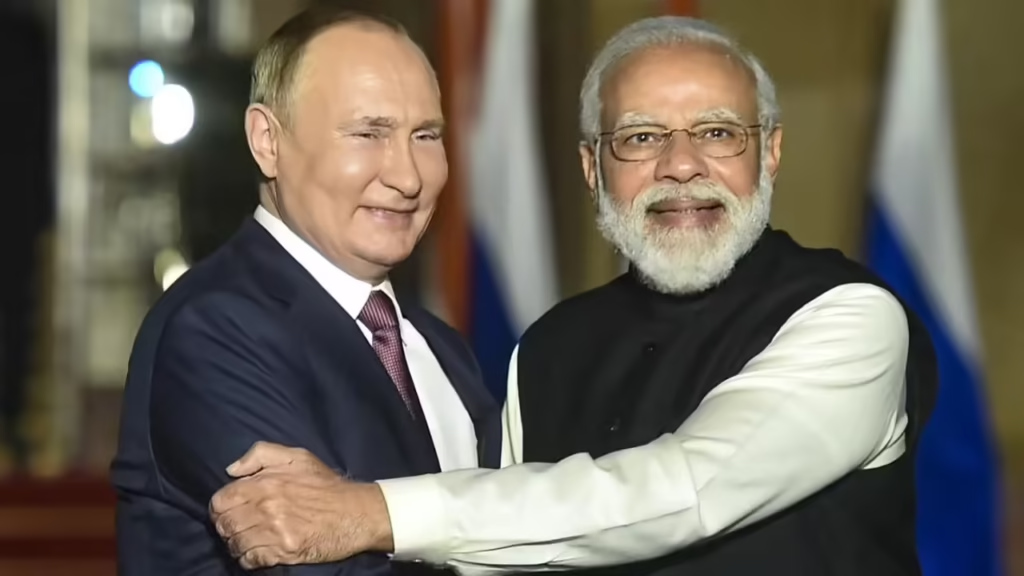
The RELOS Pact’s real significance lies not in granting base access or expanding military footprints, but in improving interoperability and efficiency between the armed forces of two long-standing partners. Coming soon after President Vladimir Putin’s state visit to India for the 23rd Annual Bilateral Summit, the agreement reaffirms Moscow’s willingness to sustain its strategic relationship with New Delhi at a time when global alignments are rapidly evolving.
Explanation of the Agreement
The RELOS Agreement is part of India’s growing framework of logistical cooperation with key partners. It is comparable in purpose to India’s existing pacts, such as the Logistics Exchange Memorandum of Agreement (LEMOA) with the United States, the Acquisition and Cross-Servicing Agreement (ACSA) with Japan, and the Mutual Logistics Support Agreement (MLSA) with Australia. Each of these arrangements allows mutual access to designated facilities for refuelling and replenishment during joint activities while preserving full sovereignty and transparency in their implementation.
In this sense, RELOS strengthens the practical side of India-Russia military cooperation. It enables both sides to support each other’s forces during naval deployments, training exercises, and HADR missions, thereby reducing logistical delays and enhancing operational readiness. Rather than being a platform for military expansion, it serves as a mechanism to improve coordination and reliability in an increasingly complex maritime environment.
Operational and Strategic Value
Operationally, RELOS allows Indian and Russian forces to work more efficiently during joint exercises and training programs. It also supports India’s scientific and logistical interests in the Arctic region, where cooperation with Russia in polar research and maritime navigation is likely to become more important as the Northern Sea Route gradually opens due to the melting of Arctic ice. This development provides India with an opportunity to participate in emerging Arctic shipping and research activities through Russian ports such as Murmansk, which could become gateways for India’s access to the Arctic Ocean. In this context, RELOS provides logistical backing for the movement of Indian naval and research vessels, helping India consolidate its presence in a region where China already projects influence by describing itself as a near Arctic state.
The agreement also connects with the proposed Chennai-Vladivostok Maritime Corridor, a project envisioned to enhance connectivity between India and Russia’s Far East. RELOS can play a complementary role by ensuring logistical support along this route, facilitating naval cooperation, trade movement, and maritime connectivity across the Bay of Bengal, the South China Sea, and the Western Pacific. Such linkages would not only strengthen India’s maritime reach but also bring strategic balance to the Indo-Pacific by creating new pathways for cooperation outside the traditional Western-centric networks.
Strategically, the agreement contributes to India’s long-term goal of maintaining balanced defence partnerships across multiple poles of power. It allows New Delhi to deepen engagement with Moscow even as it continues to strengthen cooperation with the United States, Japan, Australia, and France. By adding the RELOS pact to this matrix, India ensures that its defence cooperation remains diversified and not overly dependent on any single partner.
For Russia, the pact provides an opportunity to maintain a visible presence in the Indian Ocean Region through cooperative logistics. It allows Russian naval assets to access Indian facilities for refuelling and maintenance during friendly visits or exercises, enhancing Moscow’s ability to sustain its presence in the central maritime routes of global trade. This reciprocal arrangement complements Russia’s strategic interests in both the Pacific and Arctic, linking its northern and eastern maritime domains with the Indian Ocean through India’s logistical network.
Geopolitical Context and Implications
The geopolitical value of the RELOS Agreement must be understood within the framework of India’s strategic autonomy. At a time when Russia faces increasing Western isolation, India has chosen to continue defence engagement based on mutual interests and long-standing trust. This reflects New Delhi’s independent foreign policy and its refusal to align fully with any power bloc.
While some observers interpret the agreement as an attempt to counterbalance China’s growing presence in maritime domains, its actual intent is functional and pragmatic. RELOS ensures that India and Russia can maintain operational synergy despite global tensions and evolving alliances.
For India, the agreement’s strategic merit lies in flexibility. It enables cooperation with both Western and non-Western partners without undermining any relationship. When seen alongside LEMOA, COMCASA, and logistics support agreements with Japan and Australia, RELOS adds another layer to India’s maritime strategy, one that emphasises access, preparedness, and resilience rather than power projection.
In a wider geopolitical sense, RELOS also reaffirms Russia’s intent to re-engage with the Indo-Pacific through India, bridging its Arctic ambitions with Indian Ocean outreach. The pact thus symbolically connects two emerging theatres of maritime geopolitics, the Arctic Ocean and the Indian Ocean, through a framework of cooperation and mutual access.
Conclusion
The RELOS Pact represents continuity in India-Russia defence cooperation and reflects both countries’ pragmatic recognition of shared interests. While it does not signal a dramatic shift in maritime power balances, it marks an important step toward operational maturity and structured collaboration between the two sides.
By enabling cooperation across diverse maritime zones from the Arctic through Murmansk to the Indian Ocean via Chennai and Vladivostok, RELOS aligns with India’s vision of becoming a capable and self-reliant maritime power. For Russia, it strengthens its re-entry into the Indian Ocean Region through partnership rather than competition. Together, the two countries have taken a realistic step toward integrating logistics, research, and strategic access, reinforcing their long-standing partnership in an evolving multipolar maritime order.
Kartik Sahu & Dewang Ganesh Thosar are Postgraduate Research Scholars in International Relations at South Asian University, New Delhi, India.