15 December 2025, NIICE Commentary 12151
Dr Mirwais Balkhi
The world, particularly the Western and the United States, is dealing with Islamic terrorism in Afghanistan and its surrounding region in two unclear ways; first, it has a non-formative and pragmatic definition of each terrorist organisation individually, e.g., the US’ engagement with the Taliban of Afghanistan following the Doha agreement between the US and the Taliban in February 2020. Second, the temporary inactiveness of a terrorist organisation has always been taken for granted; e.g., in the strategy of the War on Terror, less attention has been paid to the potential reorganisation and reemergence of a terrorist organisation. Al Qaeda’s strategic passivity and hibernation period are taken for granted by the US and others. It is considered an almost-dead organisation in the US.
These days, the Islamic State of Khorasan or IS-K apparently appears to be the only concerned terrorist organisation that has remained a serious security threat to the West and the United States from South-West Asia and Afghanistan. In the past few months, almost all the analyses on terrorism’s potential or actual threats to the US and the West have pointed towards IS-K.
IS-K is now the prime target to fight terrorism by all, even geopolitical rivals like the US and Iran. The Washington Post recently pointed out in a report citing leaked documents from the US Department of Defence (Pentagon), “Afghanistan has become the coordination centre of IS-K. It is trying to plan attacks from Afghanistan to any possible country.” It is something that Hossein Amir-Abdollahian, the Minister of Foreign Affairs of Iran, also acknowledged a while ago and said: “It is no secret to anyone that the leaders and trained forces of IS Iraq, Syria, parts of Libya have been moved inside Afghanistan.”
A consensus is informally formed by Western and the US as stakeholders of South-West Asian issues that the Taliban is a militant turned-political organisation, and Al Qaeda is a totally collapsed network. The only active and potential threat to all is IS-K, a common understanding that also favours the Taliban and Al Qaeda.
The Triangle of Terrorism in South-West Asia
Contrary to a stereotypical understanding of the radical organisations, the Taliban, Al-Qaeda, and IS-K as opposing terrorist organisations by the majority of people in the West and the US, they compose a triangle of Islamic terrorism in the region of Afghanistan as complementary parts of South-West Asia and Central Asia. All three have a tri-goal to firstly establish an Islamic state based on pure Islamic Sharia (geographic boundaries differ for each). Secondly, the establishment of the Islamic State must be through terror and a new war, which means eliminating any internal obstacles against the Islamic State (tactics may differ for each). Thirdly, fighting against the West and the US is based on Westernophobia and Americanophobia (a common goal). What differs from each other is the approach to achieving the ultimate goal.
Unlike claims on core and fundamental differences between the three terrorist organisations, there have been overlaps in ideas, methods, and members of the Taliban, Al Qaeda, and the IS-K. A Taliban member easily turns Al Qaeda members or IS-K or vice-versa following attacks and targets against one organisation by the NATO-US. The serious attention of the United States and its allies in the war with al-Qaeda after 2000 led to the strengthening of the Taliban in Afghanistan and South Asia. Later, the shift of focus from al-Qaeda following Osama’s elimination in May 2011 to the war with the Taliban around 2014 resulted empowerment of IS-K. Now, refocusing of the United States to fight IS-K provides the ground for global action of the Taliban and the re-emergence of al-Qaeda in a different way.
Taliban’s Export of Terrorism
The Taliban believes in establishing an Islamic state within the boundaries of present Afghanistan (TTP for Pakistan, TTT for Tajikistan). However, they believe that exporting terror means into other Islamic states and supporting the Taliban-like-minded organisation to establish their Islamic states. Therefore, the Taliban explicitly supports Tehrik-e-Taliban-e-Pakistan, Tahrik-e-Taliban-e-Tajikistan, and like national terrorist organisations like those in Uzbekistan. Following taking power in Afghanistan in 2021, the Taliban has shown less interest in supporting Islamic terrorist organisations like ETIM, Chechenian, and Jundullah, which fight against non-Islamic and non-Sunni states.
Al Qaeda’s New Avatar
Al Qaeda follows its own strategy of fighting colonial factors, which prevent the establishment of an Islamic state. Its priority has changed from fighting against non-Islamic regimes in the Islamic countries to fighting the Western and the US interests and its regional allies. It currently has mutual strategic relations with the Islamic Republic of Iran; Al Qaeda is reorganising itself with the technical and financial support of hardliners within the Iranian regime.
Currently, Al Qaeda, a considered terrorist organisation to the West, NATO, and the US, is actually revamping and reorganising itself through a strategic alliance with countries around Afghanistan. It will soon rebrand and reemerge in its new avatar. The killing of the leaders of Al Qaeda by the United States, such as Ayman al-Zawahiri, cannot be considered an effective war against the cause of terrorism. Al-Qaeda’s undeniable potential, such as the legitimacy of Osama bin Laden among the extremists in South-West Asia, its traditional sources of income in the Arab- Islamic world, its organisational experience and war tactics, and its influence, gives it value for the geopolitical rivals to invest in it as a strategic asset to fight against enemies. Iran’s pragmatist approach towards Sunni jihadism, like Hamas and the Muslim Brotherhood, is not new. The unique geopolitical tensions among the regional players in South-West Asia and international actors in that region give space for Al-Qaeda to use the opportunity for its reshaping. It’s a win-win game for both Al Qaeda and Iran.
The Frenemies of The Taliban and IS-K
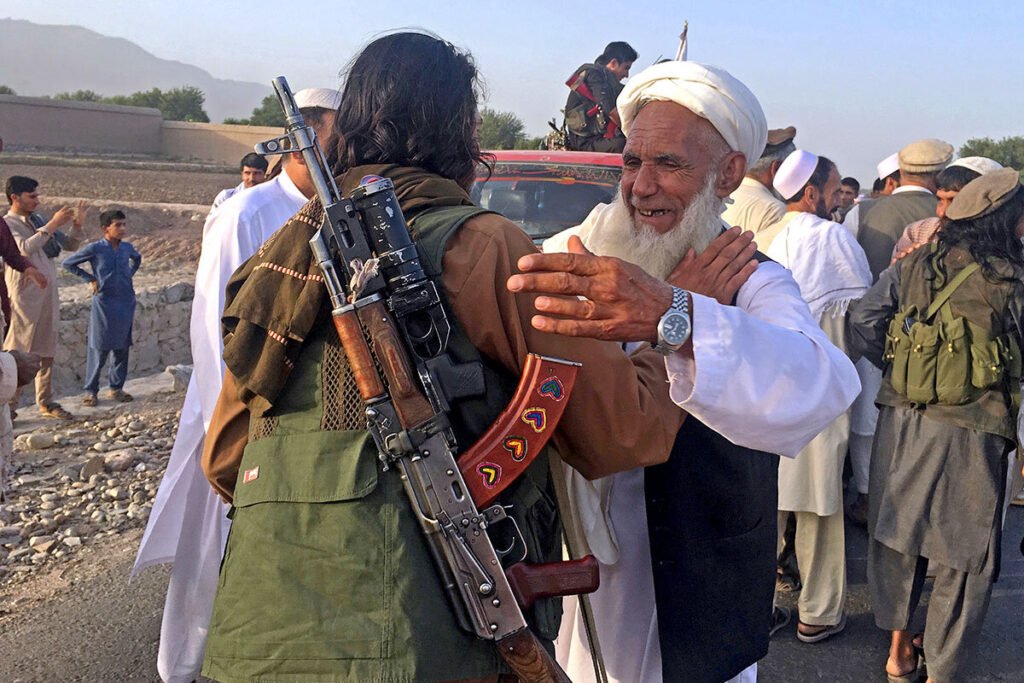
The Taliban and the IS-K are not enemies; they are frenemies with the convergence of goals but with different approaches. They have a symbiotic living at the bottom and among the main bodies of their fighters and sympathisers. The difference in approaching a pure Islamic State has resulted in conflicts between the two.
1. As Friends
The leading members of IS-K have a history of working with the Taliban in Afghanistan and Pakistan. For example, Sanaullah, the current leader of IS-Khorasan, and Salahuddin, who is in charge of the overseas operations of IS-Khorasan, have a background in the Haqqani network, as the main ally of the Taliban, in which Sirajuddin Haqqani, the leader of the Haqqani Network, serves as the minister of interior. He is the deputy of Mulla Habitahullah Akhundzada, the Taliban’s supreme leader. Or Hafiz Saeed had worked with Tehrik-e-Taliban-e-Pakistan.
The Taliban released about 4,000 IS-K members from prisons in Afghanistan after the fall of the republic. The release caused them to join their respective nuclei without delay and create the ground for the presence of five to six thousand IS-K operatives in Afghanistan. In fact, the IS-Khorasan is a combination of veteran members of the Taliban and al Qaeda in Pakistan, Afghanistan, Central Asia, and the Arab world. Sanaullah, Salahuddin, Sultan Aziz, and Muhawia, the leaders of IS-K, have had connections with the Taliban in the past.
2. As Enemies
Despite having a friendly and symbiotic environment, the Taliban and IS-K currently have differences and confrontations, too. The difference is not in terms of ideology; they do not criticise each other’s beliefs, but rather each other’s behaviour and approach. Therefore, their disagreement is in terms of using power, which the Taliban has concise within nation-state boundaries and exports terror to different states, while IS-K does not believe in consolidating power within political borders and rejects national politics.
There are enough reports and evidence that during the Islamic Republic of Afghanistan, the Taliban and IS-K conducted joint operations in Kabul. Such cooperation has sometimes had difficulties due to differences in the behind-the-scenes management of the aforementioned groups at the leadership level. But among the middle ranks and their ranks, such collaborations not only did not face problems but were also successful.
The turning policy of the Taliban from pure military fighting to a political approach widened the gap between the Taliban and IS-K leadership. The Taliban started political interactions with the US, Russia, China, and other countries of the region, which eventually ended up with a Doha agreement between the Taliban and the US. Since then, IS-K has highlighted three accusations of the Taliban to increase its supporters:
- The Taliban turned corrupt, suffered from intra-Emirate power struggles, and distanced themselves from the Islamic goals.
- Taliban leaders have good relations with countries such as China, Russia, and Iran, and they are taking a step against Islam.
- Taliban leaders are trying to interact with the infidel countries of the world, including the US, and have signed a peace agreement with it.
Implications
The unified objective of the Taliban, IS-K, and Al Qaeda and their common enemyology provide a common environment for all three to organizationally strive, recruit more youths, and design cross-Afghanistan missions. The Taliban, IS-K, and Al Qaeda’s lower and middle-level apparatus have overlapped. For over two decades, they have changed sides depending on circumstances. The Taliban’s oligarchic decision-making leaders, including the supreme leader, cannot leverage to eliminate the IS-K and Al-Qaeda members from the Taliban’s war machine. Therefore, the IS-K and Al Qaeda are easily using the opportunity in Afghanistan under the Taliban to preserve the Talibani Islamic State and to follow their regional and international missions by exporting terrorism and fighting governments in South-West Asia.
The troika of Islamic Terrorism in South-West Asia eventually ends on a divergent path, and that is fighting NATO-US and their regional allies by all means. The Taliban-IS-K and Al Qaeda may have areas of conflict among themselves, but their overseas operation is a crucial part of their objective and survival policies.
Westernophobia, and particularly Americanophobia, is a common consequence of the thoughts and behaviours of all three terrorist organisations. One of the main points of confrontation among the Taliban, IS-K, and Al Qaeda is the accusation of each other for cooperating with the US or remaining silent to fight against it. Therefore, regardless of the speculations they have against each other, the war against the US, wherever possible, including inside the US, is a priority for the Taliban, Al-Qaeda, and IS-K. Considering this perspective, the potential of attacks on Western countries, especially the United States, is high.
Recommendations
The US-NATO withdrew from Afghanistan, justifying that the mission was accomplished following the death of Osama bin Laden. However, the actual cause of the US-NATO presence in Afghanistan and fighting Terrorism has not been eliminated. The withdrawal caused a vacuum in the region; therefore, a non-military approach towards appeasing the Taliban cannot prevent the autocratic regimes within South-West Asia and the larger region not to using the potential of the Islamic Terrorism triangle against each other and the US-NATO.
Unlike the Taliban claims, the war continues in Afghanistan. This war is on three sides. On the one hand, a battle between falsehood and falsehood in which Islamist groups such as IS-K and the Taliban have died based on differences in approach. The goal of both is to solve the endless problems of the Islamic world. An unknown purpose that becomes the force for recruitment and survival of Islamic extremist currents. On the other hand, the war of democracy and human values against extremism, which democratic and cultural forces are fighting against terrorism in the soft and hard dimensions. NATO and the United States of America should stop separating ISIS Khorasan and the Taliban. It clarifies the political definition of the triangle of mother terrorist networks with the Taliban-Al-Qaeda side and IS-K, which have a common goal and nature in the matter of united struggle intellectually and operationally.
In the security policy of the countries targeted by extremists, the nature and purpose of terrorist groups as a whole are considered. The separation between one terrorist group and another group in a tactical and short-term situation leads to the flourishing of terrorism. In today’s diverse world and geopolitical games, a weakened terrorist group adjusts its approach to seek the support of a large country and develops again under its shadow. IS-K is now purposefully using the facilities it has within the ranks of the Taliban to surprise them by carrying out operations, which has become one of the weak points of the Taliban. This group uses the same “fight and flight” tactics that the Taliban used against the previous government of Afghanistan.
Dr Mirwais Balkhi is a Visiting Fellow at NIICE.