8 December 2025, NIICE Commentary 12020
Manila Prajapati
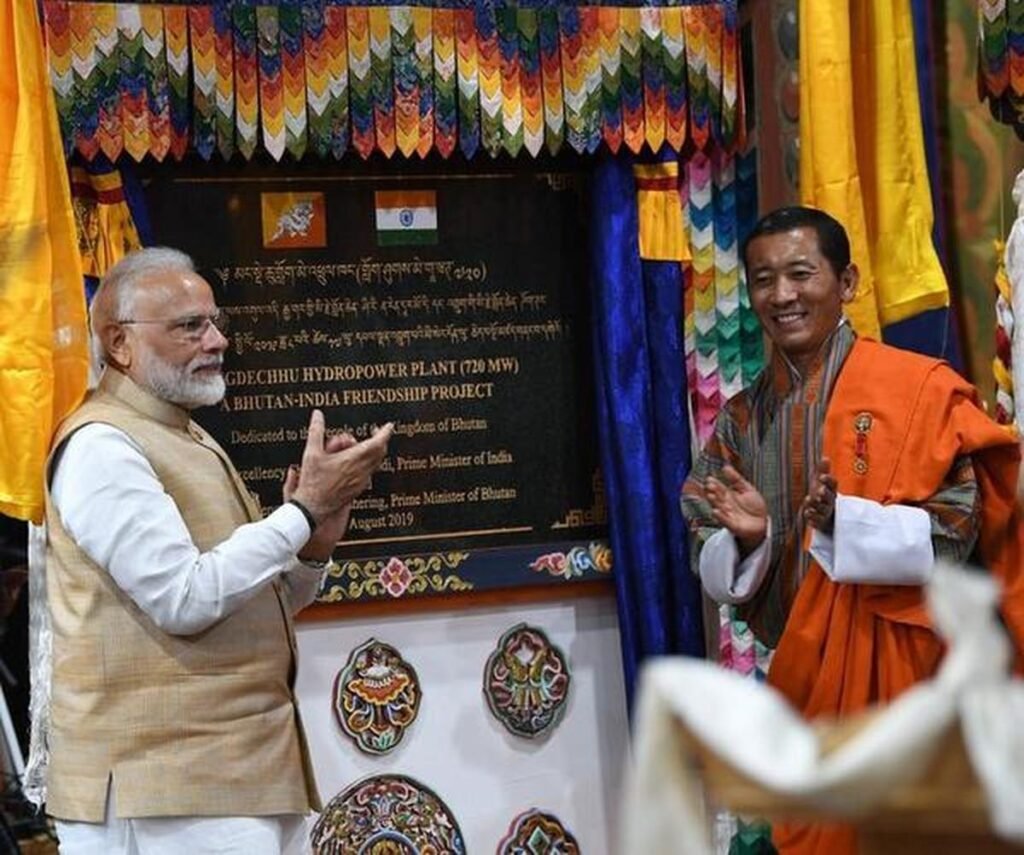
The recent Bhutan visit of Prime Minister Narendra Modi on November 11 and 12 marked one of those milestones in India-Bhutan Relations. It marked a significant moment in India’s diplomacy with its Himalayan neighbour. The visit underscores cooperation in areas like health, education, culture, connectivity, but hydropower was still the major focus. Hydropower has played a major role in shaping the India-Bhutan relations for over a year into one of strong economic development, interdependence and mutual trust. Hydropower has grown to be more than just a tool for development rather it has emerged as a tool of strategic energy diplomacy. This text examines how hydropower is changing the dynamics between India and Bhutan and what it means for regional stability and economic growth.
History: Foundation of India-Bhutan Hydropower partnership
India Bhutan hydropower relationship is longstanding; formal cooperation began in 1961 and received impetus in 1974. In due course of time, the partnership had been established into various agreements and projects such as 336 MW Chukha HEP, 60 MW Kurichhu HEP, 1020 MW Tala HEP and 720 MW Mangdechhu HEP. Project pipeline, including the large Punatsangchhu-I (1200 MW), Punatsangchhu-II (1020mw), reflects both ambitions and continuity in partnership. Cooperation in hydropower has been an economic backbone rather than just energy. According to the reports, Hydropower accounts for 63 per cent of Bhutan’s total exports and constitutes the largest share of the country’s Gross Domestic Product (GDP). Whereas for India, Bhutan’s hydropower is not just a source of renewable energy, it’s a strategic asset. This helps India balance its grid while maintaining long-term energy security.
Key progress on Punatsangchhu-II Hydroelectric Project
On 11 November 2025, Modi and the Bhutan King jointly inaugurated the 1020MW Punatsangchhu-II Power plant. The concluding unit, Unit 6, with a capacity of 170 MW, was connected to the Bhutan grid in August 2025, completing the project’s full commissioning. The plant is run-of-the-river, minimising environmental dislocation, but its location is huge: it raises Bhutan’s generation capacity by roughly 40 per cent. Moreover, it has generated a significant amount of revenue, generating around Nu 4.9 billion in revenue. The financing of the Punatsangchhu II Hydroelectric Project is structured as a 30 per cent grant and 70 loan arrangement from the Indian government.
During his visit, India extended a further line of credit for energy development; the value of this has been reported in the news as around 40 billion rupees ($455 million). This loan is indicative of India’s long-term commitment to energy infrastructure in Bhutan, not just generation but possibly transmission and grid integration.
Strategic Logic for India: Energy Security, Climate goals and geopolitical goodwill
For India, three reasons make Bhutan Hydropower so attractive. First, Bhutan hydropower adds low-carbon, reliable power to India’s energy mix, helping to keep the grid stable while balancing variable renewable sources. Second, this can be imported relatively rapidly into India through existing cross-border lines, meeting its growing seasonal and regional demand. Third, the cooperation reinforces India’s soft power, as energy projects deepen bilateral relations and reflect a supportive, development-centric approach in a part of the world where competition is increasing. Experts call hydropower both an energy tool and a diplomatic asset.
Benefits and opportunities for Bhutan
Hydropower has been and continues to be a major driver of the Bhutanese economy, traditionally commanding a large proportion of government revenues and exports. Its hydropower export earnings have grown steadily; data show over Nu 36 billion in export sales between 2023 and April 2025. This consistent inflow supports public spending, debt servicing and future social investment. While hydropower deepens economic interdependence with India, it simultaneously gives Bhutan bargaining power and regional relevance. With strong energy earnings, Bhutan can invest in diversification, infrastructure and socio-economic programs without over-reliance on external aid. Such a move will enable Bhutan to pursue sustainable development while retaining state ownership of strategic assets. However, Bhutan’s heavy dependence on hydropower also exposes it to hydrological risks and long-term debt obligations.
Regional and Geopolitical Implications
The deepening hydropower cooperation with Bhutan strengthens India’s presence in the strategically important Himalayan region. It matters all the more when China is steadily increasing its engagement with Bhutan through boundary talks, such as the 25th round of boundary talks between China and Bhutan in October 2023 and the establishment of the Joint Technical Team (JTT) to implement the three-step roadmap for the delimitation of the boundaries. By supporting Bhutan’s development with energy projects, India secures a vital position in the Himalayan geopolitical map. For neighbouring countries like Nepal, with its equally extensive hydropower possibilities and interest in attracting investment and export markets, the India-Bhutan model holds some valuable lessons. It indicates the value of good institutional arrangements, clear government-to-government agreements and effective roles for national utilities and private partners. Strong coordination, transparent pricing and timely investment in cross-border transmission lines will be required to convert this regional opportunity into real benefits.
Challenges and risks
Hydropower development is technically difficult in the Himalayas. Punatsangchhu-I, while being a prestigious project, has experienced delays and cost overruns. Geopolitical risk, landslides, or problems during monsoons are ever-present in the Himalayas, as witnessed by the Bhutan flash floods and landslides in July 2023. If due to Climate change, hydropower fails to perform well, the country might experience financial trouble.
Conclusion
Modi’s Visit, together with the launch of Punatsangchhu-II, went beyond ceremonial gestures and marked a new phase in India-Bhutan cooperation. Hydropower is no longer only a tool for development but rather a strategic instrument for energy security, Bhutan green growth and regional stability. If strategically managed, India–Bhutan collaboration can also become a foundation for wider regional power trade frameworks involving Nepal and Bangladesh. If used carefully, this expanding energy partnership can be a model not just for collaboration within the Himalayas but also in the sphere of energy-focused diplomacy across South Asia.