26 November 2025, NIICE Commentary 11963
Mira Rai & SoHee Park
The global political landscape appears to be receding from the “Third Wave of Democratisation,” giving way to a worldwide surge of authoritarianism. Yet, running counter to this prevalent trend, South Asia is experiencing an unprecedented gust of democratic momentum. This commentary attempts to delineate the causes and processes of this region’s formidable wave of resistance–which one might fittingly term The South Asian Spring–and, in doing so, aims to examine the significance of digital technology, particularly Information and Communication Technology (ICT), in the context of democratisation.
Conventional studies on the relationship between digital technology and democratisation are broadly bifurcated into two schools of thought: optimism and pessimism. The optimist approach (e.g., Rujigrok, 2017) argues that ICT facilitates democratic movements by lowering the cost of collective action necessary to resist authoritarian regimes, thereby promoting democratisation. Pessimists, on the other hand, largely dominated by the digital authoritarianism literature (e.g., Xu, 2021), contend that technology instead increases the intensity of authoritarian surveillance, thereby enhancing the efficiency of state repression. Against this backdrop, the democratic movements in South Asia stand out as a compelling set of cases that emphasise the positive aspects of the internet’s influence on democracy.
Given this context, the crucial question remains: What are the underlying causes and conditions that have given rise to this unprecedented regional wave of democratisation? We argue that these movements, though distinct, share common features rooted in deep structural grievances and in the strategic use of a contentious repertoire by the digital native Gen-Z generation.
Political Opportunity Structure and Contentious Repertoire
First, the democratic surge is a reaction to the deepening structural grievances exacerbated by decades of state failure. These factors created the Political Opportunity Structure (POS; Tilly & Tarrow, 2015) that activists successfully exploited. Second, economic inequality, widespread corruption, socio-economic inequality, unemployment, and exclusion have led to profound democratic frustration. High youth unemployment and the collapsing promise of upward mobility were key drivers. Third, dynastic politics and nepotism. The entrenchment of political dynastic and patronage networks has undermined social and economic equality in South Asia, thereby stripping the regimes’ legitimacy. Over time, this frustration led to massive youth mobilisation, a process diffused and amplified by digital connectivity and social media activism, which culminated in youth-led uprisings across the region.
The movements in Sri Lanka, Bangladesh, and Nepal demonstrate how digital platforms are used as essential tools for coordination, framing, and resistance. The Aragalaya movement in Sri Lanka (2022) arose against President Rajapaksa and Prime Minister Ranil Wickremesinghe, driven by the country’s deteriorating political economy: (i) the dominance of the Rajapaksa political dynasty, (ii) the nation’s increasingly dysfunctional political economy, and (iii) the resulting catastrophic economic crisis. The movement unfolded over four months and was propelled by rapid social media mobilisation. Young people generated unifying hashtags like #GotaGoHome that articulated the central protest demand. They also used digital platforms to share schedules and locations for protests, circulate news and images of events, and livestream speeches and discussions from the main protest site, GotaGoGama, as well as from other locations.
In Bangladesh, the Anti-Discrimination Student Movement (ADSM; 2024), also known as the July Revolution, ultimately ousted then-Prime Minister Sheikh Hasina. The student-led protest has its roots in deep structural issues within its political and economic systems. The mass uprising was initiated as a protest over the reinstatement of a civil service job quota for descendants of the 1971 Liberation War veterans. The policy exacerbated people’s dissatisfaction with the regime, seeing it as totally authoritarian, corrupted, unequal, and economically exclusionary. The ADSM movement relied on digital platforms for a collective voice among Gen Z activists. These cyber platforms provided students with direct access to amplify their democratic demands, disseminate real-time information, coordinate activities, share evidence of state violence, and connect with international audiences.
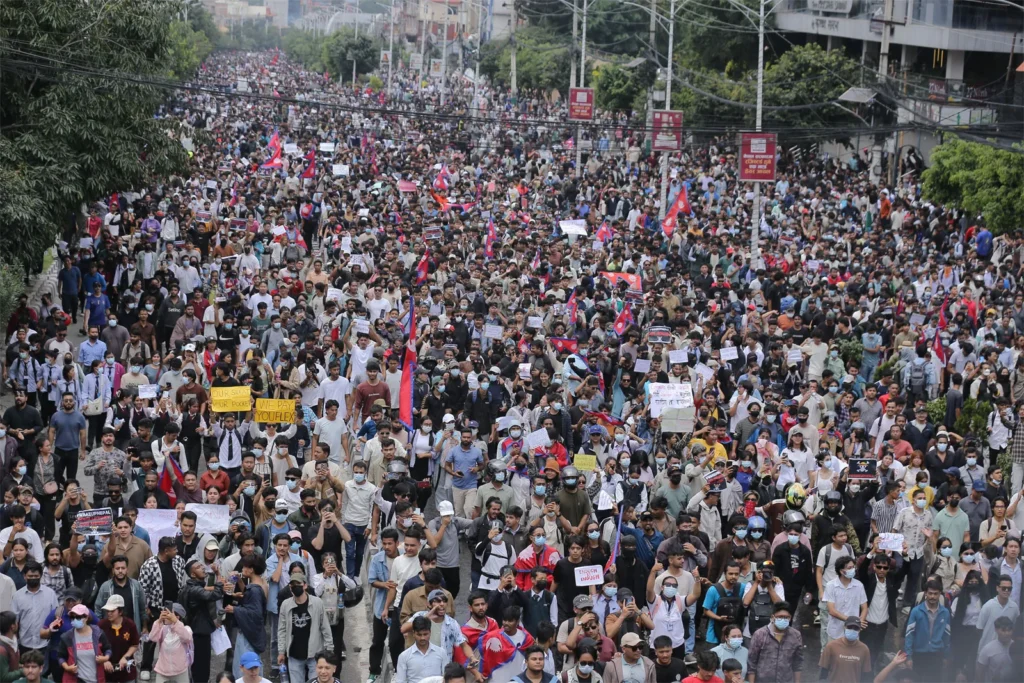
The most recent country to experience such turmoil is Nepal (2025). The movement began with the viral online TikTok trend #Nepobabies, which exposed the wealthy lifestyle of politicians’ children. Although initially triggered by a social media ban, it instantly gained momentum to channel years of democratic grievances. Here, the case of Nepal is similar to Sri Lanka and Bangladesh, with persisting structural frustration coming from inequality and structural hierarchies rooted in caste, class, ethnicity, gender, and religion. The #Nepobabies trend ignited youth anger by denouncing nepotism and clientelist politics that have undermined the regime’s accountability. It is important to note that the movement was heavily influenced by the protests in Indonesia, Bangladesh and Sri Lanka. Nepal’s Gen Z movement demonstrates a successful diffusion of democratic values and contentious repertoires through digital platforms across the region.
Catalysts
Why, then, did the South Asian Spring erupt at this particular historical moment? We argue that the timing reflects a critical miscalculation by authoritarian leaders across Sri Lanka, Bangladesh, and Nepal; these competitive authoritarian regimes (Levitsky & Way, 2010) failed to sustain the delicate balance required for effective authoritarian control (Svolik, 2012). In each case, rising illiberalism intensified long-standing grievances to the point where mass mobilisation became inevitable. Over the last decade, governments in these countries have increasingly relied on coercive measures: expanding state corruption and repression, eroding civil rights, and tightening digital surveillance. These measures were meant to entrench authoritarian power, but instead, they magnified public discontent, particularly among digitally connected youth who were already experiencing acute inequality and political marginalisation.
The tipping point emerged when these regimes responded violently to largely peaceful protests. Rather than deterring mobilisation, state repression generated widespread public sympathy for demonstrators and transformed diffuse frustration into unified resistance. Authoritarian overreach, in other words, inadvertently activated a powerful democratic backlash. This convergence of escalating illiberalism, mismanaged repression, and a digitally empowered generation ultimately accelerated the collapse of governments that once appeared stable.
Mira Rai is a Research Associate at NIICE, and she is currently pursuing her Ph.D. in International Relations at Ewha Womans University, Seoul, Korea. SoHee Park is pursuing her M.A. in Political Science at Ewha Womans University, Seoul, Korea.