25 October 2026, NIICE Commentary 12852
Swaansh Mahat
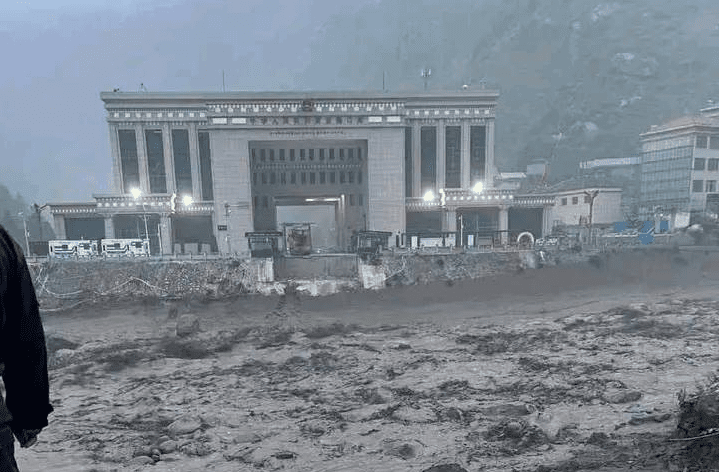
The Gyirong–Rasuwa disaster of 26 August 2026 has created a specific test for cooperation between Nepal and China. Can the two countries pass a warning about a fast-moving mountain hazard across their border and turn it into protective action downstream? A joint exercise would expose weaknesses that another general commitment to data sharing could leave unresolved.
In a preliminary synthesis published on 13 October, the International Centre for Integrated Mountain Development describes a rock-and-ice collapse followed by a destructive surge through the border corridor. The report identifies a cascading hazard, rather than a conventional glacial lake outburst flood, while leaving questions about the collapse mechanism open. Its findings call for wider hazard assessment and stronger regional cooperation.
A Shared Warning before a Complete Explanation
The distinction matters for the warning system. Monitoring a known lake is one task; detecting a sequence that begins with an unstable mountain slope is another. Neither country should assume that a system designed around one familiar category of flood will identify every dangerous event. Joint planning needs to examine what different observations can establish and how uncertainty will be communicated.
Scientific investigation should continue without making complete causal agreement a precondition for protective communication. An initial message might report an unusual surge or a suspected blockage while making clear what remains unconfirmed. The recipient needs enough information to judge an appropriate response. A carefully qualified warning can be more useful than a delayed message that sounds certain.
This requires agreed language between institutions. What does an unverified observation mean? Who can issue an update, correct a location or withdraw a warning? A shared procedure would distinguish an operational alert from a finished scientific conclusion. It would also establish which agencies on either side are responsible for forwarding information beyond their own desks.
There is relevant regional experience, although it cannot simply be transplanted to a different river. ICIMOD’s account of community warning arrangements on the transboundary Ratu River describes equipment working alongside trained people and cooperation across the Nepal–India border. The important principle is that information travels through an organised relationship, with downstream action as its purpose.
Test the Transfer of Responsibility
Nepal and China could apply that principle through an exercise covering the entire warning sequence. Give the participating teams a hypothetical observation upstream, incomplete information about its cause and a problem with the usual communication channel. Then test which message crosses the border, who acknowledges it, and how the responsible downstream authorities respond.
The exercise must continue beyond acknowledgement by a national agency. Local government, emergency services and the people expected to act need to understand what the message requires. Officials should establish how an alert will reach people working beside the river and those whose movement requires assistance. The time taken at each stage would reveal where useful warning time is lost.
Such an exercise would not promise that every settlement can be warned before every event. Fast cascades may leave very little time, and some may begin where observations are sparse. Those limits need to remain visible. They strengthen the case for land-use decisions, safer infrastructure and evacuation planning alongside warning equipment.
The diplomatic difficulty deserves a direct answer. States may be cautious about releasing raw observations, acknowledging uncertainty or allowing another government to interpret conditions within their territory. A bounded operational arrangement could identify the information required for immediate safety without demanding unrestricted access to every national dataset. Its scope and limitations should be written down.
Fund a Service that Survives Damage
Maintenance is part of that agreement. A sensor that reports normally during a demonstration may be damaged by the event it is intended to monitor. Communication networks can fail at the same time. The exercise should therefore examine what happens when equipment stops reporting, which alternative observations remain available and who has authority to fund repairs.
Budget responsibility needs to be assigned before the equipment is installed. The countries and supporting organisations should identify who pays for staffing, calibration and replacement. A project that funds only the purchase creates a predictable problem when its initial grant ends. The service needs an operating arrangement that the responsible institutions can sustain.
Public communication after the exercise can be modest and useful. Authorities could explain which warning routes were tested, what delays were found and what will be changed. Operationally sensitive details can remain protected. Communities nevertheless deserve to know the meaning and limitations of the warnings they may receive.
The October synthesis gives both governments a reason to act while the disaster is still under examination. They can begin with one corridor and a defined scenario, then revise the procedure in light of the result. The valuable outcome would be a demonstrated chain of responsibility across the border, including a way to keep it functioning after the first equipment failure. An agreed timetable for repeating the exercise would also prevent the procedure from disappearing when individual officials change posts.
Swaansh Mahat is an independent writer and English-language educator based in Kathmandu, Nepal.