
24 March 2026, NIICE Commentary 12386
E V A Dissanayake
The strategic landscape of the Indian Ocean Region (IOR) shifted dramatically following the March 2026 kinetic engagement between United States naval assets and Iranian vessels within the Exclusive Economic Zone (EEZ) of Sri Lanka. This incident, involving the sinking of the IRIS Dena, exemplifies the “collateral of combat” - the unintended yet devastating environmental degradation resulting from great power competition in neutral waters.
As a littoral state positioned at global maritime chokepoints, Sri Lanka now faces an ecological crisis that transcends traditional security paradigms. When the IRIS Dena submerged in Sri Lanka's EEZ, it released thousands of metric tons of hazardous materials, including heavy fuel oil and potentially specialized military chemicals, into a delicate marine ecosystem. The environmental fallout is not merely a localized disaster; it challenges the frameworks of International Relations (IR) and maritime law, specifically testing the efficacy of the United Nations Convention on the Law of the Sea (UNCLOS) in the face of modern naval warfare.
From an offensive realist perspective, the presence of Iranian naval assets in the IOR and the subsequent U.S. strike reflect a zero-sum struggle for regional hegemony, with states maximizing security and influence at the expense of rivals. Yet this focus on military power often ignores the “high politics” of environmental security. For Sri Lanka, whose EEZ hosts the strike, the consequences extend beyond strategic calculations. Under maritime sovereignty, the coastal state has “sovereign rights for the purpose of exploring and exploiting, conserving and managing the natural resources” within its EEZ. The torpedoing of the IRIS Dena, therefore, constitutes not only a military event but also an infringement on Sri Lanka’s environmental and economic security, as the resulting pollution effectively “weaponized” the ocean against the coastal state. This sets the stage for a detailed examination of how the incident unfolded within Sri Lanka’s waters.
A Conflict Spills into Neutral Waters: from Strategic Tensions to an Environmental Crisis
On March 4, 2026, the Indian Ocean, long considered a zone of relative maritime stability despite its strategic “choke point” status, witnessed a dramatic escalation of the U.S.-Iran confrontation. A U.S. Navy submarine engaged and sank the Iranian frigate IRIS Dena within Sri Lanka’s EEZ, roughly 40 nautical miles south of Galle. While geopolitical discourse has focused on violations of maritime norms and the expansion of external rivalries into South Asian waters, a more silent and potentially irreversible casualty has received comparatively little attention: the marine environment.
Modern maritime warfare in sensitive EEZs constitutes environmental aggression whose consequences extend far beyond the immediate tactical outcome. The sinking of a heavily armed warship introduces toxins, debris, and acoustic shock into ecosystems that support fisheries, tourism, and biodiversity. For Sri Lanka, whose economy and food security are closely tied to the ocean, the event represents not only a security crisis but also an environmental emergency.
The Anatomy of the Incident: Torpedoes in the EEZ
The IRIS Dena was reportedly returning from a naval event in India when struck by at least one heavyweight torpedo, causing a catastrophic underwater explosion. For a small maritime island-nation like Sri Lanka that lies along strategic global shipping routes, high-intensity combat operations within its EEZ exposed it to risks generated by conflicts, in which the state itself is not a participant.
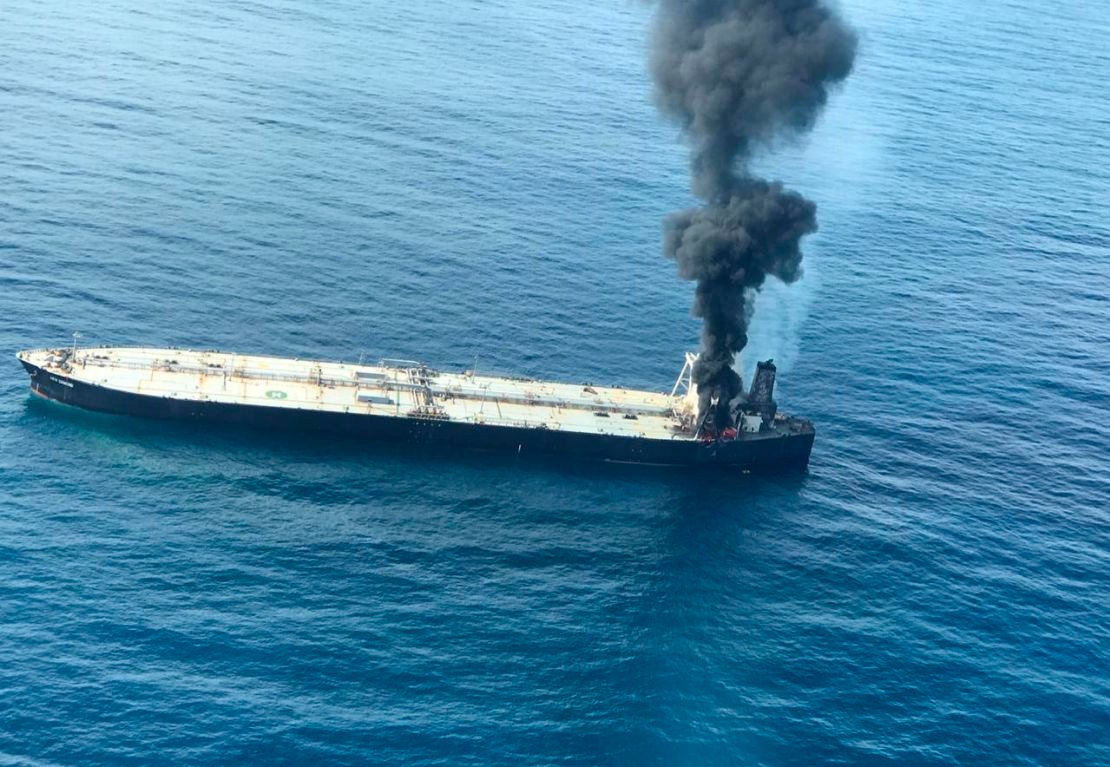
In the immediate aftermath, an oil slick formed on the surface, while debris, including containers and barrels of pollutants, began washing ashore along the southern coast near Hikkaduwa and Dodanduwa. These areas are crucial for tourism, coral reef conservation, and local fishing. The presence of foreign military wreckage transformed scenic coastal zones into sites of contamination, illustrating how distant rivalries can produce tangible local consequences.
Immediate Environmental Impacts: Toxins and Turbidity
The sinking of a modern warship releases a complex mixture of hazardous substances. The frigate carried large quantities of marine diesel, lubricants, hydraulic fluids, and other chemicals essential for naval operations. When torpedoes destroy vessels, structural failure occurs almost instantaneously, allowing substances to disperse into the surrounding water.
Hydrocarbons can suffocate marine life by coating gills and reducing oxygen exchange, while toxic compounds disrupt reproductive cycles. Fateful as it is, these pollutants do not remain confined to the surface. They emulsify, sink, and circulate through the water column, contaminating plankton, fish, and larger predators. Over time, toxins bioaccumulate, moving up the food chain and potentially affecting human consumers.
Debris from the wreck poses additional long-term risks. Warship materials often contain heavy metals such as lead and copper, insulation fibers, electronic waste, and specialized coatings. As these materials degrade, they leach contaminants into surrounding waters, turning the wreck site into a persistent source of pollution rather than a one-time spill.
Threat to Biodiversity: A Fragile Marine Corridor
The waters off southern Sri Lanka are among the most biologically rich in the Indian Ocean. They host migratory routes for blue whales, dolphins, and other cetaceans, as well as extensive coral reef systems that support fisheries and coastal protection. The torpedo explosion generated powerful pressure waves, causing acoustic trauma. This may have caused marine mammals relying on echolocation to navigate and communicate, inducing disorientation, internal injury, or even death. Such disturbances may also alter migration patterns, pushing species away from critical feeding or breeding grounds.
Shipwrecks, resting at depth, disrupt benthic communities. Contaminated vessels can create “dead zones” as chemicals leach into sediments. Deep-sea organisms, already slow to recover due to low biological productivity, may suffer long-lasting damage. Coral reefs face indirect threats from drifting pollutants and increased turbidity, weakening resilience and increasing susceptibility to bleaching and disease. Coral degradation cascades into impacts on fisheries and tourism.
Legal and Sovereignty Challenges
The incident also exposes significant weaknesses in international maritime governance. Under Article 56 of the UNCLOS, coastal states possess sovereign rights to explore, exploit, conserve, and manage natural resources within their EEZ. However, these rights are difficult to enforce when environmental damage results from military action by powerful states.
Warships enjoy sovereign immunity, complicating the application of environmental conventions such as MARPOL - International Convention on Marine Pollution, of the International Maritime Organization, which primarily regulates commercial vessels. As a result, accountability mechanisms for pollution caused by naval combat remain ambiguous. The destruction of a foreign vessel in Sri Lanka’s EEZ, therefore, challenges the concept of environmental sovereignty: although the damage occurs within national jurisdiction, the coastal state may lack the legal means to seek compensation.
This situation leaves Sri Lanka confronting an environmental costs created by actors beyond its control. The absence of clear liability frameworks for wartime pollution effectively shifts the burden of response and remediation onto the affected state.
Great Power Rivalry and Environmental Security
From a strategic perspective, the confrontation reflects broader power competition in the Indo-Pacific. Realist interpretations emphasize the pursuit of regional influence by major powers, often overlooking environmental consequences. For littoral states like Sri Lanka, the environmental fallout from distant conflicts is as immediate and threatening as conventional military risks. The pollution of marine resources threatens Sri Lanka’s “Blue Economy.” Damage to whale populations, coral reefs, or coastal waters could undermine livelihoods and national revenue for years to come. Thus, environmental harm becomes a form of indirect coercion, weakening a state’s economic base without a conventional military attack.
When external rivalries produce tangible ecological damage to a nation’s waters, neutrality offers limited protection, potentially forcing coastal states to seek new security arrangements to prevent their waters from becoming battlegrounds.
Toward Environmental Accountability in Maritime Conflict
The IRIS Dena incident highlights the urgency to incorporate environmental considerations into maritime security frameworks. Existing legal regimes were largely designed for peacetime, and not high-intensity naval combat in contested waters. Strengthening international norms could involve clearer rules on environmental conduct during military operations, compensation mechanisms, and monitoring systems for ecological damage. For Sri Lanka, the immediate priority is environmental monitoring and mitigation; however, the larger challenge is to ensure that the ecological burdens of great-power competition are not imposed on vulnerable littoral states.
When War Leaves a Lasting Ecological Legacy
The sinking of the IRIS Dena is more than a tactical episode; it is a reminder that modern warfare increasingly affects domains once considered peripheral. The environmental consequences of naval combat can persist long after the political crisis fades, altering ecosystems and regional stability.
If such incidents become more frequent, the Indian Ocean risks transformation into a contested military theater where biodiversity is collateral damage. Addressing this requires a shift in international thinking, recognizing that environmental degradation is a core security issue. Safeguarding maritime sovereignty must include defending ecological integrity. Without stronger accountability, the life of the Indian Ocean will continue to bear the hidden scars of conflicts it did not choose.
E. V. A. Dissanayake is an Independent Researcher from Sri Lanka. She is a Robert Bosche Stiftung Fellow and a Visiting Scholar of Columbia University, USA.
