18 March 2026, NIICE Commentary 12355
E. V. A. Dissanayake
The United States–Republic of Korea (ROK) alliance, long anchored in kinetic defense and regional deterrence, is undergoing a historic transformation into a “Technology Prosperity Alliance” as of early 2026. This article examines the emergence of the ‘Pax Silica’ – a strategic framework consolidating global artificial intelligence (AI) and semiconductor supply chains within a trusted bilateral ecosystem. It highlights a central paradox: a deep structural integration through sub-2nm research and development, and the convergence of Korean nuclear energy – the ‘Small Modular Reactors’ (i-SMRs) with the U.S. data-center demand is unfolding alongside intensifying American trade protectionism.
Through analysis of the February 2026 U.S. Supreme Court ruling on executive tariff powers and the subsequent shift to Section 122 and Section 232 duties, the paper explores Seoul’s ‘Pragmatic Autonomy’ and ‘Invest-to-Exempt’ strategy. It argues that the partnership has evolved into a co-dependency of equals in which South Korea’s dominance in High Bandwidth Memory (HBM) and energy infrastructure constitutes its primary advantage. The alliance’s success will depend on managing tensions between industrial onshoring mandates and the need for a resilient, integrated technological bloc.
The Shift from Security to Circuitry
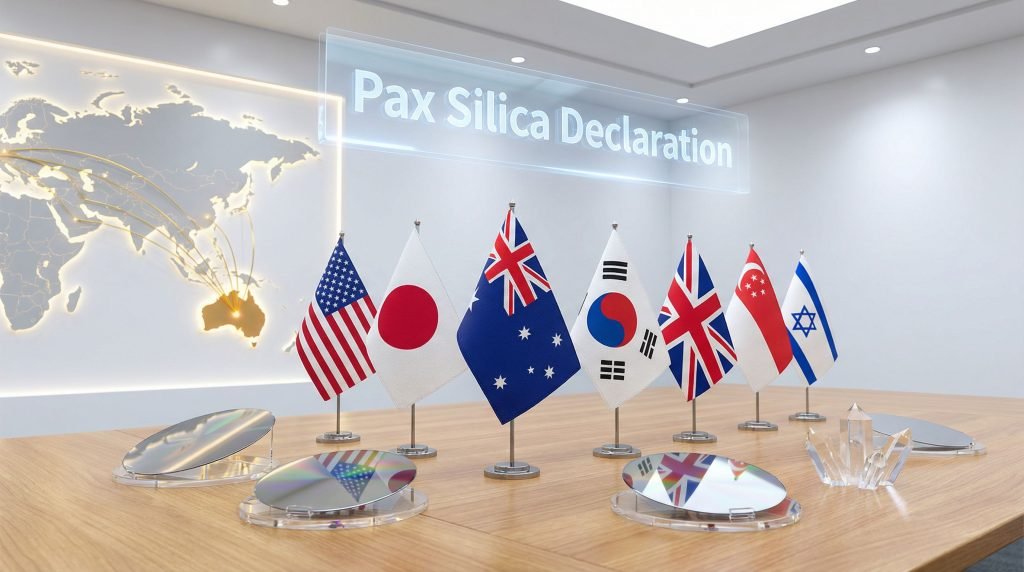
For more than seven decades, the U.S. – ROK alliance was forged around deterrence and defense along the Demilitarized Zone (DMZ). By early 2026, however, its primary frontline has shifted from the Korean Peninsula to semiconductor cleanrooms in Pyeongtaek and AI hubs in Northern Virginia. This transition reflects the rise of a “Technology Prosperity Alliance” anchored in Pax Silica, a U.S.-led framework launched in December 2025 to consolidate semiconductor and AI ecosystems among trusted partners. Seoul’s role has thus expanded from regional security partner to indispensable technological linchpin.
Yet this “Silicon Peace” is fraught with contradictions. The October 2025 U.S.–Korea Technology Prosperity Deal institutionalized cooperation in sub-2nm fabrication, 6G, and quantum computing, but aggressive U.S. trade measures have simultaneously strained the relationship. After a February 20, 2026, Supreme Court ruling limited executive emergency economic powers, Washington pivoted to Section 122 and Section 232 authorities, imposing a 15% global import surcharge and 25% tariffs on advanced AI chips. As Washington prioritizes industrial onshoring and Seoul seeks to leverage its technological indispensability, the alliance has entered a phase defined less by shared values than by negotiations over sovereignty and interdependence in an AI-driven world.
The Architecture of Pax Silica
Formalized through the December 2025 Technology Prosperity Deal, Pax Silica represents a shift from traditional trade agreements toward “full-stack geopolitical integration”. Its foundation is the recognition that the global AI economy depends heavily on South Korean hardware. Samsung Electronics and SK Hynix together command roughly 80 percent of the global HBM market, with SK Hynix supplying much of the memory used in next-generation GPU platforms. Under Pax Silica, these firms function as strategic infrastructure providers, ensuring a secure supply of the computational fuel powering U.S. AI systems.
The framework also prioritizes long-term technological alignment through a “Science and Technology Bridge.” This links the U.S. National Semiconductor Technology Center (NSTC) with South Korea’s 450-billion-dollar K-Semiconductor Belt initiative. In February 2026, a bilateral working group on sub-2nm nodes and advanced packaging enabled Korean engineers and U.S. software architects to collaborate at early design stages, accelerating development cycles while shaping global standards for the AI era.
The Friction of ‘Friend-Shoring’: The 2026 Tariff Landscape
Despite this integration, Pax Silica operates amid volatile U.S. trade policy. Following the Supreme Court’s February 2026 ruling invalidating tariff use under the International Emergency Economic Powers Act, the administration invoked Section 122 of the Trade Act of 1974 to impose a 15 percent global import surcharge addressing balance-of-payments concerns. For South Korean exporters, this temporary 150-day measure effectively became a new baseline cost, complicating trade even for products previously protected under the 2025 K-Trade Deal.
More consequential for the alliance is the targeted use of Section 232 national-security tariffs. A January 2026 proclamation imposed a 25 percent duty on advanced AI chips, including HBM modules and high-performance logic circuits comparable to Nvidia’s H200 and AMD’s MI325X. The policy aims to incentivize domestic production by conditioning duty-free access on U.S.-based manufacturing. Korean firms must therefore weigh the enormous capital costs of building American fabrication facilities against the competitive disadvantage of exporting tariff-burdened products.
Pragmatic Autonomy: Seoul’s Strategic Response
Faced with these pressures, South Korea has adopted a strategy of ‘Pragmatic Autonomy,’ centered on an ‘Invest-to-Exempt’ doctrine. Leveraging its dominance in HBM, Seoul seeks tariff relief proportional to its investment in the U.S. industry. After the February 2026 tariff escalation, the Ministry of Trade, Industry, and Energy invoked a “no less favorable” clause from the 2025 U.S.–Korea Joint Fact Sheet, arguing that Korea should receive treatment comparable to Taiwan’s exemptions secured through major investment pledges.
This strategy has accelerated the construction of U.S.-based ‘Mega-Fabs’ as insurance against future trade volatility. Samsung Electronics fast-tracked its $37-billion Taylor, Texas, foundry, obtaining a temporary occupancy certificate in February 2026 and planning domestic production of 2nm AI chips for major clients. Similarly, SK Hynix began building a $4-billion advanced packaging facility in Indiana, the first of its kind in the United States. By localizing key stages of production, Korean firms aim to preserve market access while neutralizing Section 232 tariffs.
The Energy–AI Nexus: A New Strategic Currency
An emerging dimension of the alliance is the convergence of high-performance computing and carbon-free energy – the “Atoms for Algorithms” paradigm. AI data centers are projected to consume up to 12 percent of U.S. electricity by 2030, straining existing infrastructure. To address this, the two countries have developed an “Energy-for-Compute” axis leveraging South Korea’s advanced nuclear technology.
Following the passage of Seoul’s SMR Special Act in February 2026, the deployment of Small Modular Reactors accelerated as a reliable power source for energy-intensive AI clusters. Public-private partnerships are already materializing in the United States. Hyundai Engineering & Construction, in cooperation with Holtec International, has begun work on SMR units at the Palisades site in Michigan to support regional digital infrastructure. In Texas, a massive integrated energy and AI campus combines Korean reactor technology supplied by Doosan Enerbility with semiconductor fabs and hyperscale data centers. These projects signal a shift from transactional trade to an interdependent ecosystem linking energy security and technological leadership.
A Co-dependency of Equals
By 2026, the traditional U.S. security umbrella has evolved into a “silicon canopy.” Military cooperation and industrial policy are now intertwined, producing a relationship defined by mutual technological dependence. The U.S. contributes software ecosystems, standards, and market demand, while South Korea supplies critical hardware and, increasingly, the carbon-free energy infrastructure required to sustain AI development.
Nevertheless, this “Silicon Peace” remains fragile. The Section 122 surcharge and Section 232 tariffs demonstrate that even close allies are vulnerable to domestic protectionist pressures. For Seoul, the central challenge is maintaining technological indispensability without eroding its domestic industrial base through excessive offshoring. For Washington, excessive economic coercion risks pushing vital partners toward greater strategic autonomy.
Ultimately, the U.S.–ROK partnership offers a defining case study of 21st-century statecraft. In an era where economic security is inseparable from national security, the management of “Tariff-for-Tech” tensions will shape the trajectory of global innovation. Through joint SMR projects and sub-2nm research collaboration, the two countries are not merely exchanging components but co-developing the infrastructure of the digital age. Sustaining this alliance will require a more predictable regulatory environment to ensure that the Technology Prosperity Alliance functions as a source of mutual resilience rather than economic attrition.
E. V. A. Dissanayake is an Independent Researcher from Sri Lanka. She is a Robert Bosche Stiftung Fellow and a Visiting Scholar of Columbia University, USA.