17 December 2025, NIICE Commentary 12179
Srilakshmi Pradeep & Sidhant Kumar
India and Russia’s friendship dates back decades. Both countries mutually cooperate on trade, defence and call themselves “strategic partners.” Putin’s recent visit was high on optics, while the world awaited big announcements, the visit underscored developmental and logistics discussions. His visit amid the ongoing US-India tariff impositions was a strong signal of India’s search for newer and alternative alignments. Both parties recalibrated the importance of the International North-South Transport Corridor for better trade advancements and connectivity. India’s focus now is on trade resilience, aimed at securing and advancing its existing trade along the INSTC.
Indian trade faced setbacks in the last months of 2025 due to the US tariff imposition. India remains the hardest hit among the Asian countries, facing a staggering 50 per cent tariff. This has substantially affected the export-import relations between India and the US. Since the US was one of India’s largest exporters of textiles, jewellery, and agricultural products, the sudden imposition struck a sharp blow. This has led to a lack of access to the American market and has put pressure on India’s export-driven sectors, thereby exposing trade to vulnerability. It is in this context that Putin’s visit becomes important, as India reassesses its geopolitical alignments and also diversifies its trade.
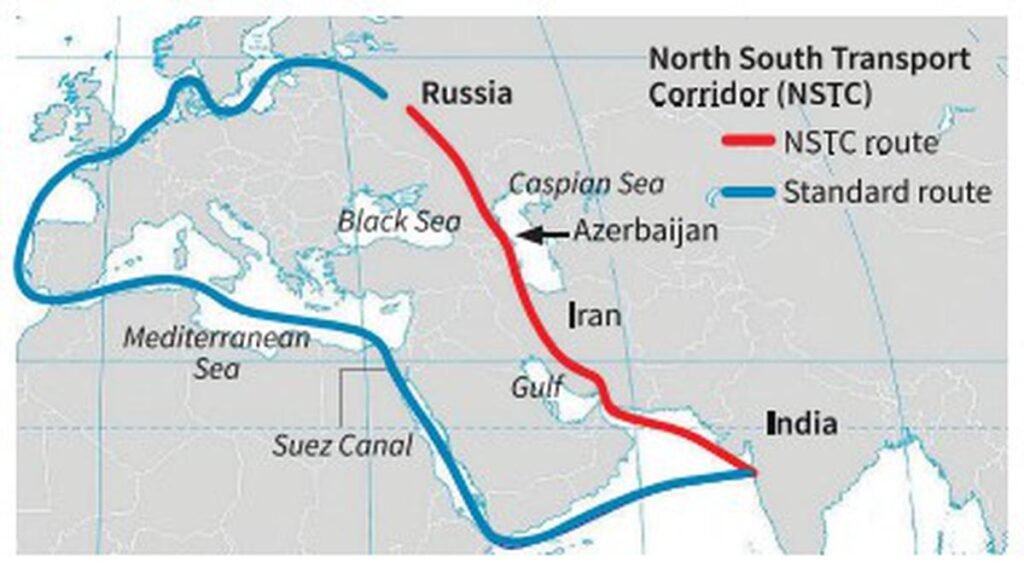
The International North-South Transport Corridor is a multimodal maritime route that connects India to Eurasia via sea, rail, and road. It bypasses the Suez Canal route for faster and cost-effective trade. The corridor was established in 2000 and currently comprises 13 member states, with one observer state. Amidst growing trade disruptions, the INSTC emerges as a strategic lever. Cost-effectiveness and strategic access to the Eurasian countries are its major advantages. Though the corridor isn’t functioning fully, Putin’s visit highlighted the importance of the route and developmental prospects through trade. India and Russia have proposed improving the India-Russia bilateral relations to $100 billion. To achieve that, one of the crucial junctures is the development of INSTC. The tariffs threaten India’s export engine, with $87 billion directed to the US, equivalent to 2.5% of India’s GDP. India has widened its export focus to 50 countries across West Asia, Central Asia, Africa, Russia, the Middle East, and Europe, among others. In this context, the INSTC assumes heightened geopolitical importance. The strategic crossover of INSTC along many of the proposed focus areas will help in gaining access to trade-sensitive markets.
The progress of INSTC over the years has been characterised by partial functioning and internal problems among the states. Putin’s visit reaffirmed developments along the corridor, signalling its strategic importance not only for India but also for Russia. The development of the INSTC requires the highest level of political backing, as investors and capital are more likely to commit when projects are supported by strong and sustained political leadership. The present scenario of volatility in the Indian trade is significant in maritime trade, especially the INSTC. More than bilateral trade, it’s more of a political reassurance for India since the US tariffs and trade disruptions. Strong political backing would enable more focused and sustained development of the corridor, reinforcing India’s pursuit of strategic autonomy. The corridor provides an alternative and more reliable form of trade, thereby making the trade resilient.
As an alternate route, the INSTC emerges as a critical lifeline. In 2022, India’s exports to INSTC member countries totalled $20 billion. The significance lies in identifying how to strategically diversify trade. India has a high export potential in the countries of Turkey, Russia, Ukraine, Kazakhstan, and Oman. Take Turkey, where India’s exports currently amount to around US$10 billion, despite an estimated export potential of US$68.6 billion. A similar gap is visible in Russia, where present exports stand at US$2.9 billion, and the potential market is valued at nearly US$50 billion. Kazakhstan, too, reflects this imbalance, with exports of just US$437 million against a potential of US$12.5 billion. This shows an opportunity, and by strategically leveraging the INSTC, the potential of these states will help strengthen trade. Further gains from the Free Trade Agreements between India and Europe can prove beneficial, particularly their growing demand for Indian goods, which will help strengthen the corridor. This provides the corridor with a comparative advantage over others.
The potential of the INSTC cannot be tapped fully without addressing its challenges. The agreement does not mention any concrete timeline for the completion of the project, leaving its implementation uncertain. The infrastructural gaps and sanctions have delayed a full-fledged operational INSTC. Despite consistent efforts being taken for the development, solid action is still underway, meaning the corridor remains only partially functional and cannot yet fully support India’s trade resilience.
In view of continuing US tariffs and the alternative search for markets, India must act decisively and strengthen its INSTC corridor. Though the potential of the corridor is limited, Putin’s visit can reinforce the advancements. Through the corridor, India can initiate new collaborations with strategic markets, bolstering trade resilience and securing a more stable economic future.
Srilakshmi Pradeep is a Research Intern at NIICE & Sidhant Kumar is a Visiting Fellow at NIICE.